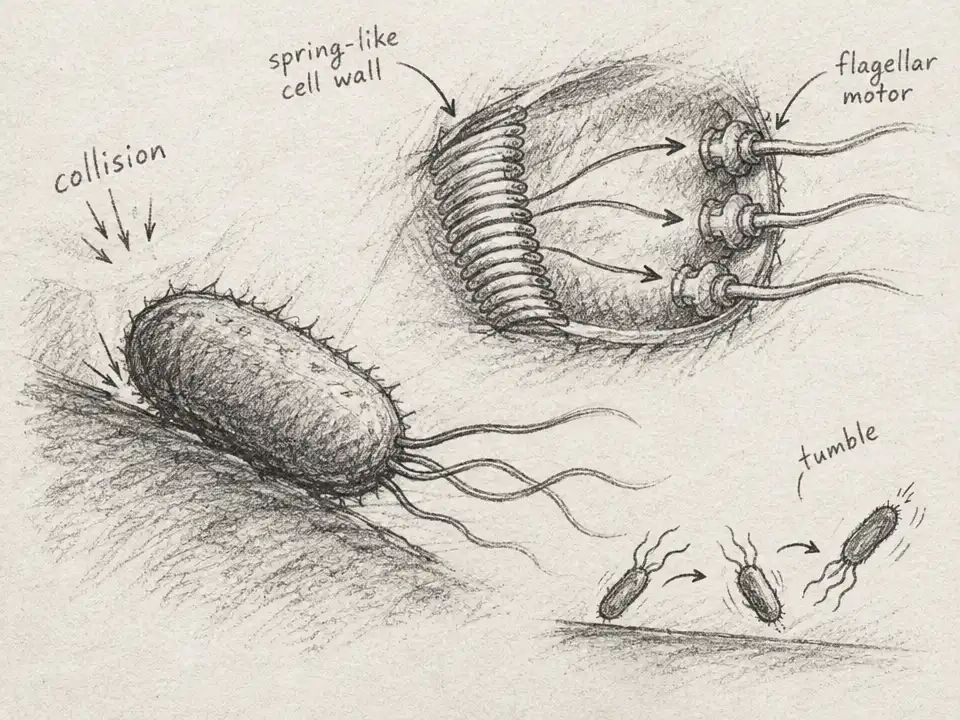
A bacterium swimming beside a wall can get stuck in a tiny but consequential loop: it touches the surface, tumbles, and turns back toward it. Chemical navigation offers little help if the surrounding fluid has no useful chemical gradient. Could the cell instead use the collision itself as a cue—and could its own outer structure help decide what to do next?
A new computer model explores that possibility by bringing together two fields that rarely share the same starring role: physical learning, in which a material is trained to route forces, and bacterial motility, the physics of how microbes swim. The idea is strikingly concrete. A cell wall would not merely hold a bacterium together; after its internal structure was tuned, it might carry a mechanical message from the point of impact to the machinery that steers the cell.
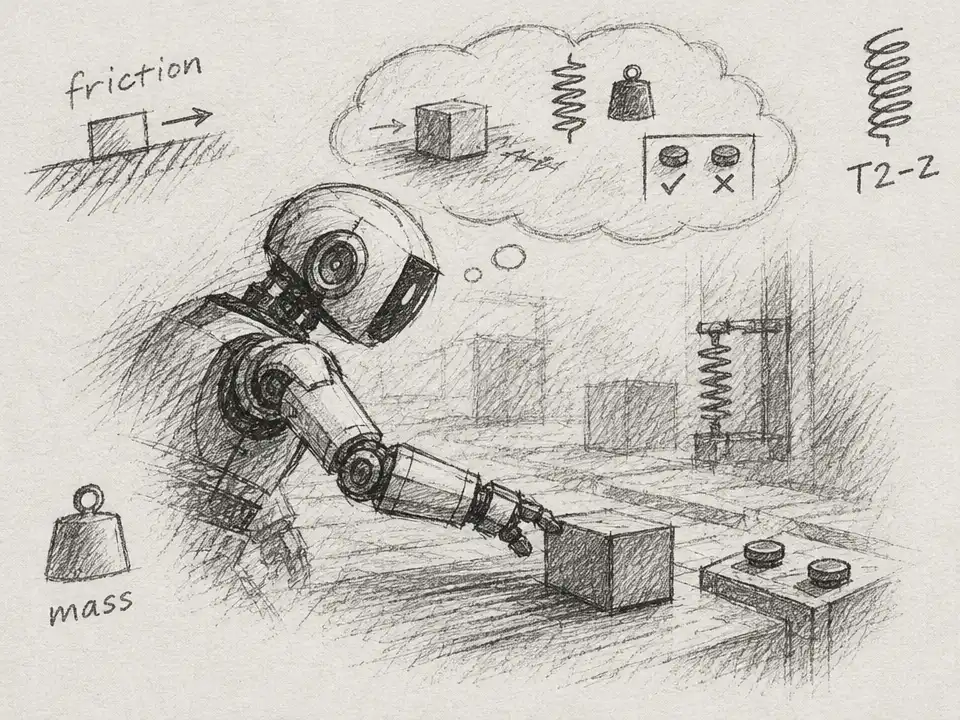
The researchers represent an E. coli-like cell wall as a disordered mesh of springs. In real bacteria, the wall’s peptidoglycan mesh is built from strands joined by crosslinks. In the model, those connections become springs whose stiffness can change. The simulated swimmer has four flagellar motors, which drive the rotating filaments that propel it. Rather than giving the bacterium a new chemical sensor, the researchers ask whether the spring network itself can be trained to pass a force from one motor region to another.
Training here has a specific meaning. The model applies a force at one location, measures how the network responds, then adjusts spring stiffnesses using a local feedforward-feedback rule. Repeated across different motor locations, this process makes some routes through the mesh better at transmitting stress than others. The altered pattern is a kind of physical memory: the information is stored in the network’s mechanical structure, not in a brain-like controller. But the training is imposed by the researchers in the model; the simulated bacterium does not independently discover the response.
Here is the proposed route from impact to escape. A flagellum meets a surface and loads its attachment to the cell wall. The trained mesh carries that strain across the cell and compresses attachment points near motors on the far side. The model then gives compression a biological consequence: it makes the motors’ stator units detach more readily. Stators help anchor and power a flagellar motor, so losing them weakens that motor’s push. During a tumble, this imbalance can favor a turn away from the wall.
That last step is a hypothesis, not an established bacterial response. Experiments show that load can help stabilize stators, but no experiment has tested whether compressing the relevant wall crosslinks makes them detach. The model assumes a compression-sensitive release mechanism, then asks what would follow if that mechanism worked. Keeping this distinction clear matters: the study is a computational proposal about a possible biological pathway, not a report of bacteria observed learning to escape.
Within the simulation, the result is substantial. On the first tumble after near-wall entrapment, swimmers with trained walls escaped in 0.62 of simulated events, compared with 0.43 for the untrained baseline. An idealized controller that directly knew which side had touched the wall reached 0.65. By the researchers’ measure, the trained wall recovered 89% of that controller’s advantage. The comparison suggests that a material pathway could approximate part of a steering function without directly sensing or commanding each motor.
The timing is as important as the route. A contact is brief: the median time a flagellum spends above the model’s contact threshold is 0.11 seconds. The motor attachments must respond before that mechanical cue disappears. In the untrained network, the eventual motor imbalance could be large if allowed enough time, but during the short simulated collision it barely develops. Training increases the force delivered to the far side enough for the proposed motor response to happen in time. In other words, the wall must do more than transmit a signal; it must deliver one quickly enough to matter.
The model also hints that behavior might improve before the material’s mechanical response is fully optimized. After 300 training cycles, the simulated swimmer recovered 84% of the ideal controller’s escape advantage, even though the network’s mechanical task error could keep falling with further training. Once the motor imbalance crosses the threshold needed to steer, making the route more precise may not change the turn much. The authors estimate that a few hundred encounters could fit within a generation for a bacterium in sustained contact with structure. That is a comparison of modeled cycles with environmental encounters, not evidence that living cells actually train this way.
A changing wall poses another challenge: bacteria continually remodel their peptidoglycan. In additional simulations, the learned pathway survived turnover when the most tension-bearing connections were protected from severing; indiscriminate turnover erased it. This raises a useful biological question about whether the crosslinks carrying important loads could also be the ones most likely to persist. The result remains conditional on the model’s rules for remodeling and bond protection.
Several uncertainties stand between this mechanism and a living swimmer. The simulated network is smaller and simpler than a complete cell wall, and it leaves out features such as wall prestress from internal pressure. Most importantly, the compression-triggered stator release has not been measured. The paper’s proposed next steps are testable: look for remodeling near motor anchors after repeated controlled wall contacts, then compare how quickly previously exposed cells escape near-surface traps. Until such experiments are done, the wall’s role as a learner remains an intriguing possibility.
Still, the crossover changes how one might picture a cell’s boundary with its world. A collision does not have to be translated into a message by a separate central command system. In principle, a tuned material could carry the signal, shape the motor response, and alter what the cell encounters next. If nature uses a pathway like this, learning would leave its trace not only in chemical circuits, but in the way a living material bears and routes force.