Imagine trying to notice a firefly’s tiny shift while staring into a searchlight. That is the problem astronomers face when they try to detect a planet by measuring its star. The planet may be too faint to see directly, but its gravity makes the star move in a small, repeating wobble. Catching that motion takes extraordinary precision—and a trustworthy way to tell whether the star has shifted.
One way to measure a star’s position is to compare it with other stars in the same image. But those reference stars are often faint, and a small space telescope may not gather enough of their light to make a steady comparison. A close binary pair offers a shortcut: one star can serve as a reference for the other. The TOLIMAN mission, described in the paper, is designed to monitor the changing separation of Alpha Centauri A and B for signs of planetary tugs.
TOLIMAN’s optical design reshapes the star’s light rather than leaving it as a simple bright dot. A patterned element at the telescope’s pupil—the opening that collects light—spreads the image into a detailed pattern. That pattern provides local reference marks and helps make measurements less vulnerable to optical changes such as focus drift. The planned instrument is a 12.5-centimeter telescope aboard a 16U CubeSat, aimed at the Alpha Centauri pair.
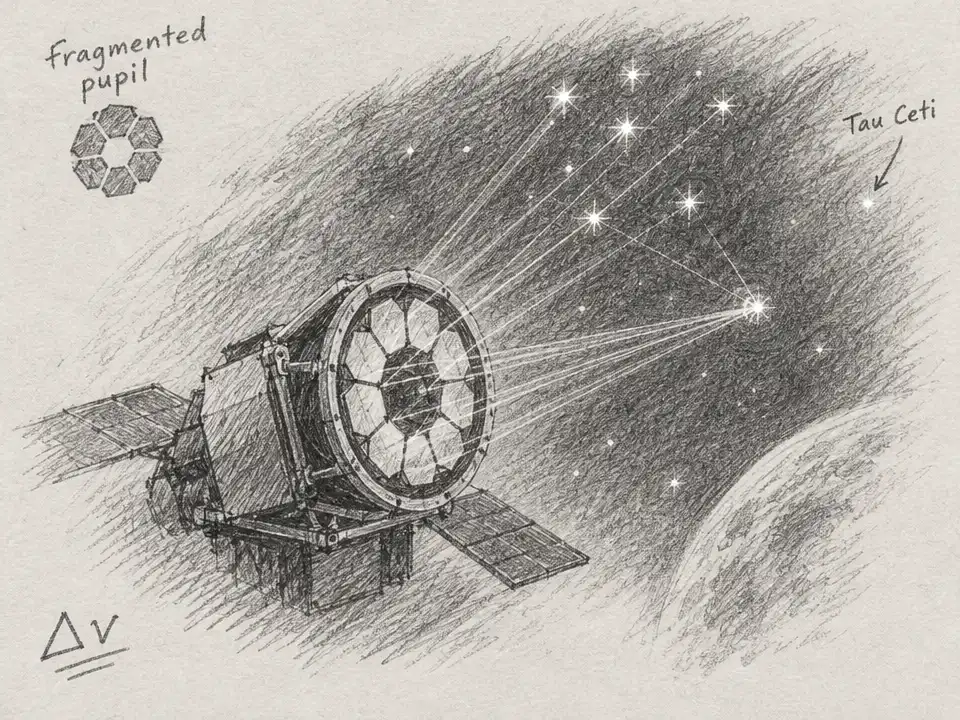
But the binary-star trick has a narrow reach. Most nearby stars do not have a suitable bright companion beside them. Consider Tau Ceti or Epsilon Eridani, two nearby Sun-like stars that astronomers would like to examine for rocky planets. Their potential reference stars lie across a much wider patch of sky. A conventional telescope capable of sharply imaging that whole patch would need a demanding optical system and a detector with an enormous number of pixels.
The paper’s more radical idea is to change the telescope’s mirror so the reference stars do not need to appear where they sit in the sky. The authors call the concept a fragmented pupil telescope. Its primary mirror would be divided into a pattern of optical segments, with different parts assigned to different stars. Light from those widely separated directions would be redirected so that, in the camera, the target star appears surrounded by a compact group of bright reference stars.
The stars themselves have not moved closer. The mirror would make their light arrive at neighboring places on the detector, forming an artificial comparison field. An observer could then track the target’s position against several references in the same small image. If a planet pulls the target star back and forth, that shared view could help separate the real motion from shifts caused by the telescope or camera.
The researchers point to a possible supply of reference light around both targets. In a field with a radius of 2.6 degrees around Epsilon Eridani, they identify six stars brighter than magnitude 6.5; around Tau Ceti, they identify four. Their combined light is estimated at 170% of Epsilon Eridani’s light and 54% of Tau Ceti’s. Those estimates suggest that useful reference stars may be available without collecting a gigantic image of the entire field.
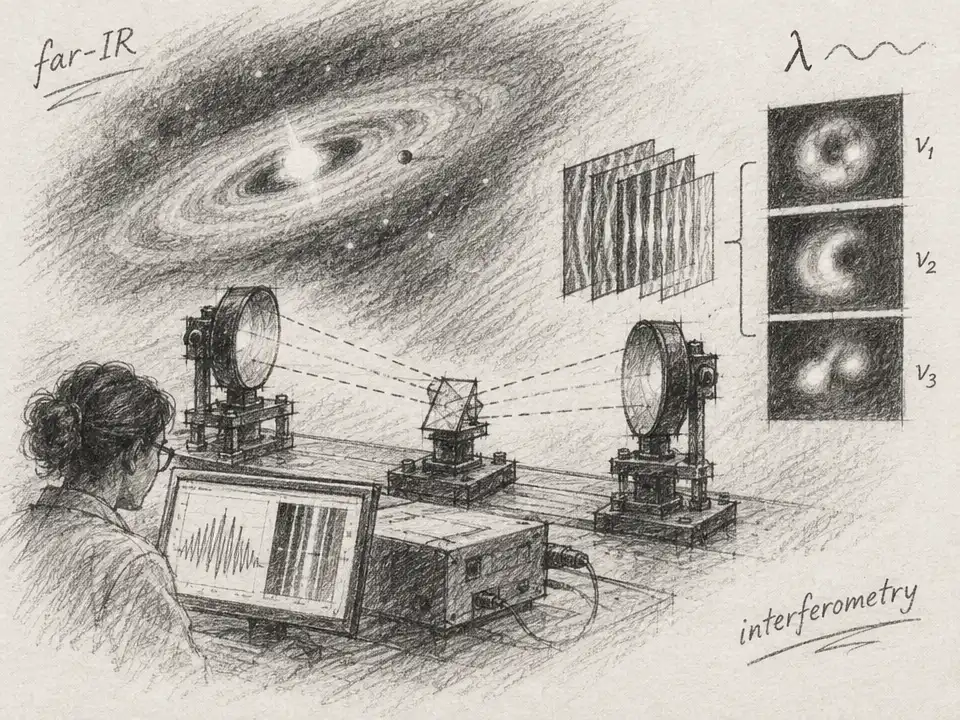
There is a price for this optical shortcut. Because the mirror is shared among different stars, each target receives light collected by only a portion of the full aperture. The resulting images would be interferograms—patterns made by overlapping light waves—rather than ordinary star images. And the layout of the reference stars would have to be built into the mirror itself. The authors note that a mirror designed for one target would not simply be reusable for another.
That limitation makes the proposal a targeted instrument, not a general-purpose survey telescope. It also marks an important boundary between what the paper describes and what it demonstrates. TOLIMAN is a mission with hardware progressing toward assembly and a launch window expected to open in mid-2027, according to the paper. The fragmented-pupil telescope, by contrast, is an optical concept. The authors say detailed simulations and signal-to-noise calculations for it will appear in future work; this paper does not report a built prototype or a completed performance test.
That distinction matters because the desired signal is so small. Earth-mass planets around Sun-like stars produce stellar motions that demand micro-arcsecond precision. A clever mirror could make the reference stars easier to use, but it still has to prove that its unusual images can support measurements that precise amid real optical imperfections and detector noise.
The promise is not that a modest spacecraft could suddenly photograph an Earth twin. It is that a custom piece of optics might turn a scattered neighborhood of stars into a compact measuring instrument. Instead of building a giant camera to see everything at once, astronomers could build a mirror that brings only the most useful stars together. For a few nearby systems, that could offer a new route to tracing a planet by the slight motion it leaves behind in its star.