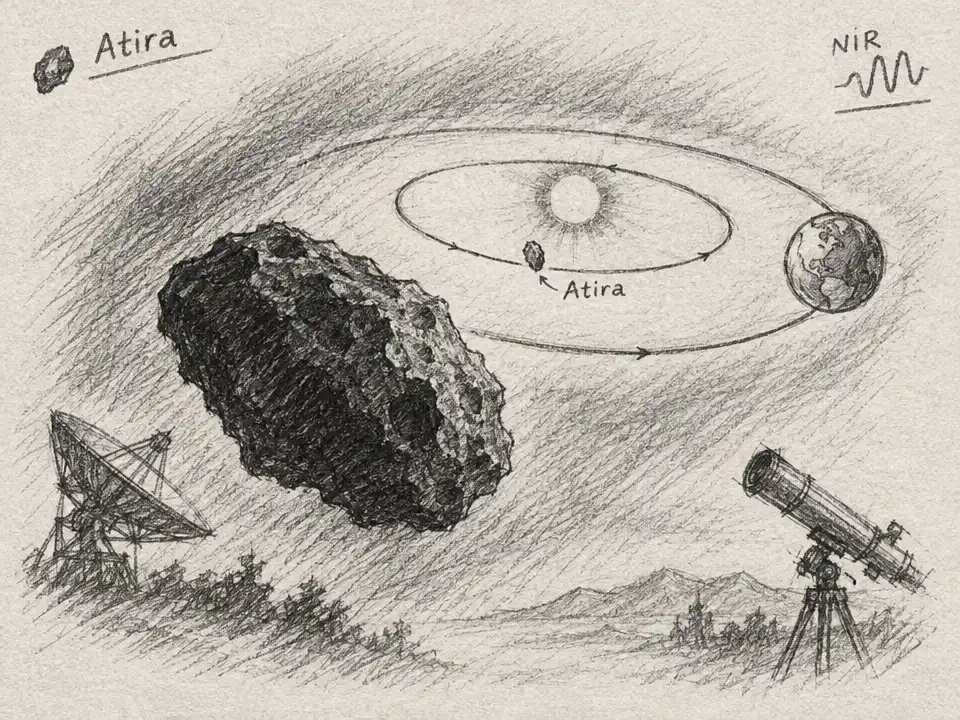
Some asteroids are hard to find not because they are especially small, but because they keep to the Sun’s side of the sky. Atira is one of them: its orbit stays inside Earth’s, placing it in a difficult twilight zone for ground-based observers. But its location is only the first clue in a more puzzling case. This asteroid appears much darker than the population models say an object on its path should be.
The first challenge is working out what “dark” means for a small world seen from millions of miles away. Atira’s size was estimated from radar observations; its visible brightness was measured separately. Put those clues together, and researchers infer a diameter of 4.92 ± 0.95 km and a geometric albedo of about 0.02. In other words, Atira reflects only a small fraction of the sunlight that falls on it.
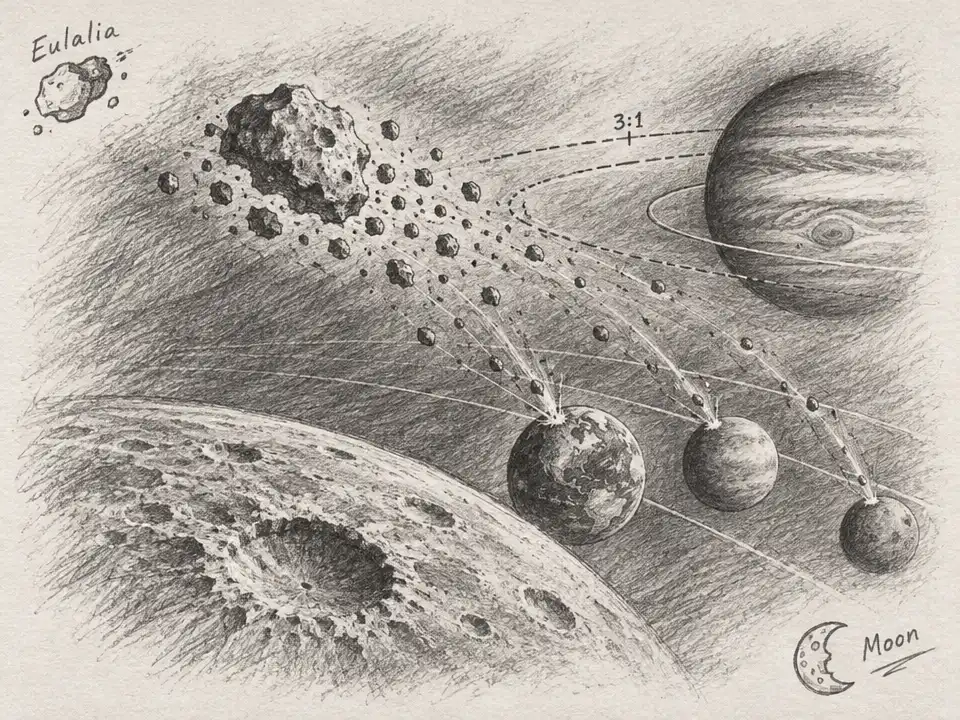
That measurement sets up the mystery. Many near-Earth asteroids are thought to have escaped from the main asteroid belt, between Mars and Jupiter, through gravitational escape routes called resonances. Those routes act like orbital doorways: over time, repeated tugs from planets can move an asteroid onto a path that brings it much closer to the Sun. But asteroids delivered from the inner part of the belt are generally expected to be silicate-rich and more reflective. Atira’s inferred surface is unusually dark for that story.
To gather another clue, the researchers observed Atira with the Astrophysical Research Consortium’s 3.5 m telescope at Apache Point Observatory. On 2024 May 6, they measured its brightness through four color filters during a 31.9-minute sequence. The resulting colors showed a modest red slope from the bluer filters toward the red, then a nearly flat trend at longer wavelengths. The spectrum was useful, but it did not deliver a neat chemical fingerprint.
That ambiguity matters. The colors most closely match an X-type asteroid, a broad category that can include bodies with different surface materials. Combined with the very low albedo, the measurements support a more specific provisional interpretation: a P-type, a dark, primitive-looking asteroid. “Provisional” is doing real work here. The observations help sort Atira into a family of possibilities; they do not reveal its exact ingredients or identify the place where it formed.
Next, the team compared Atira with NEOMOD3, a model of the near-Earth asteroid population. The model uses an asteroid’s orbit and brightness to estimate likely delivery routes and the albedos expected for objects with similar properties. For Atira, it favors delivery through routes associated with the inner Main Belt, at about 66%. Routes associated with the central and outer Main Belt contribute about 26%.
But the model’s albedo estimate points the other way. For objects with Atira’s orbital and brightness characteristics, it assigns a probability of 7 ± 2% to low albedo, compared with 64 ± 4% for intermediate albedo and 29 ± 4% for high albedo. Atira itself lands in the low-albedo category. The comparison is not a direct measurement of Atira’s surface—the radar and brightness evidence provide that. It is a sign that the observed asteroid is an uncommon outcome within the model.
Is the answer simply that Atira came from farther out in the belt, where darker, more primitive asteroids are more common? That is one possible route. The authors examined known asteroid families in the inner belt, where collisions have produced groups of related fragments. Two dark families, Erigone and Clarissa, might sound promising. But published models of how their fragments spread through space do not support either as the source of a fragment as large as Atira. That closes two doors, not every door in the inner belt: another primitive source there remains possible.
The central or outer Main Belt offers another lead. Low-albedo P-type asteroids are common in the outer belt, and the population model gives Atira a 26% combined chance of arriving through routes associated with those regions. One resonance in that group contributes about 19%. These are estimates of dynamical pathways, not a cosmic birth certificate: an asteroid can enter a resonance from more than one part of the belt.
There is an even older possibility. In models of the early Solar System, changes in the giant planets’ orbits could have scattered small bodies from a primordial disk beyond Neptune into the Main Belt. Some of those visitors might have remained there for billions of years before later escaping toward the Sun. In that scenario, Atira’s material could have made two long journeys: first from the distant outer Solar System into the asteroid belt, then from the belt into its present orbit. The paper presents this as a plausible history, not a conclusion about Atira specifically.
One comparison object offers a tempting but uncertain shortcut. Atira and the asteroid Phaethon have similar orbital inclinations, and the model finds overlapping escape routes for Phaethon and several objects proposed to be associated with it. Yet Atira’s colors differ from Phaethon’s, and a shared route through space does not establish that they broke off from the same parent body. The resemblance is a clue to test, not a solved family connection.
For now, the evidence narrows the puzzle without closing it. Atira is a dark object whose orbit points most strongly toward the inner belt, while its surface properties leave room for a more distant, primitive source. The authors also caution that one unusual asteroid cannot show whether the population model is wrong: among 38 inner-Earth objects they assessed, intermediate albedo was favored for 33. More spectra and better albedo measurements across this hard-to-observe population could reveal whether Atira is a rare exception—or the first sign that the Sun’s near-side neighborhoods contain more dark material than expected.