Imagine trying to film a spinning coin by taking one still image, shifting the camera, and taking another—only the coin completes its motion in less than a trillionth of a second. That is the challenge facing researchers who want to watch quantum systems change. A new experiment offers a different kind of camera: instead of moving a probe through time, it gives different moments different colors, then reads those moments from the energies and directions of escaping electrons.
The team tested the idea on potassium atoms. Their target was a fleeting dance between an electron’s spin and its orbital motion. In conventional pump-probe spectroscopy, a short laser pulse starts the motion and a second pulse checks what has happened. To reconstruct the whole sequence, researchers repeat the experiment many times, shifting the delay between the pulses a little each time. The method is powerful, but the long scan can be vulnerable to laser drift, fluctuating signals, or samples that do not last.
In potassium, the pump pulse launches the outer electron into a pair of closely spaced 4p states, known as a fine-structure doublet. The states differ in how the electron’s spin and orbital motion combine. Because their energies are slightly different, a coherent mixture of them evolves in time: the electron’s quantum state shifts through a repeating pattern. The splitting is 7.15 meV, corresponding to an oscillation period of about 578 fs.
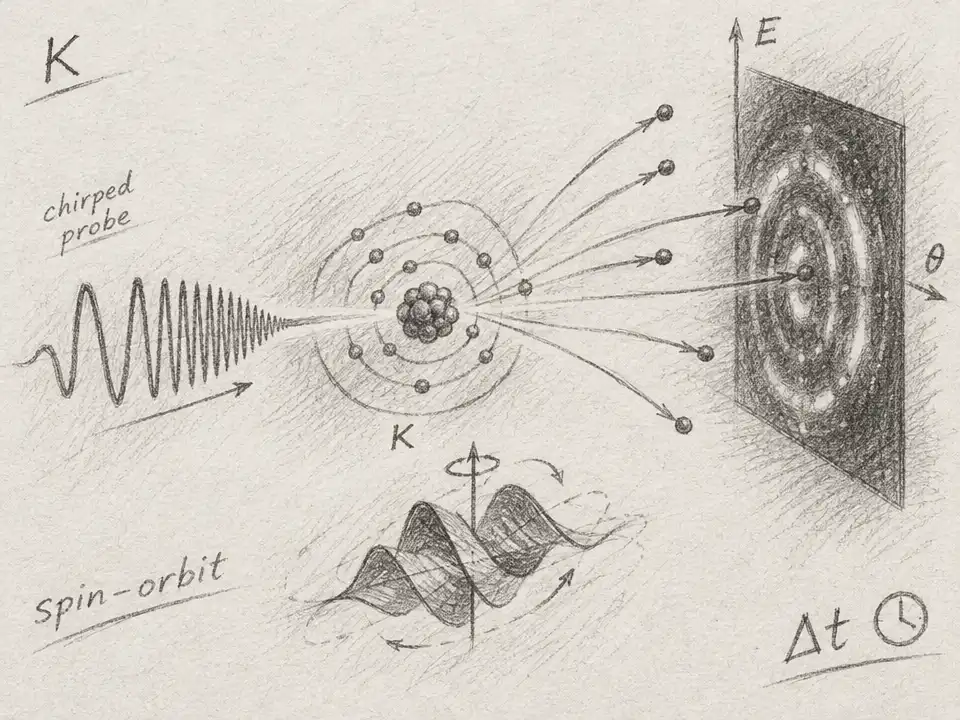
The key is to let the probe pulse carry a time code. When the probe’s color changes as it passes, it can knock electrons out of the atom at different moments using different photon energies. Those electrons leave with different kinetic energies. Meanwhile, the directions in which they fly—their angular distribution—carry information about the potassium electron’s changing state. Put the two measurements together, and energy marks when the atom was probed while angle helps reveal what it was doing.
The researchers first tested a discrete version of the idea. They shaped a supercontinuum laser pulse into three differently colored probe pulses, each aimed at a different stage of the potassium motion. The pulses were arranged so their photoelectrons appeared in separate energy channels. One channel captured the state around 289 fs, another around 433.5 fs, and a third around 578 fs. Their measured angular patterns changed across those channels in the way expected for the evolving spin-orbit wave packet.
Then came the more ambitious version: one broad, chirped probe pulse that changes frequency continuously. Higher-frequency parts arrive earlier, lower-frequency parts later. As the pulse ionizes the atom, the changing probe frequency sorts the released electrons by energy, turning the energy distribution into a timeline. The experiment mapped a window exceeding 300 fs onto the photoelectron signal. Across that energy band, the changing angular pattern formed a distinctive fork-like shape: a visible trace of the wave packet’s evolution, rather than a set of snapshots collected one delay at a time.
This is not a clock with unlimited sharpness. The continuous method trades time resolution against the precision of the electron-energy measurement and the rate at which the laser’s color changes. In this experiment, the spectrometer’s 80 meV energy resolution translated to a time resolution of approximately 60 fs. Finer timing would require improving the energy measurement, changing the chirp, or both. The pulse itself also had to be carefully shaped and calibrated so that a given electron energy could be reliably matched to a probing time.
There is another complication: the probe does not simply observe the atom without affecting it. Potassium has nearby 4d states that can participate in the ionization process. Those intermediate states can redirect population or add extra photoelectron signals, complicating the pattern. The researchers had to design the pulse sequence to manage these pathways and compare their measurements with quantum simulations. The models captured the main behavior, though some details differed, including how clearly certain features appeared.
That price—careful pulse design, energy resolution, and a detailed account of competing pathways—is also what makes the approach interesting. A scan-free record could be especially useful when signals are weak, experiments run slowly, or a sample changes before a long delay scan is complete. The authors point to possible future applications in X-ray and extreme-ultraviolet photoelectron experiments, including at free-electron-laser facilities. Those settings are prospects, not demonstrations in this study.
For now, the result is a proof of principle in potassium, not a universal movie camera for electrons. More complex atoms, molecules, and materials may bring denser energy levels and a tangle of ionization routes that are harder to separate. But the experiment suggests a new way to ask a familiar question: instead of repeatedly pausing a fast process at different moments, can the process itself be encoded into the particles it releases? In potassium, the answer was a fork-shaped pattern—and a promising route toward watching fragile quantum motion with fewer steps.