Imagine trying to learn how a city grew without following a single resident. You have only snapshots: how many people live there, where they are, and how those numbers change. The histories of individuals are hidden, but patterns in the crowd may still reveal the forces shaping the city.
A new theoretical paper applies a similar strategy to black holes. Its central idea is a crossover: use tools from statistical mechanics—the physics of how many unseen pieces shape a system’s overall behavior—to investigate how black holes grow across cosmic time. Rather than reconstructing every black hole’s past, the framework asks what the changing population can reveal.
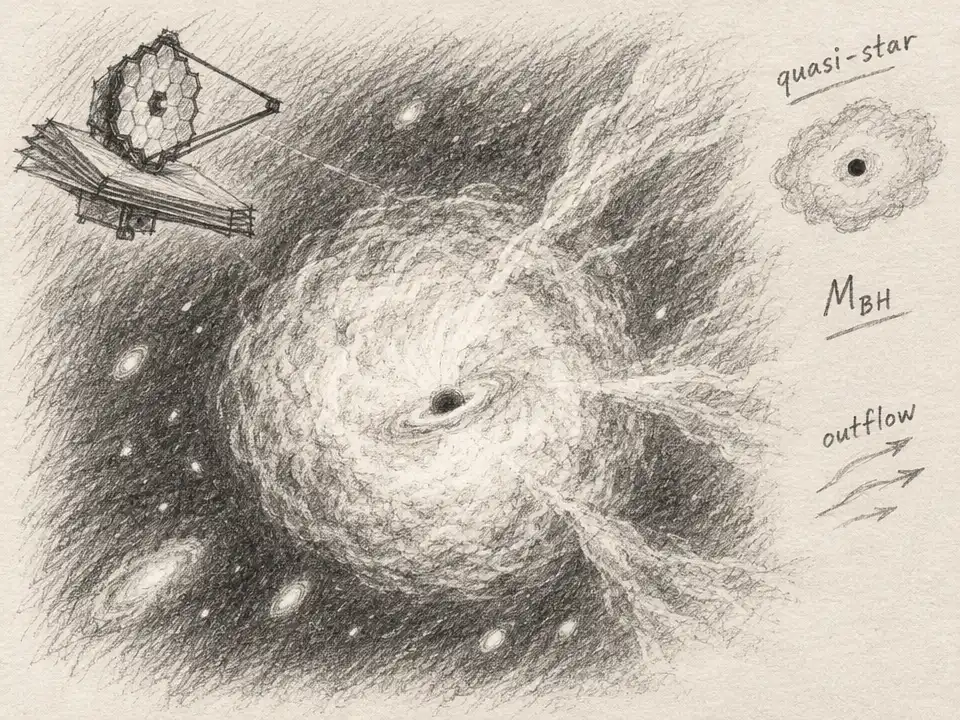
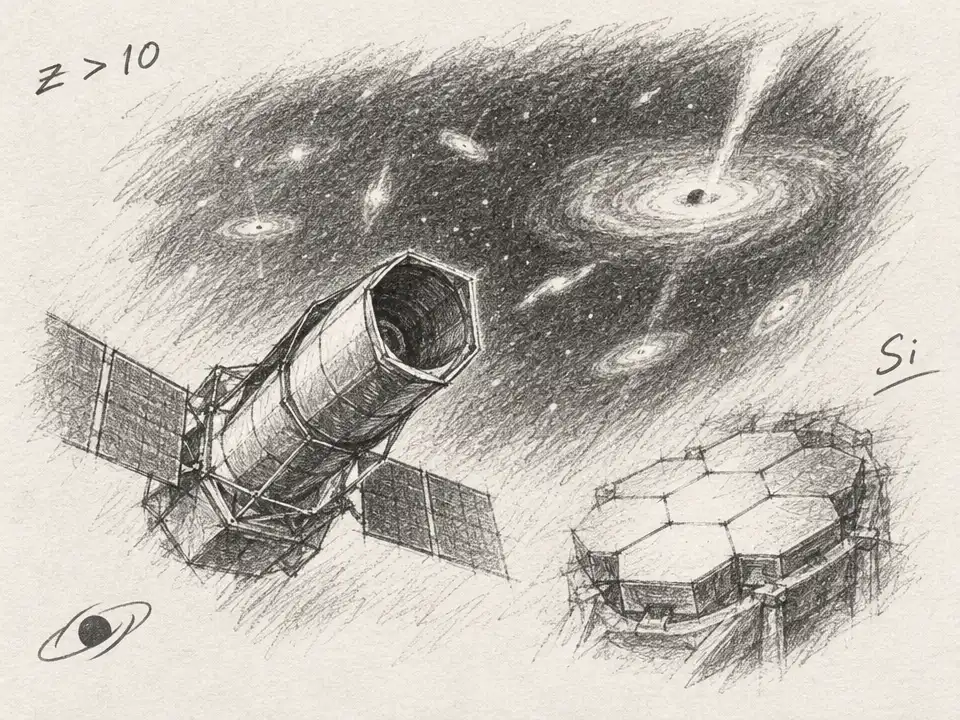
The need for such a view is striking. Black holes range from a few times the Sun’s mass to billions of solar masses, and observations reach back to an era when the Universe was about 400 million years old. Yet astronomers cannot watch one black hole through billions of years of cosmic history. They infer its mass and distance from observations made at one epoch, while the processes that built it remain largely out of view.
Those processes can include matter falling into a black hole, mergers with other black holes, and the formation of new black holes from stars. They do not happen in the same way to every object. Two black holes with similar masses today may have had very different paths to get there. The paper treats those individual histories as the hidden, microscopic side of the problem. The observable side—the “macrostate”—is the population’s distribution across properties such as mass at a particular cosmic time.
That shift in perspective matters because a population can retain clues its members do not. If the mass distribution changes between cosmic epochs, the pattern may reveal whether growth tends to push black holes toward higher masses, whether their growth histories spread out, or whether the change is more complicated than either picture alone. The population becomes a kind of record—not a complete biography, but a statistical trace of the events that shaped it.
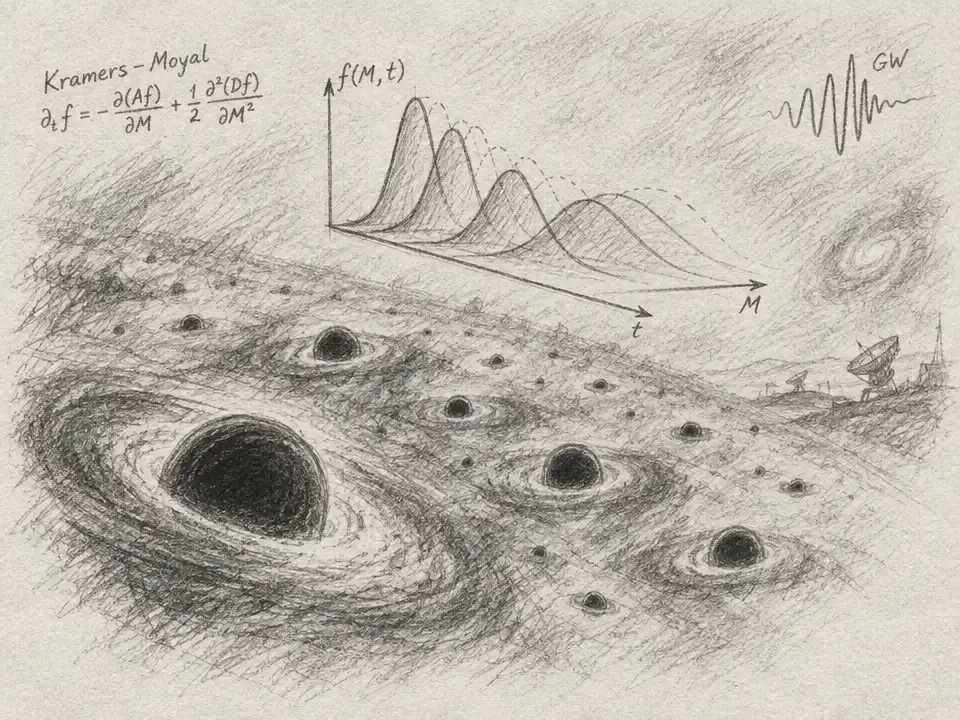
To describe that record, the paper turns to the Kramers–Moyal expansion, a framework used in statistical physics to describe how a distribution changes when individual systems undergo random processes. Its coefficients provide different ways to characterize the population’s evolution. The first captures a broad drift in mass; the second captures diffusion, or the spread of outcomes. Higher-order terms can represent more complex, non-Gaussian behavior. In plain language, they can help distinguish a population that shifts in a relatively even way from one with a lopsided or unusually varied history.
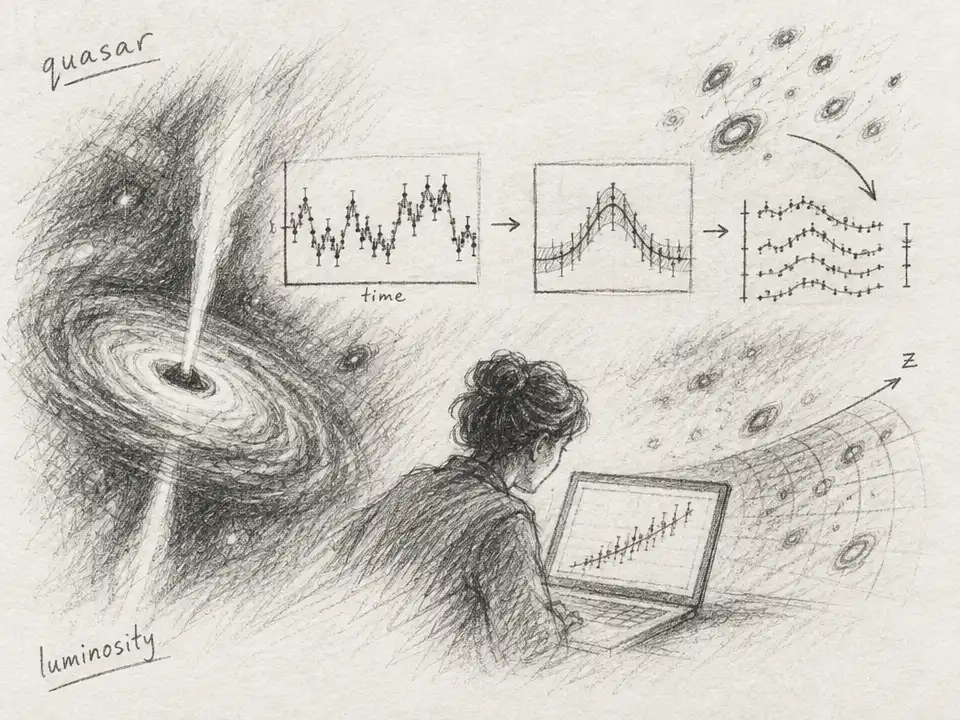
The framework is not a claim that researchers have already identified the dominant black-hole growth mechanism. It is a proposed way to ask that question using the population itself. The author outlines two routes: predict how specific physical processes should change the distribution, then compare those predictions with observations; or infer the framework’s coefficients from observed populations and work backward toward the processes. The second route could reduce reliance on assumptions about every hidden step in a black hole’s history—but it still depends on having sufficiently detailed observations.
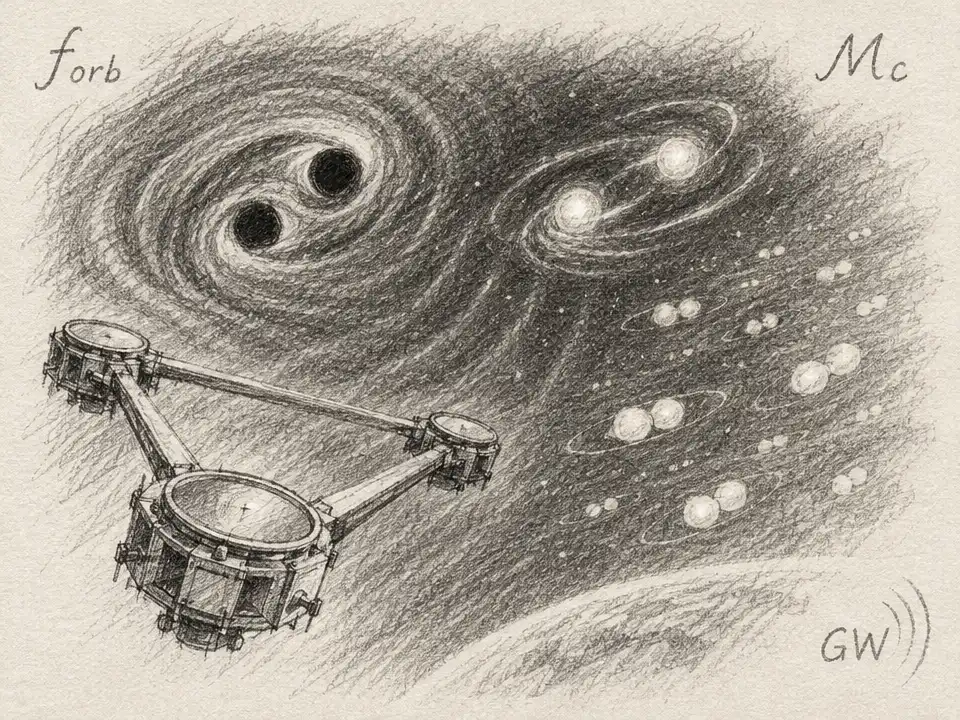
There is an important complication. Some growth pathways depend on what happened along the way, not merely on a black hole’s starting and ending masses. In a hierarchical merger, for example, the mass carried away as gravitational waves depends on other properties of the merging black holes. That makes the history harder to summarize as a simple sequence of independent steps. The paper explicitly notes this limitation: real black-hole evolution need not be Markovian, meaning that the next change may depend on more than the system’s immediate previous state.
The proposed analysis also makes simplifying assumptions. For black holes in the astrophysical mass range, it treats mass as growing over time and ignores substantial mass loss through Hawking radiation. And to estimate how the distribution changes, astronomers would need measurements across a broad range of masses and cosmic epochs, with each time interval short relative to the age of the Universe at that epoch.
That is where two kinds of cosmic messenger could meet. Gravitational waves can reveal merging black holes, while electromagnetic observations—from X-ray binaries to active galactic nuclei—can provide other views of black holes and their surroundings. The paper describes how combining these observations could eventually span nearly ten orders of magnitude in black-hole mass. The author says a statistical estimator to infer the framework’s coefficients from such combined observations is future work, not a tool already applied to a completed census.
If that approach proves workable, the payoff would be a new way to look for history in a population that cannot be followed one object at a time. A census of black holes would not tell astronomers exactly what happened to each one. It could, however, help reveal whether their growth across the Universe is dominated by steady trends, varied random histories, or more intricate processes—and how that balance changes over time.