Imagine sealing a box around a gas and leaving it alone. The molecules keep moving, colliding, and obeying laws that work just as well backward as forward. Yet the gas does not usually gather itself into one corner. It spreads out. The room seems to have an arrow of time, even though its smallest rules do not point in either direction.
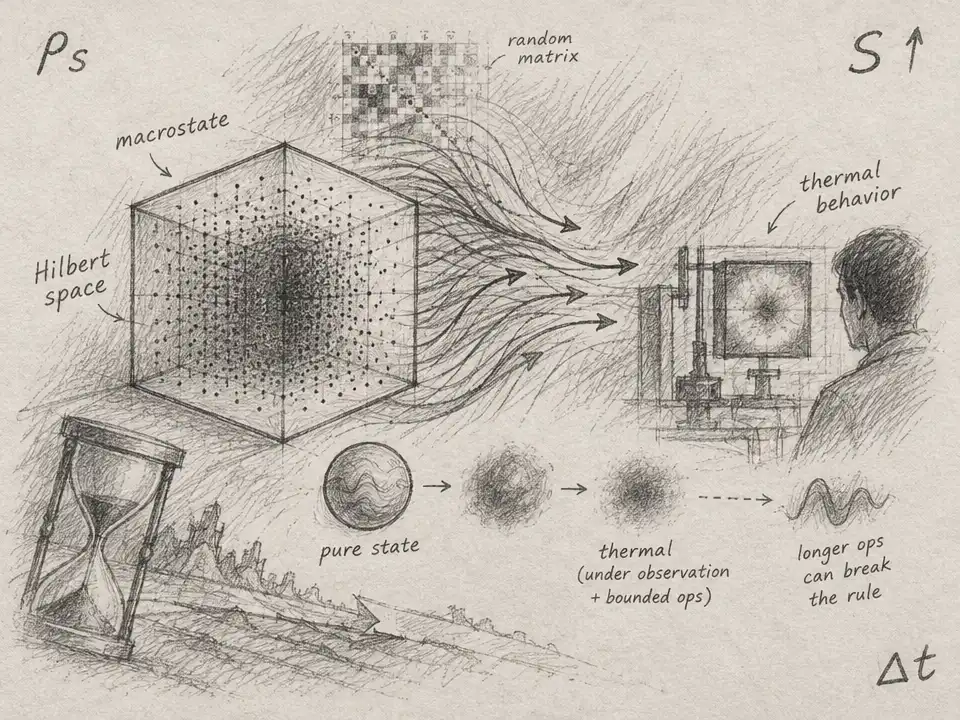
To look for that arrow, physicists have to change scale. A gas has an enormous number of microscopic arrangements that all look the same to us: same temperature, pressure, and volume. Each visible condition is a macrostate, a broad label covering a hidden multitude of possible quantum states. Some macrostates have very few compatible arrangements. Others have vastly more. The equilibrium state is not a single microscopic scene, but a region of possibility so spacious that almost every path seems to lead there.
That hidden spaciousness is the heart of Boltzmann’s idea of entropy. In a quantum version, a macrostate’s entropy is tied to the logarithm of the number of quantum states compatible with it. Think of the possible states as rooms in an immense building. A special, orderly condition may occupy a tiny chamber; equilibrium fills most of the building. The second law then becomes a question about motion through this architecture: does quantum evolution tend to carry a system from smaller rooms into larger ones?
A paper posted on October 13, 2026, by Cedric Igelspacher and Roderich Tumulka takes that question seriously for closed quantum systems. Closed means no heat or matter needs to leak in from outside. Their target is not the familiar claim that entropy often rises, but a sharper version: what, precisely, would it mean for entropy to increase when a quantum state can be spread across several macroscopic possibilities at once?
The authors describe that spread as a probability distribution over macrostates. Instead of asking whether a single label moves steadily uphill, they ask whether the distribution shifts toward macrostates with larger rooms. They define weak and strong versions of this second law: one tracks the overall drift of probability toward larger macrostates; the stronger version asks whether the probability currents between macrostates themselves predominantly point that way. This matters because an apparently rising average can hide complicated traffic underneath.
To test the definitions, the researchers study mathematical model worlds. In one, a quantum state begins in a small subspace and evolves under a randomly chosen Hamiltonian. As time passes, the state’s weight generally drains from the small subspace into the much larger remainder. In another model family, random matrices stand in for the system’s dynamics. For these models, the paper proves results showing that probability predominantly moves toward larger macrostates, with a cumulative error bounded at about 2.5% under the stated assumptions and over the modeled approach to equilibrium.
There is a catch, and it is central rather than fine print. These random-matrix systems are useful test beds, not realistic stand-ins for every gas, solid, or quantum device. Their dynamics can thermalize extraordinarily quickly because many transitions are effectively available at once. The authors say the larger challenge remains open: identify conditions that realistic macroscopic systems meet, then prove those conditions produce the same entropy arrow. Even in finite quantum systems, the underlying dynamics can allow extremely late returns toward an earlier condition. The apparent direction belongs to the ordinary timescales and the macroscopic description, not to an absolute ban on reversal.
A second theoretical study, by Yuuya Chiba and colleagues, approaches the puzzle from another scale. In a version updated on August 17, 2026, they ask what counts as thermal equilibrium when the full quantum state may be pure. A pure state is not a statistical mixture, and its whole-system von Neumann entropy can be zero. Yet its measurable, large-scale properties can agree with those of a thermal state. The authors propose checking a broad family of additive quantities—properties assembled across many parts of a system—and call states that match thermal equilibrium by those measures infinite-observable macroscopic thermal equilibrium.
The distinction is subtle but powerful. If every large-scale test gives the equilibrium answer, the system can be thermodynamic equilibrium even when its microscopic description is a single pure quantum state. The paper defines a macroscopic entropy density designed to capture that large-scale character. For states meeting its equilibrium definition, this quantity agrees with thermodynamic entropy density. In other words, the entropy relevant to a thermometer or a pressure gauge need not be the same as the entropy assigned to the entire quantum wavefunction.
The researchers also put limits on the operations in their second-law result. They model macroscopic interventions using local interactions and operations whose duration stays finite as the system grows. Under those conditions, their analysis shows that equilibrium states cannot yield an extensive amount of work through the allowed operations, and that the defined macroscopic entropy does not decrease after the operation and subsequent relaxation. But if the operation time is allowed to grow with the system’s size, they construct counterexamples. Given enough time, carefully coordinated local actions can exploit distant correlations in ways the ordinary macroscopic rule excludes.
That time limit reveals another hidden layer: the second law is not simply a statement that quantum mechanics forbids reversals. It is a statement about what happens when we describe a huge system by accessible macroscopic properties and restrict ourselves to physically reasonable operations. Zoom in far enough, and a closed system follows reversible quantum dynamics. Zoom out, and nearly all of its possibilities belong to the enormous equilibrium macrostate. Move between those scales, and the familiar arrow can emerge without rewriting the microscopic laws.
Together, the two studies offer complementary pieces of a difficult explanation. One gives precise ways to define entropy increase and proves the drift in selected random models. The other builds a thermodynamic framework for pure quantum states, with explicit assumptions about what counts as a macroscopic measurement or operation. Neither settles the second law for every real-world system. But both suggest where to look: not for a tiny mechanism that pushes time forward, but for the vast imbalance between the number of microscopic ways a system can be special and the number of ways it can look ordinary.
The room, in this picture, does not have to lock behind us. Quantum mechanics can leave a path back. The surprise is how much larger the room ahead is—and how rarely, on the scales we live by, the system finds its way out again.