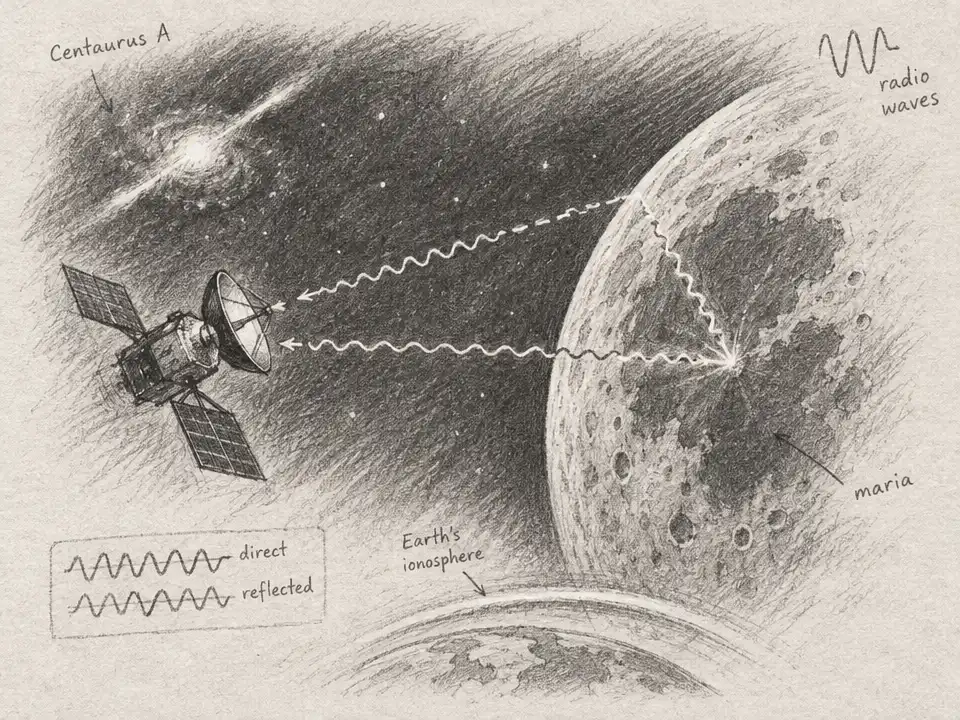
At radio wavelengths, the Moon can do something a polished mirror cannot: help an orbiting spacecraft listen to the sky with itself. A proposed technique uses lunar ground as a reflector, so one antenna receives a cosmic signal twice—once directly, then again after it bounces off the surface. The two copies interfere. Hidden in that pattern is a measurement of where the radio waves came from.
The idea could open a part of the universe that telescopes on Earth can barely hear. Below roughly 10 megahertz, Earth’s ionosphere blocks most radio waves from space. Those frequencies have been measured by spacecraft, but the resulting maps are blurry: past all-sky views had resolution measured in tens of degrees. The new proposal, called lunar reflective interferometry, aims to sharpen that picture without sending a fleet of spacecraft or laying antennas across the Moon.
The trick has an old terrestrial cousin. In the 1940s, radio astronomers used a sea cliff as one side of an interferometer. An antenna received radio waves directly and again after they reflected off the water. The difference in arrival time made the two signals rise and fall together in a pattern that revealed information about the source’s size and position. The cliff supplied a second, fixed “antenna” without anyone having to build one.
In lunar orbit, the geometry is more flexible. A spacecraft antenna looks out at the sky while the Moon sends back a delayed copy of some of the same radio emission. The surface acts as a passive partner in the measurement: no transmitter is needed. As the spacecraft moves, the effective separation and orientation between the direct path and the reflected path change. Combining measurements from different positions could eventually build up a radio image, much as Earth-based arrays combine signals from many antennas.
That moving “partner” is not the whole Moon. The proposal depends on patches of lunar terrain smooth enough to reflect very long radio waves coherently. At 10 megahertz, a wavelength is about 30 meters; at lower frequencies, it stretches to hundreds of meters or more. Bumpy ground scatters the reflection and blurs the interference pattern. The researchers used lunar topography maps and electromagnetic modeling to identify the best candidate terrain: the dark basalt plains called maria, which cover about 16% of the lunar surface and are smoother, on average, than the highlands.
Their analysis suggests that substantial areas of maria could preserve useful reflections through at least about 5 megahertz, and perhaps to about 7 megahertz for a spacecraft orbiting near 100 kilometers above the surface. At higher frequencies, only especially smooth patches or lower orbits may work well. The Moon therefore is not just a platform beneath the instrument; its local geology would shape what the telescope can observe, and when.
In the paper’s simulated setup, a spacecraft at roughly 100 kilometers could create projected baselines approaching 100 kilometers for sources near its local zenith. A long baseline can distinguish finer detail than a short one. Under the best geometric conditions, the team estimates angular resolution around one arcminute at about 5 megahertz. Their simulated multi-month map of the radio galaxy Centaurus A had a coarser resolution of 0.2–0.4 degrees, illustrating that the practical image depends on accumulated coverage, the Moon’s changing reflection, and the sky’s own radio glow.
Centaurus A is one reason to listen at these unusually low frequencies. Its giant lobes are filled with charged particles spiraling through magnetic fields, producing radio emission. Higher-frequency observations emphasize more energetic electrons and relatively recent activity. The proposed lunar measurements would be sensitive to lower-energy electrons that can survive for hundreds of millions to billions of years. Mapping their emission could help researchers trace the galaxy’s older outflows and distinguish ancient particles from places where activity has renewed.
The same low-frequency maps could turn the Milky Way into a kind of foggy landscape. Ionized gas absorbs radio emission, and the absorption strengthens as frequency falls. Distant Galactic features can fade while nearer structures remain visible, so comparing maps across frequencies could reveal how the foreground gas filters the sky. That is not a direct distance measurement: astronomers would need models or structures with independently known distances to interpret the changing brightness. But sharper maps could help separate overlapping arcs and shells that earlier, blurrier surveys could not disentangle.
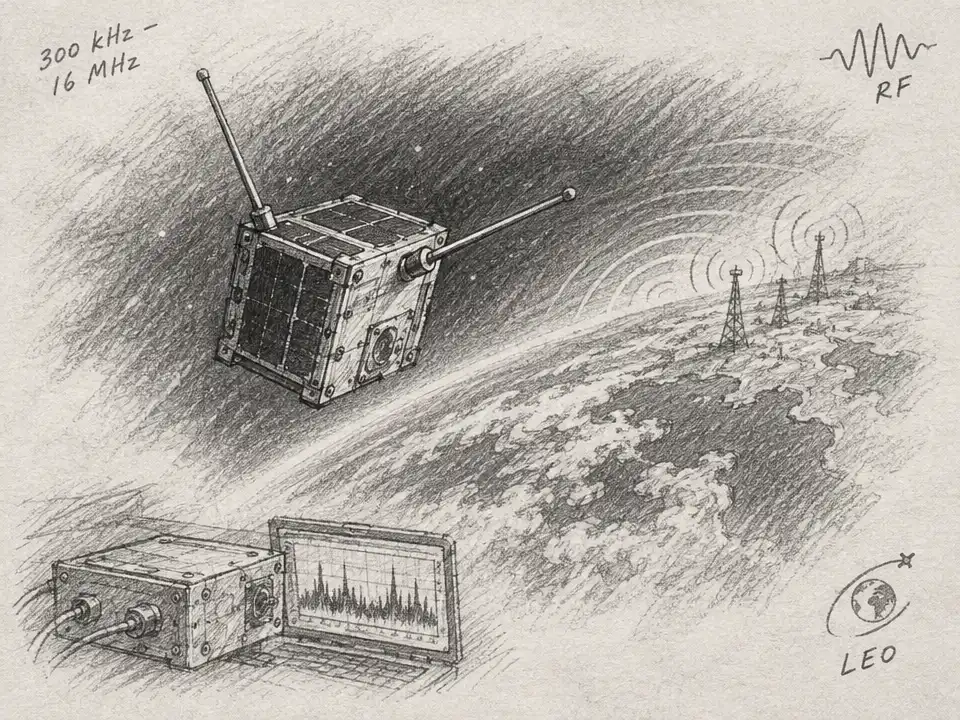
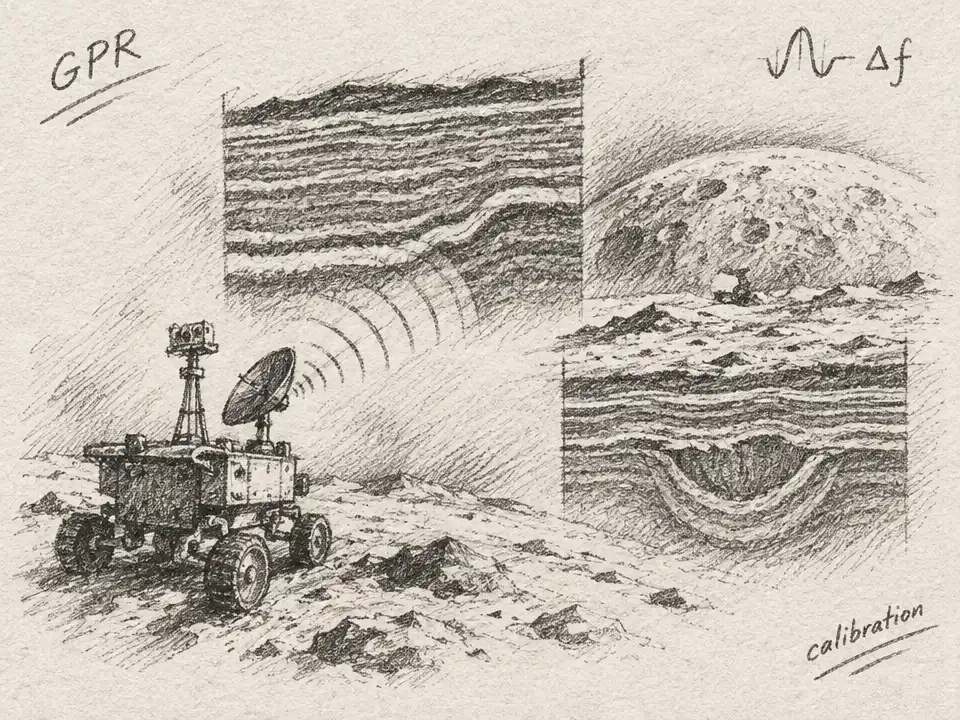
The design is still a research concept, not a telescope that has flown. The team outlines a possible small-spacecraft instrument using deployable antennas and digital signal processing, with preliminary estimates of about 12 kilograms and 50 watts. Important uncertainties remain. Surface roughness and lunar plasma can alter the reflected signal; calibration must account for the Moon’s changing response; and radio bursts from Earth’s auroras can contaminate the lowest frequencies. The authors also note that a single orbital pass produces an ambiguous, ring-like response, which repeated observations and changing orbital geometry would have to untangle.
The appeal is not that the Moon makes radio astronomy effortless. It is that a world already in the right place may supply a crucial piece of a telescope. If the reflections behave as the models predict, one small spacecraft could use lunar terrain as a virtual second antenna and bring a dim, poorly mapped radio sky into much sharper focus.