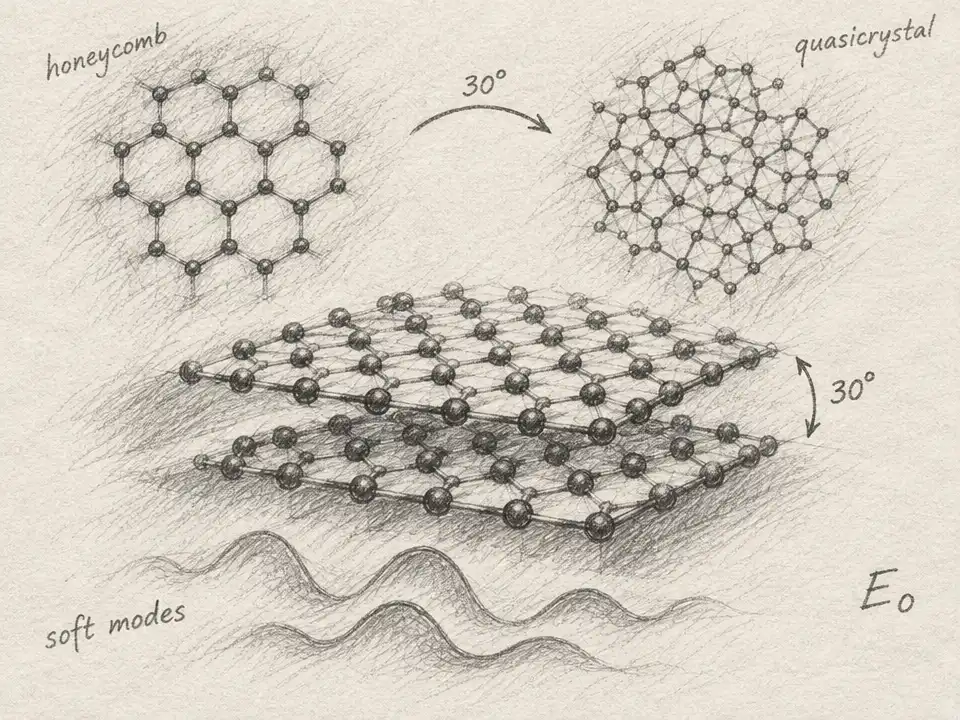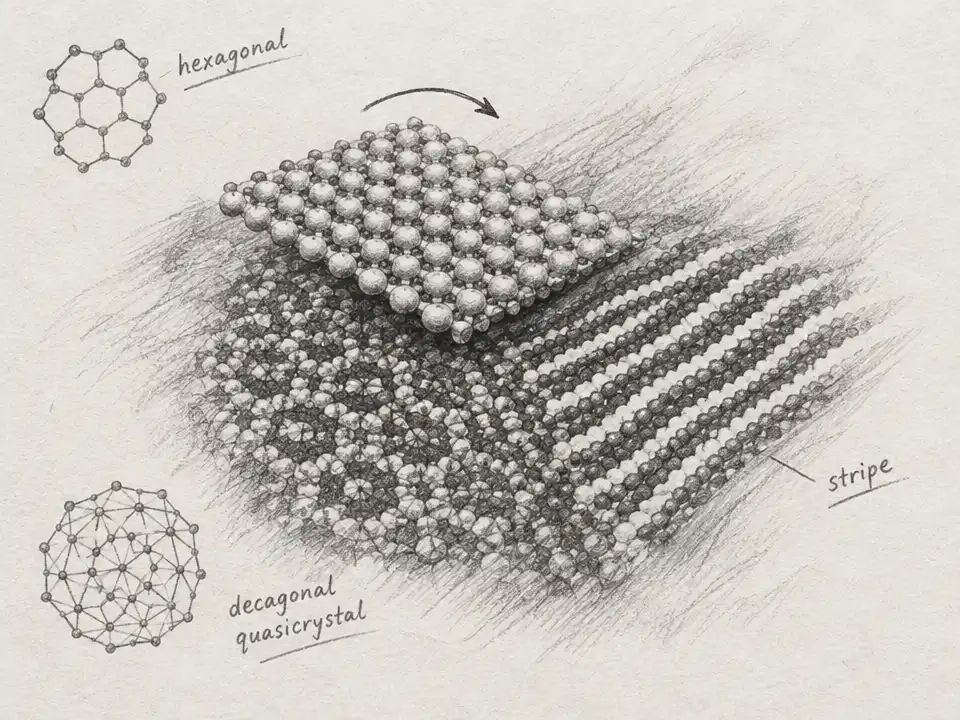
Imagine laying a neat hexagonal mesh over a surface that never repeats its pattern. The obvious move is to line up the mesh with the surface’s strongest directions. But a new theoretical study finds that the layer may fit better by turning slightly—and that its mismatch can settle into long, parallel stripes instead of the familiar patchwork of a moiré pattern.
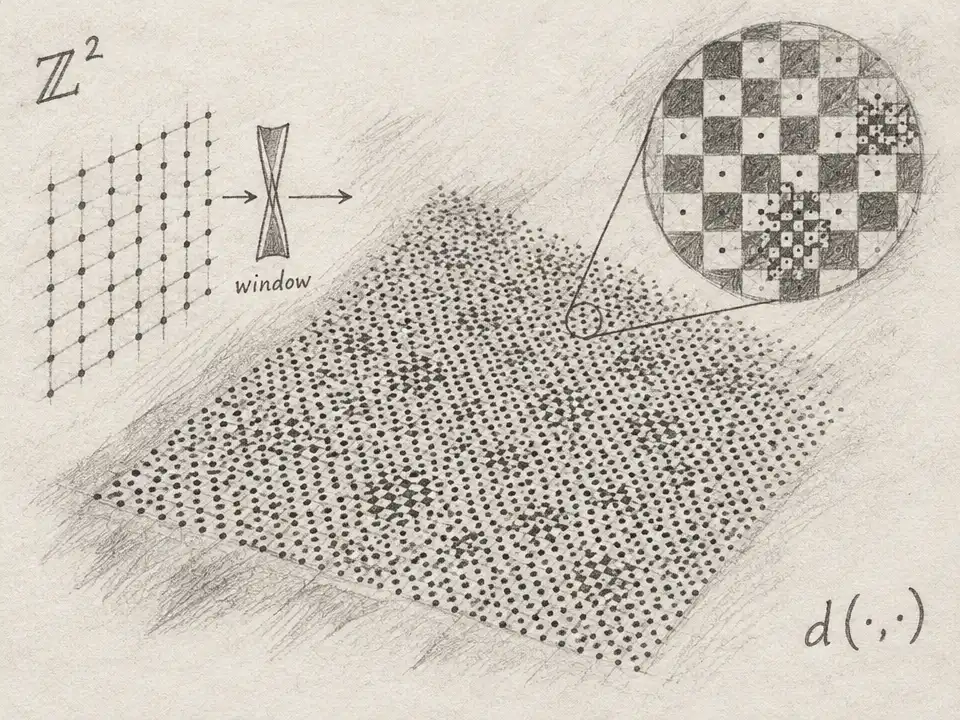
The unusual surface is a quasicrystal: ordered, but not built from a repeating unit. It can have clear directional symmetry without offering the regular rows and columns of an ordinary crystal. In the study, the researchers focused on a decagonal landscape, a pattern that can be made by combining five laser beams. A layer of particles arranged in a hexagonal crystal sits on top, trying to balance two competing demands: stay comfortably spaced from its neighbors, and settle into the low spots of the landscape.
There is a useful experimental precedent for making such a landscape visible. In a 2010 colloid experiment, researchers used interfering laser beams to create quasiperiodic patterns and watched micron-sized particles respond under a microscope. As the light grew stronger, quasiperiodic order began at especially symmetric spots and spread outward. That work showed how optical patterns can serve as adjustable landscapes for studying particles one by one. It did not test the later prediction about stripes, but it helps explain why researchers can use colloids to explore structures that are hard to manipulate atom by atom.
The twist has a history, too. When one periodic crystal rests on another with a slightly different spacing, the upper layer does not always align its axes with the lower one. A modest rotation can reduce the strain needed to accommodate the mismatch. The surprising question was whether this same strategy could work when the lower surface has no repeating lattice at all. Its directional order remains, but the usual crystal-on-crystal geometry no longer applies.
To answer that question, the researchers built a model of a hexagonal monolayer interacting with a decagonal quasiperiodic potential. They first worked out how the layer’s small vibrations respond to the patterned landscape, then compared the resulting energy predictions with numerical simulations that relaxed the particle positions. In the example they studied, the particle spacing was 5.8 μm and the pattern’s characteristic spacing was 5.4 μm. For that mismatch, the lowest-energy arrangement turned by about 5.31°. That angle is a result for this modeled setup, not a universal twist angle for every quasicrystal.
Why stripes? A patterned surface nudges the overlying particles in many directions, but not every nudge matters equally. The model identifies a pair of especially long-wavelength distortions as the strongest contributors. Because those distortions dominate, the layer’s displacements line up into broad, parallel bands. On a regular hexagonal substrate, several equally placed directions can combine into a more balanced, hexagon-like moiré pattern. Here, the quasicrystal’s geometry breaks that balance: one pair of modes stands out, and the pattern becomes strongly directional.
The simulations support the calculation. For weak interactions with the substrate, the predicted distortion closely matches the relaxed particle arrangement. As the interaction grows, additional distortions enter and the pattern becomes more complicated, but the preferred twist remains close to the calculated value in the range the researchers examined. The central result is not that quasicrystals always produce simple stripes. It is that a particular mismatch and interaction regime can favor a low-symmetry, stripe-dominated arrangement that a simple alignment argument would miss.
That directional pattern suggests a mechanical consequence. In the weak-coupling model, the researchers predict no static friction—the layer should not be locked in place just because it rests on the substrate. But once it slides, the motion could excite the dominant vibration more readily in some directions than others. The result would be kinetic friction that depends on which way the layer moves. This is a prediction, not a measured friction effect: the paper’s stripe pattern comes from theory and numerical relaxation, and the authors point to optical-lattice colloid setups as a way to test it.
The broader lesson is that irregularity does not mean the absence of structure. A quasicrystal lacks a repeating cell, yet its organized directions can steer how another material twists, bends, and moves across it. A seemingly small rotation can reveal which distortions the interface prefers—and may turn a geometric mismatch into a map of direction-dependent behavior.