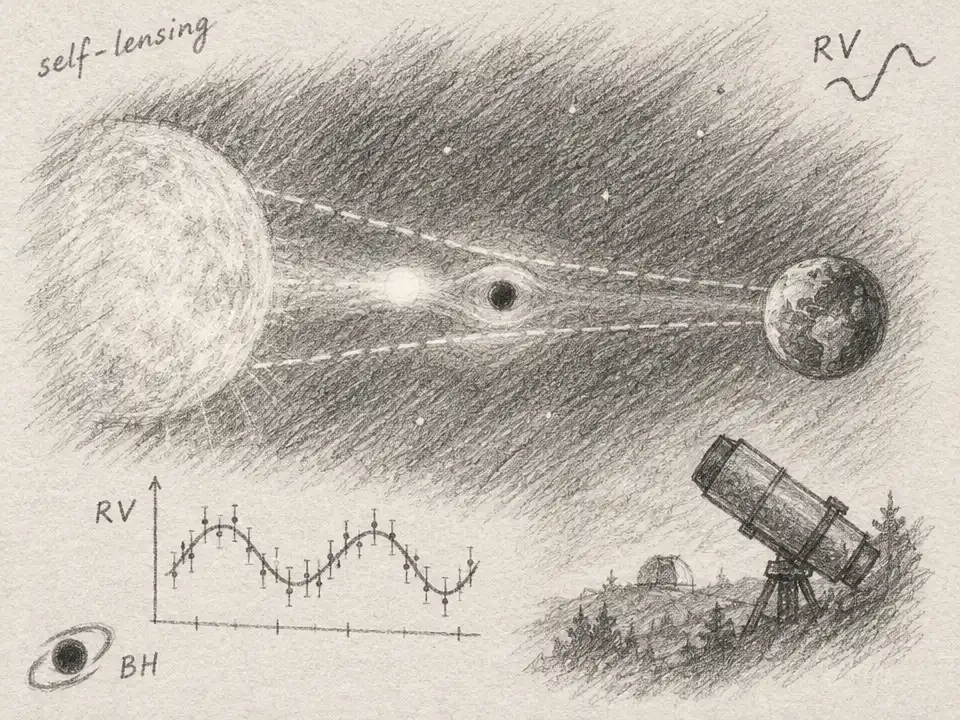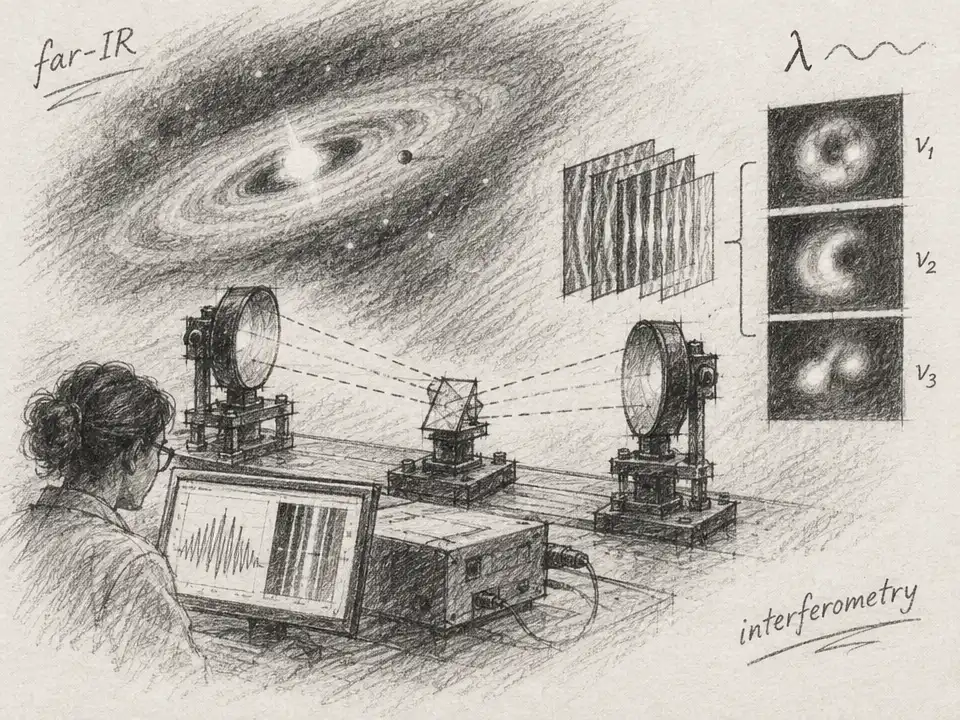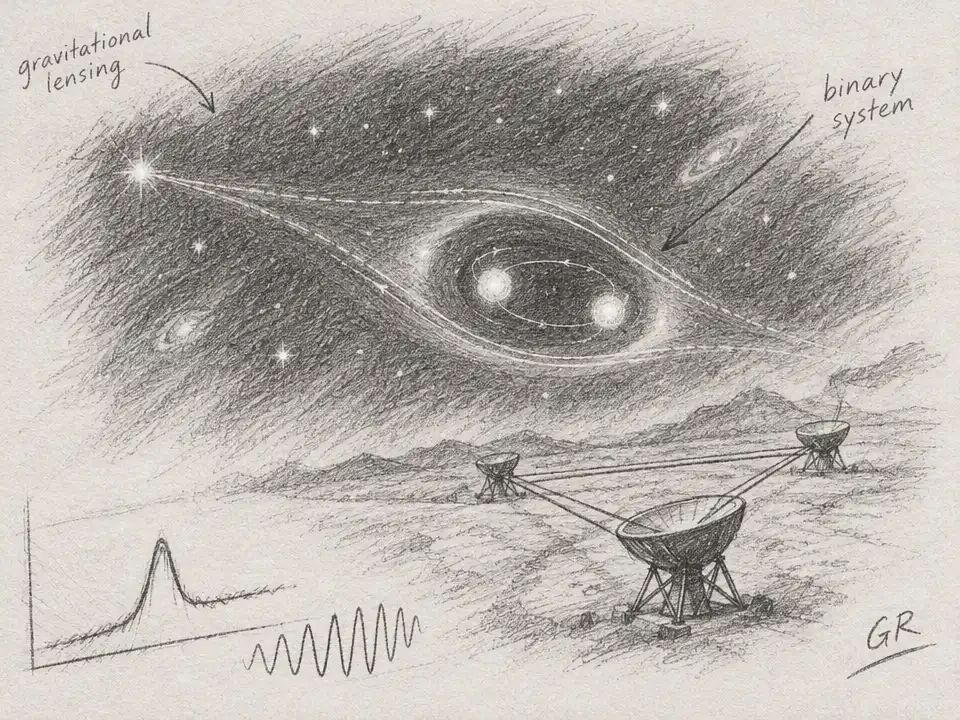
Imagine a distant star brightening as another star system passes in front of it. The foreground stars are too small and far away to see directly, but their gravity bends the background star’s light, briefly changing its apparent brightness. Now imagine watching those foreground stars move around each other as well. Put the two observations together, researchers propose, and a fleeting cosmic alignment could become a new test of Einstein’s gravity.
The first part of that test is microlensing. When a foreground object crosses almost exactly between Earth and a background star, its gravity redirects the star’s light toward us. The star appears brighter, and the changing brightness traces the lensing system’s influence. If the lens is a binary—a pair of stars—the light curve can reveal details about the pair, including a mass inferred under the assumption that General Relativity is right.
That last condition matters. General Relativity has passed many tests, but most familiar checks probe the solar system or environments where gravity is comparatively strong. The researchers are interested in an especially weak-field regime, with a dimensionless Newtonian gravitational potential of about 10−8. Some proposed alternatives to Einstein’s theory predict that gravity might behave differently in such settings. A test there would ask not just whether the theory works near home, but whether it holds across the varied neighborhoods of our galaxy.
The new approach is a kind of cosmic double check: weigh the same binary in two different ways. Microlensing measures how strongly the pair bends light. Interferometric astrometry measures how the stars move around one another, letting researchers infer their dynamical mass from the orbit. The comparison can constrain a parameter called γ, which describes how much spatial curvature is produced per unit mass. In General Relativity, γ equals one. A mismatch between the lensing and dynamical masses could point to a different value.
Each measurement supplies something the other cannot. A microlensing light curve can reveal the lens’s influence even when the lens itself is faint. But it does not, by itself, provide the same independent check on mass as a measured orbit. Conversely, watching stars move reveals their dynamics, but not how their gravity bends a separate beam of light. Combining the techniques turns one binary into two kinds of gravity experiment.
The hard part is seeing the orbit. A distant pair may be separated by only a few milliarcseconds in the sky—an angle far too small for an ordinary telescope to resolve. The proposed solution uses long-baseline optical interferometry, which combines light collected at widely separated telescopes to measure tiny angular separations. The study explores what the Very Large Telescope Interferometer’s GRAVITY+ instrument could do with a specific microlensing event, ASASSN-22av. Its two M-dwarf stars are separated by about 3 mas and have a combined K-band magnitude of about 18.5.
This is not a report of a new, completed gravity measurement. The team ran a feasibility study: they modeled the target’s orbit, simulated the astrometric observations, and tested whether the resulting data could recover the system’s properties. Because the microlensing observations did not establish a full orbit, the simulation adopted illustrative assumptions for the binary’s orbit, including that it was near its widest separation during the lensing event. The mock observing schedule began in 2070, with observations every three years. That schedule belongs to the simulation, not to a set of observations already made.
In the simulated data, combining the orbit with the microlensing result yielded γ = 1.017, with an uncertainty of about 23%. That is a prospective precision, not evidence that gravity has already been measured to differ from—or agree precisely with—Einstein’s prediction. The point is that the two methods could be made to meet in one real system. In the mock analysis, the orbital separation itself was recovered to about 0.4% precision; uncertainty in the distance-related parallax was a larger limitation.
The researchers also estimate how a collection of targets might improve the test. Their projection starts with a forecast of 27,000 microlensing events for the Roman Space Telescope. Applying assumptions about how many would be suitable binary events, and how many would be bright and well-separated enough for the measurements, leaves about 68 promising systems. If the uncertainties improve roughly with the square root of the sample size, the combined constraint on γ could reach about 3%. That estimate depends on the assumed sample and future measurement capabilities; it is not a guaranteed outcome.
There are other limits to solve. The paper’s current method does not include events whose light curves require a full reconstruction of the binary’s orbit; the researchers say existing fitting tools would need modification to use those cases. Better parallax measurements would also sharpen the dynamical masses. And, as with any comparison of precise measurements, the result depends on correctly accounting for uncertainties shared between the two mass estimates.
Still, the central idea is appealingly direct: let light and motion weigh the same stars, then compare the answers. Rather than relying on a model of an entire galaxy, the proposed test uses a binary system’s own lensing signal and orbital dance. For now, the cosmic alignment is a promising opportunity rather than a verdict on gravity. If future observations can make both measurements precise enough, a pair of dim stars passing in front of a background beacon could help probe how space bends under gravity far beyond the solar system.