A clock is only as steady as the beat it can pick out. For a next-generation nuclear clock, that beat comes from 229Th: a rare thorium nucleus whose unusually low-energy transition can be driven by ultraviolet light. In isolation, the transition should be extraordinarily sharp. But when researchers placed the nuclei inside a crystal to make them easier to measure, the spectral line spread across tens to hundreds of kilohertz. The puzzle was not just why the signal blurred. It was what, inside an apparently solid and quiet host, was doing the blurring.
The crystal in question was calcium fluoride, a transparent material that can hold many thorium nuclei at once. That is a practical advantage: a large ensemble can produce a stronger signal than a lone nucleus. The tradeoff is that each thorium atom sits among neighbors whose charges and positions may slightly reshape the environment around it. The clock transition is nuclear, not electronic, so the surrounding material was expected to disturb it relatively little. Earlier estimates put some sources of broadening near the kilohertz scale. The measured lines, however, were far wider.
To investigate, the team measured four of the five allowed nuclear transitions in three crystals with different thorium concentrations: about 0.3, 0.8, and 4 × 10¹⁸ nuclei per cubic centimeter. They swept a vacuum-ultraviolet frequency comb across each resonance and detected the fluorescence emitted after the nuclei absorbed light. The comb’s linewidth was about 1 kHz, narrow enough to resolve resonances whose widths ranged from a few tens to a few hundred kilohertz.
One clue arrived from temperature. If the broad lines came mainly from the lattice’s thermal jostling, warming the crystal should change their widths. Instead, as the researchers varied temperature from 150 to 293 K, the resonance centers shifted but the linewidths showed no measurable change. That contrast matters: temperature altered where the transitions appeared, but not how blurred they were. The authors argue that rapid lattice vibrations are largely averaged out during the measurement, leaving a more persistent source of disorder behind.
The second clue came from adding thorium. Across the three samples, every measured transition broadened roughly in proportion to thorium concentration, even as the transition centers remained largely unchanged. For one transition, the linewidth grew from 109(15) kHz in the least-doped crystal to 286(12) kHz in the most-doped one. Another widened from 28.6(1.1) kHz to 94.8(0.9) kHz. The effect was not identical for every transition: some were much more sensitive than others. That pattern pointed toward a mechanism that couples to the nucleus’s internal structure, rather than a generic loss of optical resolution.
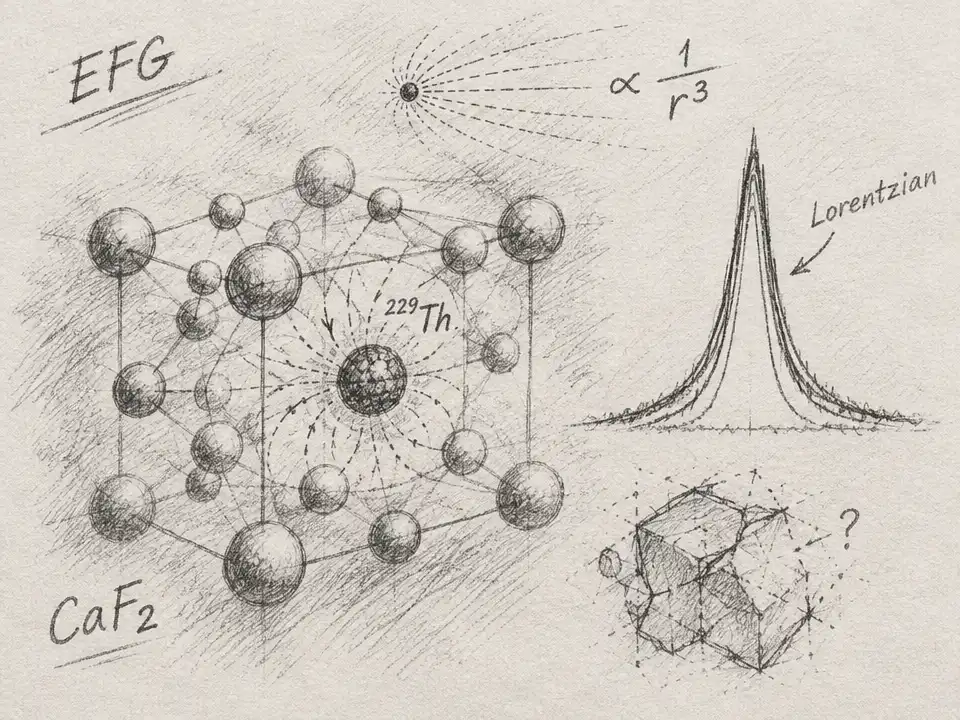
The likely culprit is a local electric-field gradient: a measure of how the electric field changes across the tiny region occupied by a nucleus. 229Th has a nuclear quadrupole moment, so this uneven field can shift and split its nuclear energy levels. If neighboring ions sit in slightly different positions from one thorium site to another, each nucleus experiences a slightly different gradient. The ensemble then responds at a spread of frequencies. A clock looking at all those nuclei at once sees one broadened line instead of one perfectly narrow beat.
Even the shape of the lines carried a clue. They were Lorentzian, not the more familiar Gaussian shape often associated with many small, independent variations. The researchers show how that shape can arise if randomly distributed dopants or defects disturb the local field in a way that falls off as the inverse cube of distance. Nearby imperfections can matter a great deal, while more distant ones add weaker shifts. In this model, the same long-range disturbance naturally produces both a Lorentzian line and a linewidth that grows linearly as the crystal contains more thorium.
That explanation is supported by the measurements and by calculations, but the exact arrangement of atoms around each thorium nucleus is not settled. The team compared several possible defect configurations using atomistic simulations and calculations of the electric-field gradients. Among the structures they tested, a pair of neighboring thorium atoms best reproduced the measured pattern of which transitions were broadest. Yet the calculated widths were about an order of magnitude larger than the measured ones, so the calculations do not amount to a precise microscopic picture. The broad cause, local field-gradient disorder, is better established than the detailed defect geometry.
The scale is strikingly small. The analysis associates the measured field-gradient variations with atomic displacements on the order of 10-4 angstroms. These are not directly imaged shifts of individual atoms; they are an estimate informed by the model and simulations. At a typical thorium concentration of 1018 per cubic centimeter, neighboring dopants are roughly 100 angstroms apart on average. Tiny changes around a dopant can therefore leave a measurable fingerprint in a nuclear resonance, even when ordinary heating does not visibly widen it.
For clock designers, the result clarifies a difficult bargain. More thorium can make the signal easier to collect, but the extra dopants also create more opportunities for the local environment to vary from site to site. The researchers suggest that cleaner crystals, improved growth and annealing, or a host made from a thorium compound could reduce these sources of disorder. Their model places an upper bound of about 5 kHz on the residual linewidth if electric-field-gradient broadening were removed; that is a projection, not a demonstrated clock performance.
The crystal has turned out to be more than a container for a promising nuclear transition. Its quiet imperfections become part of what the clock measures. By finding that the blur tracks dopant density rather than temperature, the researchers have replaced a vague materials problem with a more specific target: control the local electric landscape around each thorium nucleus. The next challenge is to learn which microscopic defects matter most, and whether a cleaner host can let the nuclear beat ring more sharply.