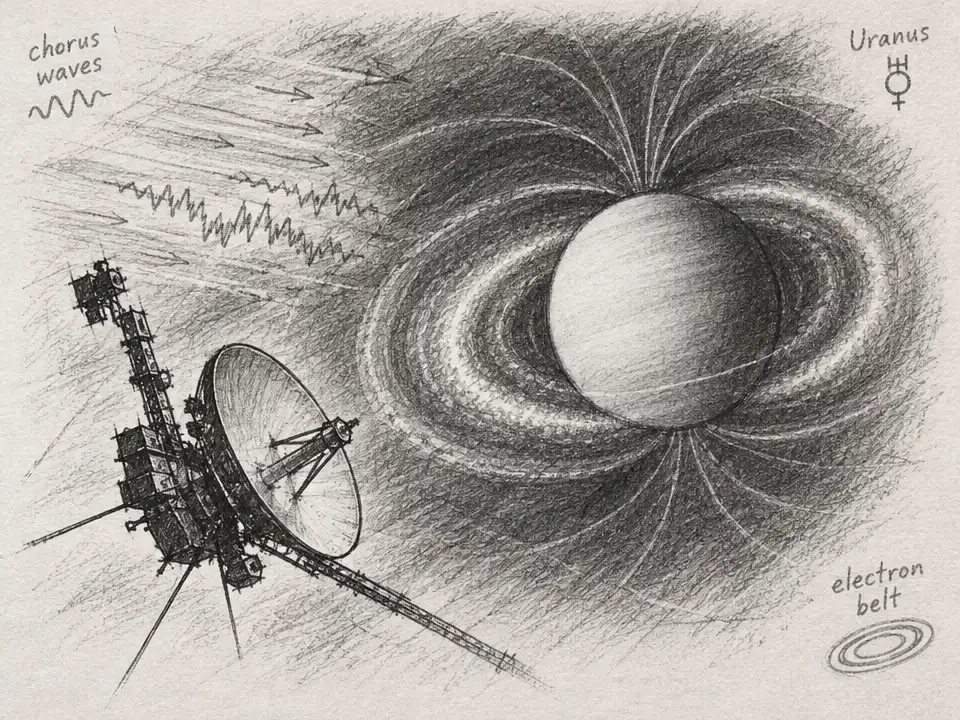
Uranus has a radiation belt that seems to break the usual pattern. When Voyager 2 swept past the planet in 1986, it found a belt packed with energetic electrons—but a much weaker belt of energetic ions. The contrast was puzzling: what had given the electrons so much energy, and why didn’t the ions show a comparable surge?
A new analysis offers a clue hiding in the timing. Voyager may have reached Uranus just as a disturbance from the Sun was washing over the planet. If so, the spacecraft did not catch Uranus on an ordinary day. It may have glimpsed a temporary particle storm—and a familiar kind of acceleration also seen near Earth.
The puzzle began with a fleeting visit. Voyager 2 is still the only spacecraft to have directly measured Uranus’s radiation environment. During its brief 1986 passage, it came within about four Uranus radii of the planet. The data showed electron intensities far higher than expected, approaching a theoretical ceiling beyond which waves should scatter particles out of the belt. The ion belt, by contrast, was unexpectedly faint.
That mismatch is hard to interpret because Uranus is unlike Earth in ways that matter for trapping particles. Its rotation axis is tilted 97.7 degrees relative to its orbital plane, and its magnetic dipole is both displaced from the planet’s center and tilted about 60 degrees from the rotation axis. The resulting magnetic field is lopsided and complicated. A spacecraft crossing it once might sample an unusual slice of the system rather than its typical state.
There was another odd clue. Measurements suggested that the low-energy plasma near Uranus was sparse during the flyby. That seemed to leave too few particles to explain how the energetic electron belt had become so intense. But the Uranus encounter also coincided with a large structure in the solar wind called a corotating interaction region, or CIR. CIRs form when fast solar-wind streams catch up with slower ones, creating a broad, recurring disturbance that can push and stir a planet’s magnetic environment.
The researchers revisit the Voyager measurements with a question: could a CIR have helped build the electron belt? The idea draws on a more recent, better-observed example closer to home. Near Earth, the Van Allen Probes recorded a CIR arriving during a solar-minimum event in 2019. Electron levels rose in stages, reaching energies of 7.7 MeV. Meanwhile, the measured 21.25 MeV hydrogen-ion population changed little. Earth, too, showed a strong electron response without a matching surge in energetic ions.
One possible accelerator is a type of electromagnetic plasma wave known as lower-band chorus. The name describes a family of emissions detected in space, not a sound that could be heard by a person. At Uranus, Voyager’s instruments recorded intense chorus waves during the flyby—between 0.1 and 0.5 of the electron cyclotron frequency. The paper notes that these were the strongest such emissions its instrument had observed at any planet.
Chorus waves can transfer energy to electrons through repeated interactions, helping them climb to relativistic energies. At Earth, the 2019 event showed the telltale sequence: a solar-wind disturbance arrived, chorus activity intensified, and electrons were progressively accelerated. The Uranus observations cannot show that sequence unfolding in the same detail; Voyager passed through only once. But the strong waves were present, and the highest particle fluxes appear to occur near periods of intense chorus activity.
The comparison suggests a way to reconcile the clues. A CIR may have stirred Uranus’s magnetosphere and helped trigger chorus waves, which in turn accelerated electrons. Earlier disturbances could have supplied a seed population for the waves to work on. The low plasma density may even have made some forms of local acceleration more efficient. In this picture, the strange electron belt need not be Uranus’s everyday condition. It may record a brief episode of space weather.
That is not the only explanation for the sparse plasma readings. The paper discusses how the CIR may have swept material out of the inner magnetosphere before Voyager arrived. Uranus’s unusual magnetic geometry may also have carried the spacecraft across sparsely populated, lobe-like magnetic field lines rather than through a fuller disk of plasma. Either possibility would make the flyby a poor snapshot of the planet’s normal environment—and could help explain why the readings seemed so contradictory.
There is a further complication: Voyager’s particle instrument did not sample every direction equally during the encounter. Its operating mode was changed, and its field of view limited how well researchers can reconstruct the angles at which particles were moving. That makes it difficult to separate changes in particle abundance from changes in where the spacecraft was looking or which region of the magnetic field it crossed. The researchers therefore present chorus-driven acceleration as a plausible explanation, not a confirmed reconstruction of what happened.
The larger lesson is that the solar wind may matter at Uranus more than a single flyby could reveal. The proposed explanation links a distant planet’s radiation belts to a process measured in detail at Earth, while also showing why Uranus cannot simply be treated as a scaled-up version of our own magnetosphere. Its steep tilt, off-center magnetic field and changing orientation may make its belts shift with both solar storms and planetary season.
One encounter left scientists with a riddle; a comparison with Earth has supplied a candidate answer. To test it, researchers will need repeated measurements: a spacecraft that can watch the solar wind arrive, track waves and particles over time, and sample different parts of Uranus’s magnetic field. Until then, Voyager’s electron-rich snapshot remains both a clue and a warning. A planet’s strangest reading may reveal less about its usual state than about the storm passing through when the measurement was made.