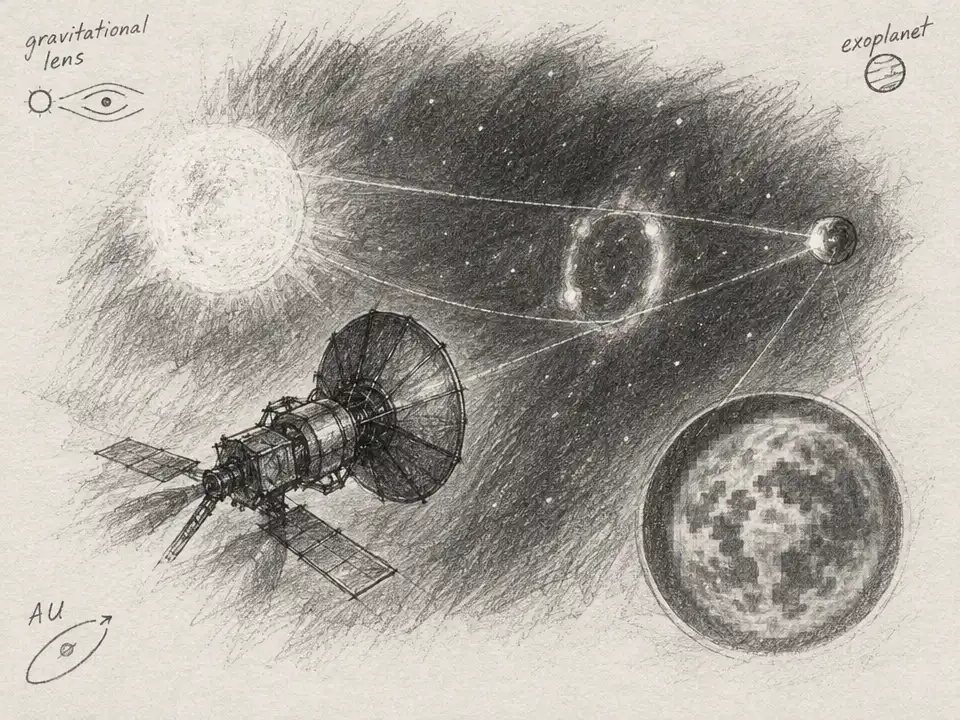
Imagine looking back toward the Sun from the darkness beyond the planets. Around its bright disk, a thin ring of light appears. It has traveled from another star system, bent by the Sun’s gravity, carrying a faint imprint of a planet that might be like Earth. The ring is not a picture. It is a puzzle—and, in principle, the Sun itself is the instrument that makes the puzzle worth solving.
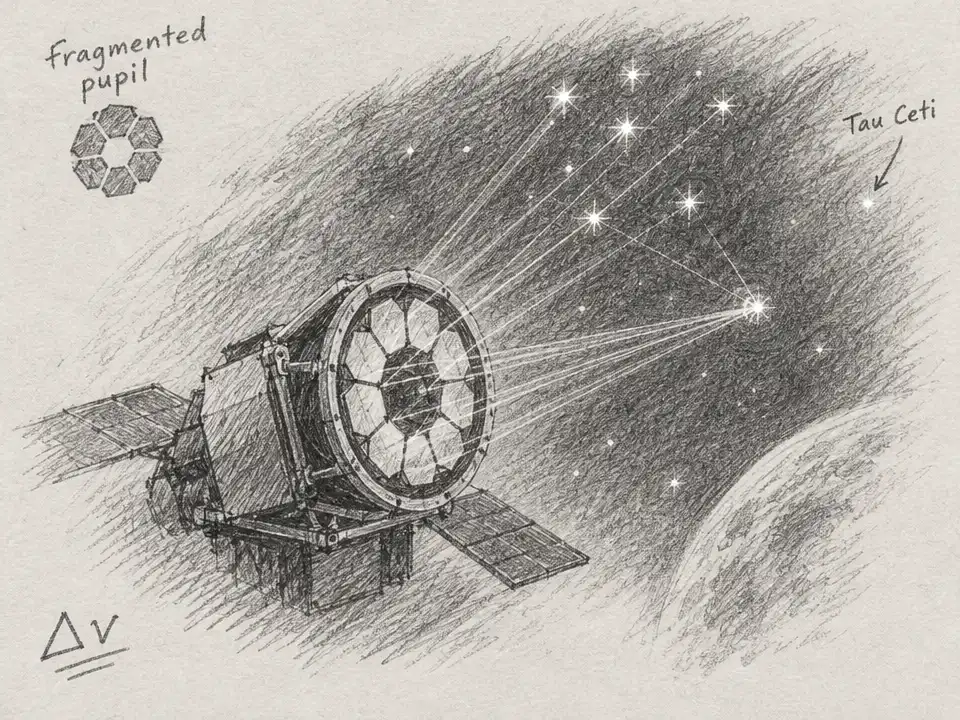
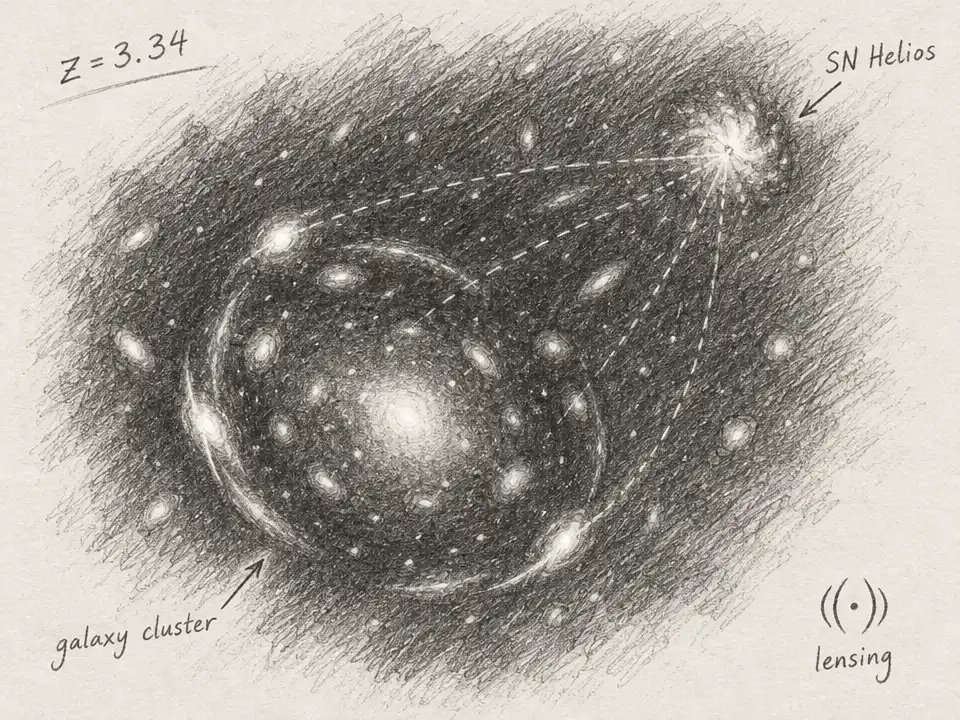
This idea is called the solar gravitational lens. Gravity bends the paths of light, and the Sun is massive enough to bend light from a distant object into a focused region beginning roughly 548 au away. One astronomical unit is the average Earth–Sun distance. In practice, observing farther out—around 650 AU or beyond—could help a spacecraft separate the solar disk from the lensed light. That is a long way to go for a telescope, but the telescope would be the least extraordinary part of the mission: the Sun supplies the lens.
The payoff could be startling. A conventional telescope would need an impossibly large mirror to pick out surface features on a small, distant planet. The solar lens could provide a route to resolving features on the scale of kilometers, using a spacecraft with a modest telescope. Instead of learning only that a planet exists or measuring its average atmosphere, astronomers might eventually reconstruct a map of its changing surface brightness: patterns of light and dark that could reveal broad differences in terrain or reflectivity.
There is an important catch in that word “reconstruct.” The Sun does not focus the planet into a crisp, camera-ready image. Its gravitational lens spreads each part of the planet’s light across the observing region, smearing the image. The spacecraft would detect a changing glow in the ring around the Sun, then use that signal to work backward toward a map. It is less like taking a photograph than trying to recover a scene from a blurred reflection.
That backward step has been tested in computer simulations. Researchers have modeled an Earth-like planet at the distance of Proxima Centauri, our nearest stellar neighbor, and asked what a spacecraft might measure. The example is a stand-in, not a claim that Proxima Centauri is known to have an Earth twin. In one study, a hypothetical planet’s million-pixel image could be reconstructed with roughly a year of cumulative observing, under the study’s assumptions. Other estimates vary with the observing setup and image quality. These are calculations, not images captured by a mission.
The image is also made one sample at a time. A small telescope cannot collect a whole planet’s lensed image at once; the spacecraft must move through the projected image region and record how the ring’s brightness changes at different positions. That makes the data resemble a long sequence of scattered clues. The reconstruction algorithm has to account for the lens’s blur as well as the spacecraft’s location when each measurement was made.
Then the target itself refuses to sit still. A planet rotates. Its star lights one hemisphere more than another, and its orbital motion changes the illumination over time. If the observatory gathers measurements over days or months, it may be combining observations of different views of the world. A 2023 study addressed this problem by simulating Earth’s rotation and changing illumination. From the simulated samples, researchers recovered recognizable continental outlines. The result suggests that motion can be modeled rather than simply treated as a fatal flaw—but it depends on knowing the planet’s rotation and orbit in advance.
And a simulated outline is not the same as a verified map of an alien world. The reconstruction study simplified the surface and illumination; it did not fully model clouds, unpredictable surface changes, or the range of ways real terrain reflects light. The authors also identified light contamination and small departures from the Sun’s idealized gravitational field as issues requiring further work. A future map would first be a map of brightness, interpreted through models—not a close-up photograph that labels oceans, forests, or cities for us.
The Sun brings its own glare. The lensed planet’s ring would be observed against light from the solar corona, the Sun’s extended outer atmosphere. That background adds noise to the measurements, and removing it perfectly is not guaranteed. Light from the planet’s host star can also interfere at some orbital positions. Researchers have estimated how these backgrounds affect observing time and explored ways to reduce their impact, but the signal has not yet been collected by a spacecraft at the lens.
Before any of that can happen, a probe must make the journey. Mission concepts propose using a lightweight solar sail: sunlight pushes the sail as the spacecraft swings close to the Sun, gaining speed before heading outward. One design study considered speeds around 20 au/year, far faster than the roughly 3.5 au/year cited for Voyager’s outward journey. Even at that proposed pace, reaching the useful observing region takes decades. A mission also needs power, communication across an immense distance, and careful navigation while it scans the projected image.
There is a further price: the target must be chosen before launch, and the spacecraft must travel in the right direction to reach the line between that distant world and the Sun. It cannot simply arrive at the lens and browse the sky. The target’s position must be measured with great precision, and the probe must track the planet’s projected image while the solar system and target move. A mission could spend years traveling only to discover that navigation, noise, or the target’s changing appearance makes the desired map harder to recover than expected.
That makes the solar gravitational lens less like a giant telescope waiting in space and more like a distant expedition with a demanding itinerary. The possibility is remarkable: not merely detecting another Earth-like planet, but attempting to resolve its surface patterns from across interstellar space. The price is equally plain—decades of travel, an exacting target and navigation problem, and an image that must be rebuilt from noisy, blurred measurements. The first success would not settle whether another world is habitable. It would show that a tiny observatory, guided by the Sun’s gravity, can make a distant planet more than a point of light.