For years, astronomers found a familiar signature in radio bursts from brown dwarfs: the waves were strongly circularly polarized, their electric fields twisting mostly in one direction. That pattern helped identify the bursts as aurora-like emissions. Then a nearby brown dwarf appeared with radio flashes that were bright, regular—and far less polarized than expected. The surprise was not just the odd signal. This object turned out to be the brightest periodic radio emitter of its kind yet reported.
The trail began in wide-field radio survey data, where ASKAP had recorded a variable source in the sky. It did not shine steadily. In observations around 887 MHz, researchers found it in 7 out of 36 visits, a duty cycle of about 20 percent. That made it easy to miss in any single snapshot, but a wide survey had caught enough appearances to mark it as worth investigating.
At first, the radio source’s identity was not obvious. The researchers compared its position with infrared catalogs and found a possible match: WISE J151721.13+052929.3, an object already classified as a T8 brown dwarf. The infrared measurements dated to 2010, while the radio observations came years later. In that time, the dwarf had moved across the sky. Before correcting for that motion, the positions differed by 3.2 arcseconds. After the correction, the offset shrank to 0.7 arcseconds—a much closer match. The dwarf lies 21.7 pc away.
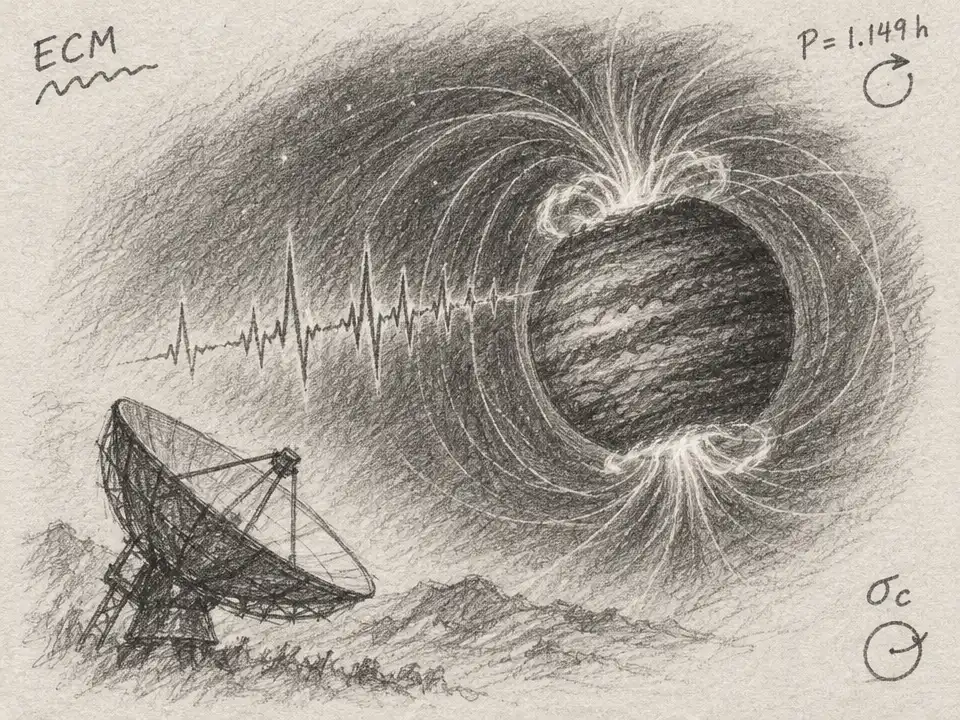
Follow-up observations with MeerKAT revealed the rhythm hidden in the intermittent flashes. Their strongest repeating pattern came every 1.149 ± 0.002 hr. The researchers interpret this radio period as the dwarf’s rotation: as it spins, a narrow beam of radio waves sweeps past Earth, much like a lighthouse beam crossing a dark shoreline. The pulses were broadband, appearing across a range of radio frequencies rather than at one narrow slice.
But the pulse pattern had a twist. In most known ultracool dwarfs with periodic radio bursts, the circular polarization fraction exceeds 50 percent. In the MeerKAT observations of this brown dwarf, it was typically about 20 percent. Earlier ASKAP observations also showed that the fraction could vary. More startling, one MeerKAT burst changed polarization direction between its two main peaks: one peak had negative Stokes V, while the second had positive Stokes V. A weaker hint of a similar reversal appeared in older ASKAP data, but those measurements were noisy.
That weak polarization might seem to argue against an aurora-like source. Other measurements pointed the other way. Even when the team assumed an unusually large emitting region—up to three times the dwarf’s radius—the radio brightness temperature exceeded 10¹¹ K. That is above the expected limit for ordinary gyrosynchrotron emission, a process involving many energetic electrons radiating together. The bursts were also narrow and repeated with a stable period. Taken together, those clues strongly favor electron cyclotron maser emission, or ECME: a coherent process that can produce intense, beamed radio waves in a magnetic field.
So how could a likely auroral signal lose much of its characteristic polarization on the way to Earth? The researchers suggest that the radio waves may pass through a complicated, structured plasma around the dwarf. In that environment, two wave modes with opposite circular polarization can mix. Their contributions then partly cancel, leaving a weaker net twist in the signal. The idea is plausible, not proven. The team also cannot explain the reversal within that single burst with its simple magnetic-field model.
One possibility is that the wave crossed a region where the direction of the magnetic field along our line of sight changed, such as near a magnetic equator or current sheet. The paper’s estimates suggest that a reversal could require a temporary change in the plasma’s density structure. Another possibility is that this unusual burst came from a different, short-lived emitting region. A single active magnetic field line can reproduce much of the observed pulse shape, but not the polarization flip; several active field lines or a more complex auroral structure might be needed.
The observations also offer a rough magnetic clue. The radio emission cuts off near 1.3 GHz, which the researchers use to estimate a minimum magnetic field strength of 0.46 kG in the emitting region. That estimate depends on how the emission is produced and whether the cutoff reflects the field itself; absorption or plasma conditions could also limit what escapes. The number is therefore a guide, not a complete map of the dwarf’s magnetic surroundings.
What makes the discovery especially useful is how it was found. Many searches for radio-active brown dwarfs favor signals with strong circular polarization—a sensible shortcut when that has been the usual pattern. But it may filter out objects like this one. Here, a broad survey first noticed variability without requiring the source to fit the familiar polarization profile. The result does not show how many such dwarfs have been missed; the known sample is small. It does show that an aurora can announce itself in an unexpected accent: a bright, repeating burst whose polarization has been blurred, or even briefly reversed, before it reaches us.