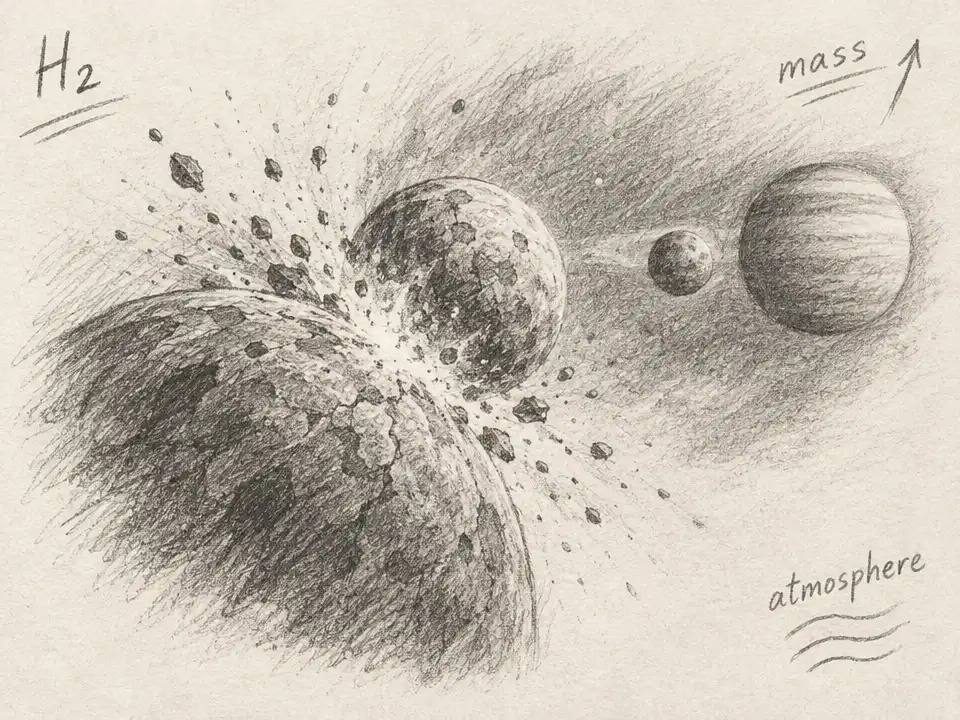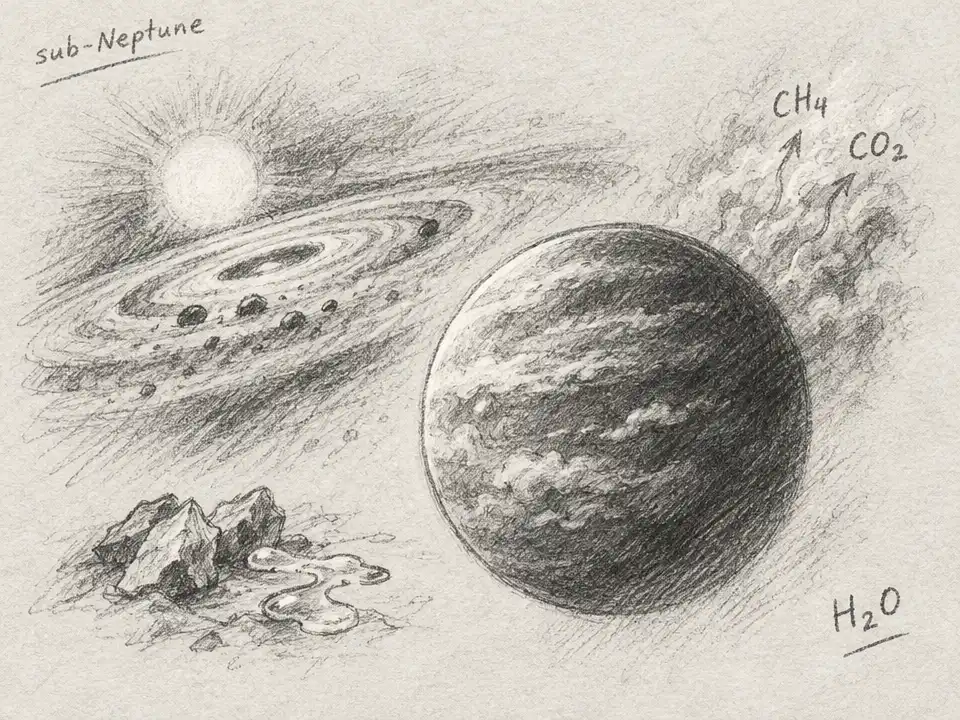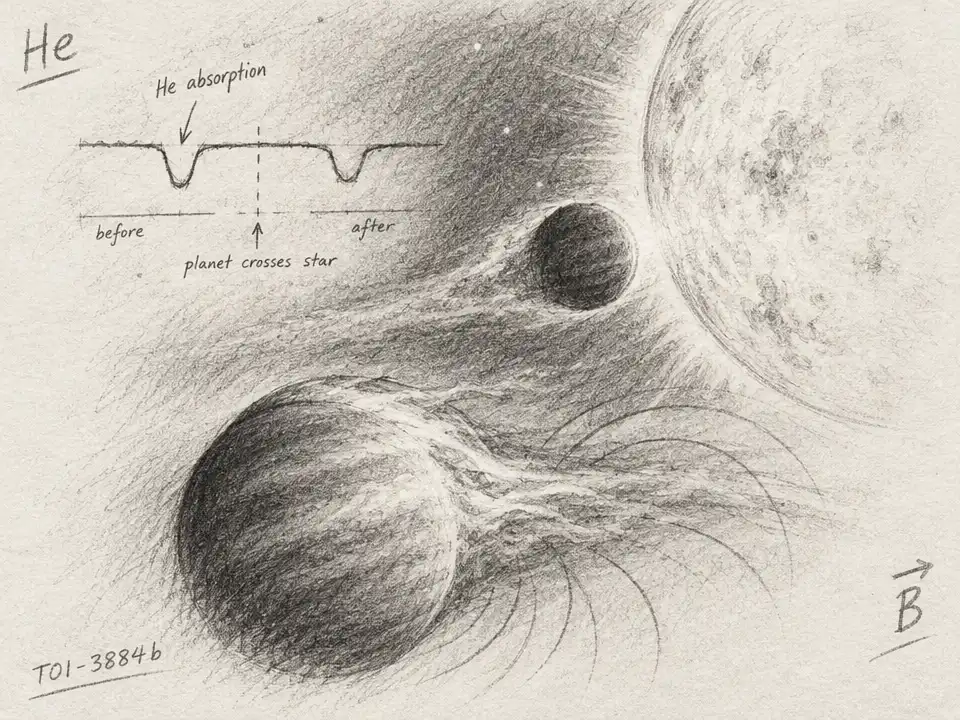
To catch a planet losing its atmosphere, astronomers often look for a shadow that is larger than the planet itself. At TOI-3884b, the clue arrived in the light of helium—and in an unexpected place: before the planet crossed its star. The signal hints that the gas escaping from this super-Neptune may be shaped not just by heat, but by a magnetic connection to its star.
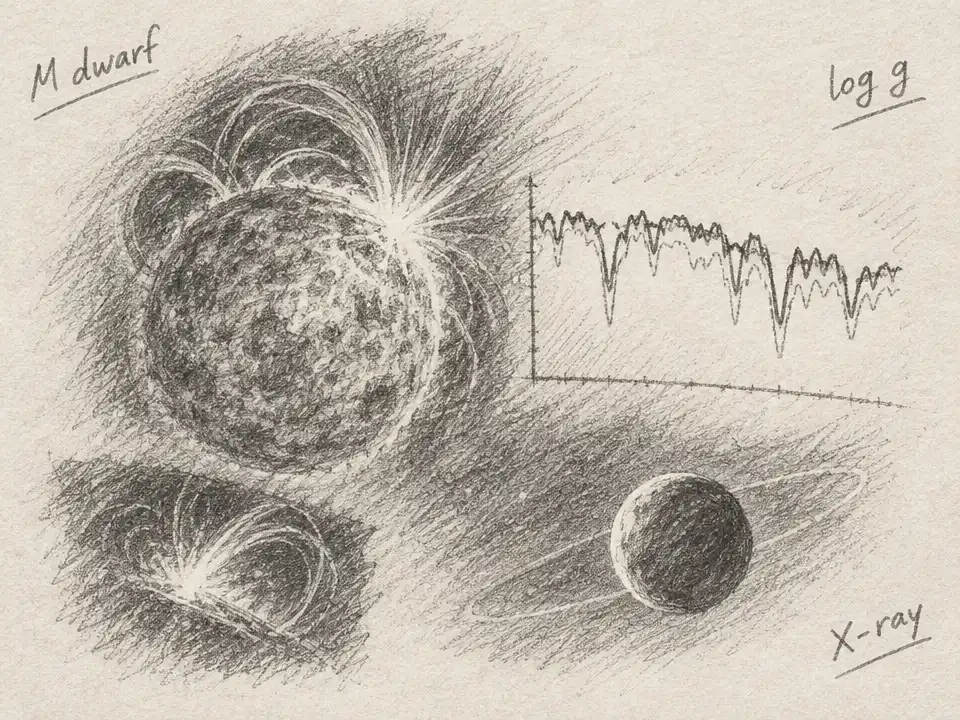
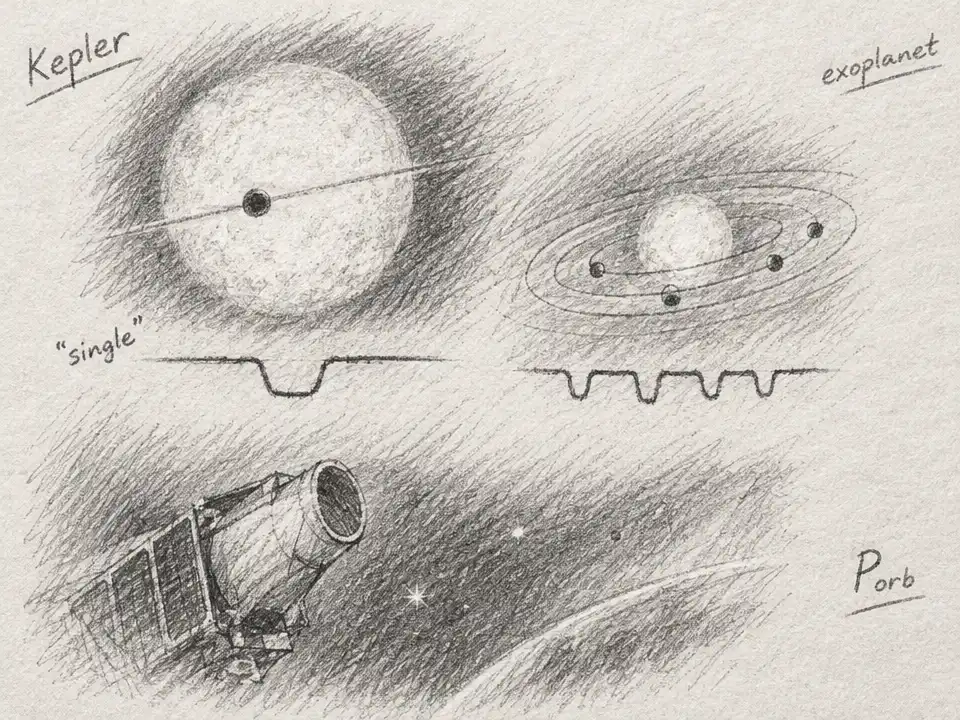
The planet circles an active M4 dwarf, a small, cool star, at a distance of 0.0361 ± 0.0008 au. It is unusually puffy for its mass, making atmospheric escape a plausible part of its story. In a study posted on October 22, 2026, researchers tracked five of its transits with the Habitable Zone Planet Finder, a near-infrared spectrograph on the 10-meter Hobby-Eberly Telescope in Texas. They gathered 49 spectra during the transits and compared them with observations taken outside them.
The target was a narrow helium feature at 10830 Å. A planet’s atmosphere can absorb starlight at this wavelength when helium atoms occupy a particular energized state. Those atoms are difficult to see in a planet’s ordinary atmosphere, but stellar ultraviolet and X-ray radiation can help create them as atmospheric gas escapes. The helium line therefore offers a way to trace a thin, extended exosphere that might otherwise be nearly invisible.
Across the five transits, the helium absorption corresponded to an excess transit depth of 6.8 ± 0.27%. In other words, at this particular wavelength, the absorbing material blocked considerably more starlight than the planet’s solid outline alone would. A simple, one-dimensional model of a flowing atmosphere translated the in-transit helium signal into an estimated mass-loss rate of about 1–4 × 10¹⁰ grams per second, for modeled upper-atmosphere temperatures of 4,000–6,000 K. That estimate depends on the model’s assumptions; it is not a direct measurement of the planet’s total atmospheric loss.
Then came the stranger part. In two observing sessions, helium absorption appeared before the planet began its ordinary optical transit. The researchers estimate that the leading signal begins about 0.25 days ahead of the transit. They found no comparable helium signature afterward—the familiar-looking trail that might follow a planet as gas streams behind it. The result is an asymmetric outline: material ahead of the planet, but no clearly detected tail behind.
That shape matters because different escape processes can leave different patterns. Heating from inside the planet is expected to drive a more symmetric outflow. By contrast, intense stellar radiation can heat and push gas outward, potentially making escape lopsided. The missing post-transit signal, alongside the pre-transit absorption, therefore favors irradiation-driven loss over a purely core-powered wind. It does not, by itself, identify exactly how the gas is being carried away.
The star’s magnetic field offers one possibility. The team measured an average surface field of 1.40 kG, then estimated how a large-scale magnetic field might weaken with distance. Under assumptions about the surrounding stellar wind, their calculation places the planet in a region where the star’s magnetic influence could dominate the wind’s flow. In that setting, magnetic field lines might act like channels, steering escaping gas toward the star and producing a leading stream. Because the planet’s orbit is nearly polar, the geometry could also help explain why the signal appears before transit but fades afterward.
It is an intriguing route from a faint line in a spectrum to a possible map of a magnetic interaction—but several links in that chain remain untested. The mass-loss estimate comes from a one-dimensional wind model, which cannot reproduce the observed pre-transit shape. The proposed magnetic channel has not yet been demonstrated with a full simulation of the star, planet, magnetic fields, and escaping gas. The team also had to estimate the high-energy radiation bathing the planet using observations of another active M4 star, because the radiation from TOI-3884 itself is not fully known.
The star adds another complication. It has a persistent spot near the region the planet crosses. Such active regions can alter a star’s helium spectrum and potentially imitate part of a planetary transit signal. The researchers argue that stellar contamination alone cannot explain the separate pre-transit absorption, but they cannot rule out some effect on the measured in-transit signal or its variation from one transit to another. More observations are needed to tell whether those changes come from the planet’s changing outflow, the spotted star, or both.
That uncertainty is also the opportunity. If astronomers can repeatedly measure where helium appears before, during, and after transit—and compare the changing shape with better measurements of the star’s activity—they could turn escaping atmospheres into probes of star–planet magnetic environments. The payoff would be more than a sharper picture of one unusual planet: it could help explain how irradiation strips atmospheres from planets around small stars, and why some worlds retain the gases that others lose.
For now, TOI-3884b offers a compelling clue, not a finished magnetic portrait. Its helium signal reaches ahead of the planet like a weather vane pointing into an unseen flow. Reading that direction may require better spectra, more transit coverage, and models that can follow the gas in three dimensions. The frontier is there in the light; the price of reaching it is learning to separate the planet’s faint breath from the restless star behind it.