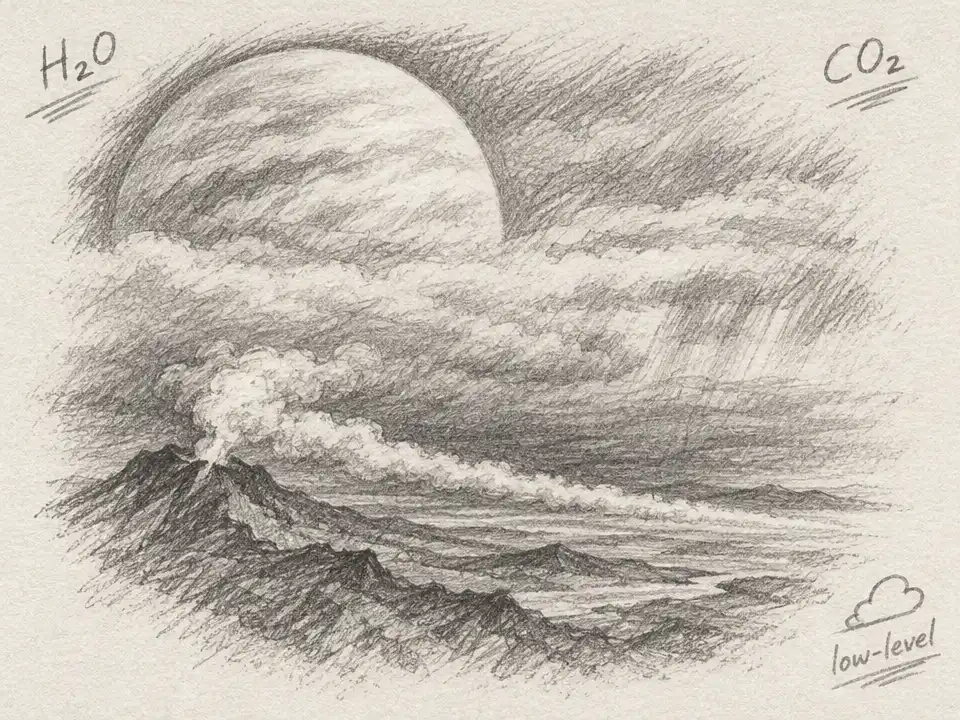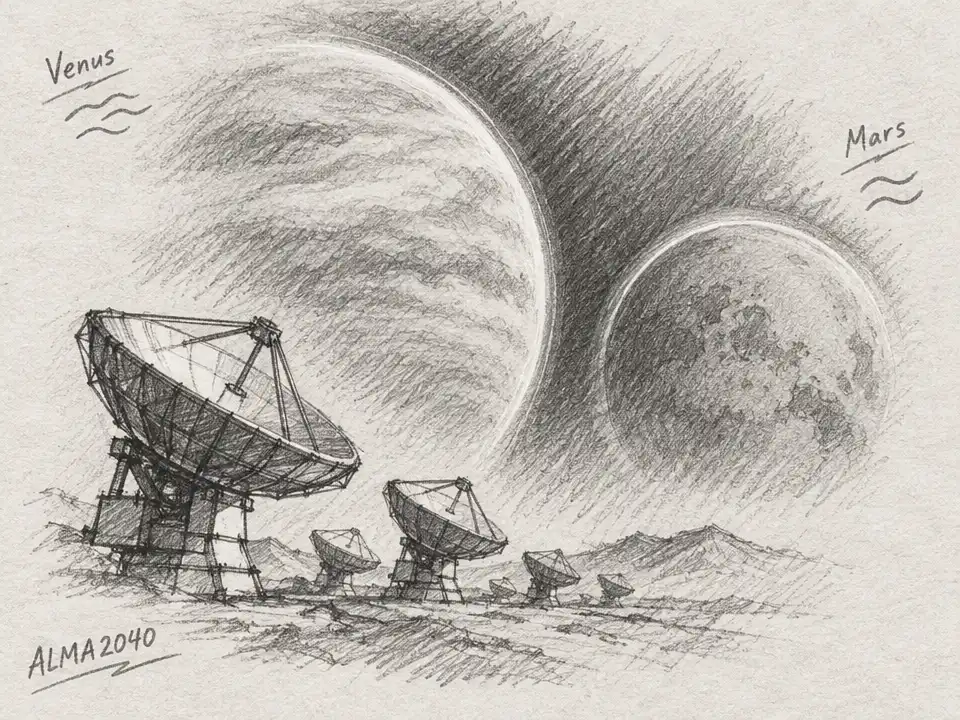
Venus and Mars are close enough to study, yet their atmospheres still hold secrets that spacecraft glimpses have not settled. How do winds shift with altitude? What happens to Mars’s circulation during a planet-wide dust storm? And how do Venus’s clouds and sulfur chemistry change over time? A new vision for a much more capable radio telescope proposes a way to keep asking: watch the planets from Earth, layer by layer, and return to them again and again.
The idea is called ALMA2040, a proposed future expansion of the Atacama Large Millimeter/submillimeter Array in Chile. Its researchers imagine resolving atmospheric structures only a few kilometers tall, even across planets tens of millions of miles away. This is a proposal, not an approved observatory or a set of observations already made. The ambition is to give ground-based astronomy a task usually associated with spacecraft: sounding the thin rim of a planetary atmosphere.
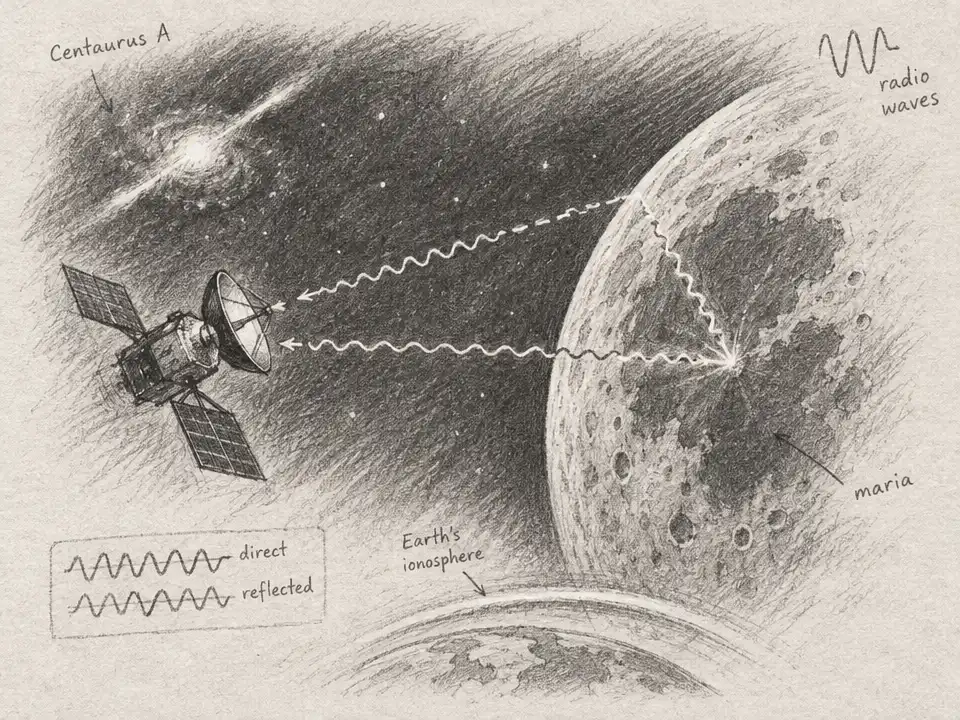
The trick is to look not down at a planet, but across its edge. When a radio telescope points at the bright disk, the signal from the atmosphere is faint against the planet’s surface and lower air. At the limb—the visible outline—the telescope’s view passes sideways through a long stretch of gas. Molecules leave fingerprints in the radio waves, and the shape and shift of those signals can reveal what the gas is doing.
Think of the limb as a stack of translucent curtains. Move the telescope’s view slightly up or down, and the path through the atmosphere changes. With sufficiently fine resolution, each position samples a different altitude. The ALMA2040 study estimates that an angular resolution of about 0.01″ could distinguish scales comparable to the atmosphere’s characteristic vertical thickness: around 5 km on Venus and 11 km on Mars.
The ambition rests on a real technique, though the crucial new capability is still prospective. In computer simulations included in the proposal, a Martian molecule called HO2 produces a much stronger signal when viewed at the limb than against the disk: about 20 K rather than 0.15 K. That comparison assumes the telescope’s beam has not blurred the signal, so it is not a predicted detection in actual observations. It illustrates why looking along the atmosphere can help reveal a trace gas that would be difficult to spot head-on.
Fine spectral measurements could also turn those molecular traces into a weather map. A molecule’s radio line shifts slightly when the gas moves toward or away from us. Read those shifts at different positions around a planet’s edge, and astronomers could infer winds at different heights. On Venus, that could test how circulation works high above the cloud tops, where fast, planet-spanning winds interact with day-to-night flows and atmospheric waves. The proposal identifies this upper circulation as a place where important details remain uncertain.
Mars presents a different challenge: its global dust storms can heat the atmosphere and reorganize circulation, while the dust that blocks some visible and infrared views has less effect on submillimeter observations. Repeated measurements could follow how winds and temperatures respond at different heights, rather than catching a single atmospheric snapshot. The study also points to a way to track the history of water. Comparing ordinary water with a heavier form containing deuterium could help researchers investigate how water has escaped from the planets over time.
That repeatability is the vision’s central promise. Spacecraft can get close, but their schedules, trajectories, instruments, and operations limit how often they can return to a particular place and altitude. A 2026 paper describing the operations of the Juice spacecraft’s submillimeter instrument offers a glimpse of the logistics behind such work: during its 2024 Earth-and-Moon flyby, the team completed 166 of 225 planned observations, and an instrument safe-mode event interrupted some of the remaining plans. The flyby was an operational test, not a direct comparison with ALMA2040, but it shows why observations from Earth could usefully fill the long intervals between spacecraft encounters.
Ground-based monitoring would not replace a probe. A spacecraft can sample a local environment directly and make measurements unavailable from Earth. Instead, the proposed array could provide the long view: revisiting a planet across seasons, local times, and changing solar activity, then setting those observations beside spacecraft measurements. A rover or orbiter might record what the atmosphere was doing during its brief visit; an observatory could help show whether that moment was typical, seasonal, or part of a longer change.
The price is formidable engineering. The telescope must sharpen its view enough to separate atmospheric layers, but still capture the broad, faint glow extending around the planets. Interferometers can lose sight of large structures when they lack measurements from short distances between antennas—a limitation called spatial filtering. The proposal says the desired observations would span a wider range of scales than current ALMA configurations readily recover. Possible fixes include adding a second, more compact array or combining the interferometer’s data with measurements from a large single-dish telescope.
And a sharp image alone will not do. The important molecular lines appear at different radio frequencies, so researchers would need high sensitivity, careful calibration, and fine resolution across multiple bands. Today, ALMA can achieve the proposed angular sharpness only in restricted configurations and conditions; the frontier is making that performance routinely available, not merely reaching it once.
If those pieces come together, Earth’s two nearest planetary contrasts could become laboratories for watching atmospheres evolve. The payoff would reach beyond our neighborhood: Venus and Mars provide real worlds against which astronomers can test ideas about rocky planets elsewhere. But the route to that view runs through a difficult trade-off: see details as fine as a mountain range, without losing the broad atmospheric pattern surrounding the whole planet.