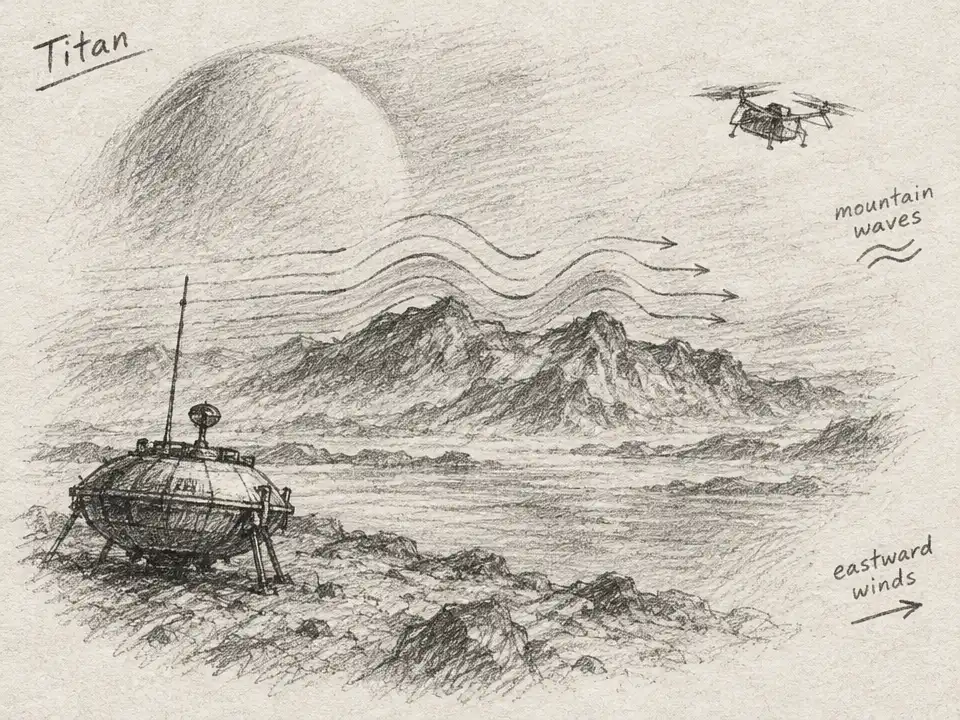
When the Huygens probe descended through Titan’s orange haze in January 2005, it found a puzzle close to the ground. Winds in the lowest kilometer blew eastward. Higher up, between roughly 1 and 5 kilometers, they turned westward. That was almost the reverse of the broad pattern expected from models of Titan’s atmosphere, which generally predicted westward winds near the equator’s surface.
A new study suggests the mismatch may not mean the probe caught Titan’s global circulation doing something impossible. It may have sampled a local weather pattern, shaped by terrain. The idea brings a familiar tool from Earth’s atmospheric science—how winds interact with mountains—into a stubborn question about weather on Saturn’s largest moon.
On Earth, air flowing across a ridge can be pushed upward and set oscillating, much like water rippling downstream of a rock. The resulting atmospheric waves can alter winds well beyond the slope that started them. Titan’s landscape is not simply a collection of sharp mountain peaks, and the study does not claim to have identified a particular ridge beneath Huygens. Instead, it tests whether broad, mapped variations in the moon’s surface can organize persistent wind patterns that a global average would conceal.
The team ran paired three-dimensional simulations with the Titan Atmospheric Model: one included Titan’s reconstructed topography, and the other replaced it with a flat surface. In both, the researchers focused on conditions around the season and location of Huygens’s descent. The model had 50 atmospheric levels, with fine vertical spacing in the lowest few kilometers—the layer where the surprising wind reversal appeared.
The contrast mattered. In the flat-surface run, near-surface winds remained westward through the lowest 5 kilometers. Add topography, and the simulated winds near Huygens changed direction with height: eastward below about 1 kilometer, westward above, and with stronger westward flow around 3 to 4 kilometers. The modeled profile also returned to eastward flow near 5 kilometers. Those changes reproduce key features of the probe’s observations, though not every aspect of the full wind profile.
To understand the pattern, the researchers separated the simulated wind anomalies into broad structures that circle Titan. Think of these as different-sized atmospheric arrangements: a wave pattern that wraps around the moon once, another that repeats four times, and weaker patterns in between. In the study’s notation, these are called zonal wavenumbers 1 through 4.
The largest-scale pattern, wavenumber 1, supplied the strongest eastward push through roughly the lowest 2 kilometers near Huygens. Its motion was mostly rotational: a broad circulation, with the landing site on the edge of a gyre. The shorter, four-part pattern, wavenumber 4, worked against that eastward anomaly near the surface. It was locally dominated by divergent motion—air moving outward or inward—and showed features consistent with a gravity-wave-like response. Smaller wavenumbers 2 and 3 also added eastward flow close to the ground.
The result is less like one gust reversing a steady wind than several overlapping patterns adding and subtracting at different heights. The terrain-locked waves alter the wind at Huygens’s particular longitude; the underlying, averaged circulation still points westward near the surface. In other words, a single descent can sample a local exception without overturning the larger atmospheric picture.
That distinction is the crossover at the heart of the work. Planetary scientists bring the puzzle—a probe’s measurements that disagree with the expected global circulation. Atmospheric dynamics supplies a way to investigate it: compare otherwise identical simulations, isolate the terrain-linked disturbances, and track how their structure changes with height. The researchers also checked whether the simulated patterns stayed aligned in phase with the modeled terrain forcing. That consistency supports a topographic origin, although it does not by itself settle every detail of how the waves behave.
The interpretation is deliberately uneven in confidence. The four-part pattern has several clues associated with a gravity wave, including a changing phase with altitude and wind-and-temperature relationships broadly consistent with wave dynamics. But the model suggests its upward propagation is possible only in a limited layer, about 2 to 4 kilometers high. Near its source and higher up, conditions inhibit propagation; the disturbance may pass through that restricted region in a way the study describes as “tunneling.” Its eventual weakening could involve dissipation, absorption, or interference, and the simulations do not determine which.
The bigger, one-part pattern is more mysterious. The analysis identifies it as a terrain-forced rotational response, but its diagnostics do not support confidently labeling it a familiar freely traveling Rossby wave or a vertically propagating inertia–gravity wave. The authors leave its underlying mechanism open. That restraint matters: the simulations offer a plausible explanation for the observed profile, not a definitive reconstruction of every wind Huygens encountered.
There are other limits. Titan’s global terrain map includes regions where elevations had to be estimated between measurements. The model’s horizontal grid is roughly 100 kilometers across, too coarse to resolve individual ridges, valleys, or smaller-scale waves. And to isolate the effect of terrain, the simulations used a dry atmosphere: they left out methane’s weather, clouds, and moist convection. Those processes could change the atmosphere’s temperature structure and winds, so a model that includes them will be needed to test how robust this explanation is.
The study also offers a cautious preview of Dragonfly, the planned rotorcraft mission to Titan. Near its landing site, the model produces similar but weaker terrain-linked patterns. Topography nudges the near-surface winds toward eastward, though their seasonal average stays close to zero. Because Dragonfly’s planned site is only about 680 kilometers from Huygens’s—and the model resolves the region with only a few grid cells—the results are broad expectations, not a forecast of local gusts.
When Dragonfly measures Titan’s atmosphere, scientists will be able to ask whether the wind changes stay anchored to the landscape, as these stationary patterns should, or travel across it like transient disturbances. That future comparison could sharpen a lesson already emerging from Huygens: on another world, the wind above one patch of ground may tell a different story from the wind averaged around an entire moon.