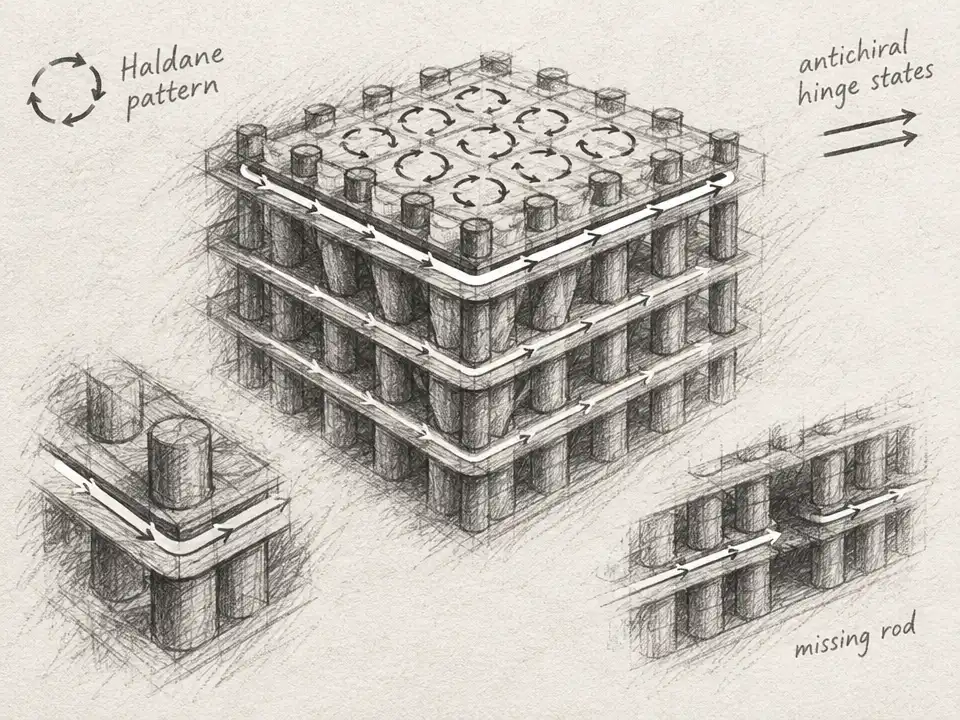
Imagine a rectangular block with four long corners. Send a microwave through the structure, and you might expect the wave to travel one way along one corner, then the opposite way along the parallel corner across from it. That is the familiar pattern for waves confined to the edges of many topological systems. But in a new three-dimensional photonic crystal, the researchers found a stranger arrangement: waves traveled in the same direction along parallel hinges.
The puzzle is not just why the waves choose a direction. It is how two separated boundaries can both carry traffic the same way without breaking the usual accounting of motion. Ziyao Wang, Tianzhi Xia, Han-Rong Xia, and Zhen Gao report an experimental answer in a microwave structure built from magnetic materials. Their result is the first experimental observation of what physicists call antichiral hinge states.
First, the vocabulary. A hinge is the line where two surfaces meet—like the corner seam on a box. A topological wave is one whose behavior is tied to the overall pattern of the system’s allowed wave states, rather than to a tiny local detail. In an ordinary chiral arrangement, waves on parallel boundaries run in opposite directions. In an antichiral one, they run together. The name sounds like a contradiction; the route to understanding it lies partly inside the crystal, not just along its edges.
Earlier antichiral models showed how the apparent contradiction can be resolved: the same-way boundary modes can be balanced by counter-propagating modes in the bulk. The boundaries do not have to carry every mode by themselves. In the new crystal, the bulk’s band structure includes nodal lines and nodal surfaces—places in momentum space where bands meet. Those features provide a different landscape from a simple, completely gapped interior. The hinge waves occupy a specific region of that landscape rather than floating alone in an empty gap.
The team’s design combines two ingredients. Within each layer, a modified version of the Haldane model creates antichiral edge behavior. Then the researchers stack the layers with alternating, or dimerized, connections. That second pattern is similar to the arrangement in a well-known one-dimensional model that can produce states at the ends of a chain. In the three-dimensional structure, the combination turns edge behavior in a layer into waves concentrated at hinges of the full crystal.
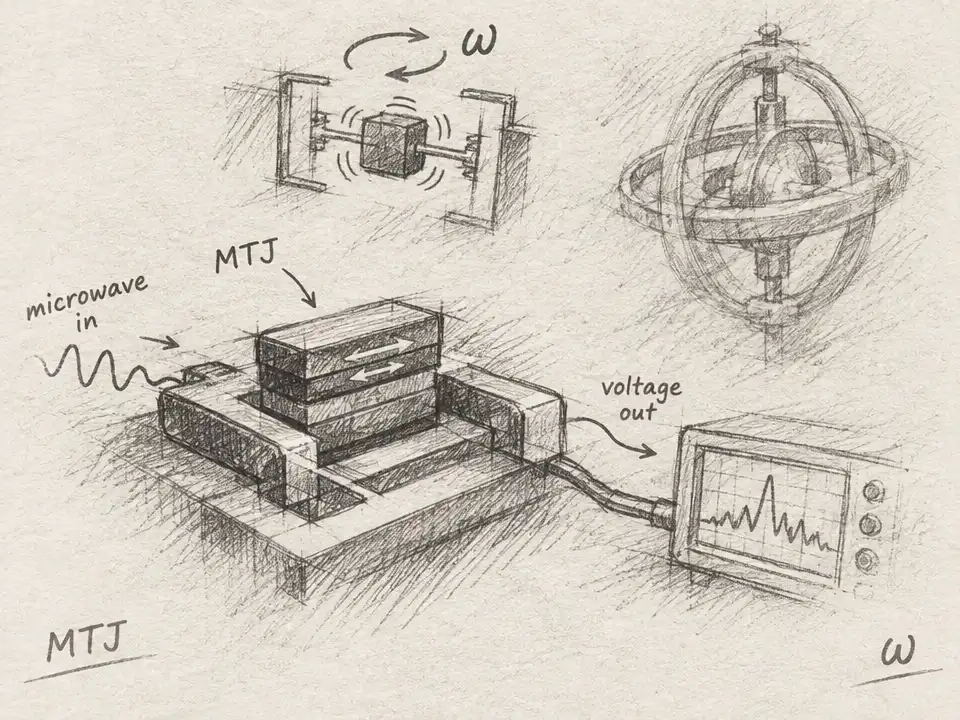
That explanation gives a useful clue, but a model alone cannot show that the real structure behaves as predicted. The researchers built a photonic crystal from yttrium iron garnet rods, a magnetic material, arranged in a three-dimensional honeycomb pattern. Permanent magnets set neighboring groups of rods in opposite magnetic directions. Carefully shaped perforated metal plates control how the layers connect. In the theoretical analysis, the team also calculated a topological quantity that takes a half-integer value across the same momentum range where the hinge states appear. That match links the predicted hinge waves to the structure’s band topology.
Then came the measurement. The fabricated sample contained 20 × 4 × 5 unit cells along its three directions. The researchers placed a microwave source at a hinge and used a probe antenna to map the electric field inside the structure, point by point. On the two top parallel hinges, they measured transmission both along and against the favored direction. In the frequency range assigned to the hinge states, forward transmission was substantially stronger than backward transmission on both paths.
A bright streak in a field map might still have a less exotic explanation: perhaps a resonance or an accidental feature of the sample. So the team checked not only where the fields appeared, but how they changed along the structure. They transformed the measured field patterns into momentum space and reconstructed the waves’ dispersion—the relationship between their frequency and motion. The two hinge paths showed tilted dispersions with positive group velocity, matching simulations. In plainer language, the waves were moving forward along both hinges, not merely lighting them up.
The final clue was a deliberate obstacle. The researchers built samples with a sharp corner and with a structural defect made by removing a yttrium iron garnet rod and its paired magnets. In both simulations and microwave measurements, the hinge waves navigated the corner and circumvented the missing piece with negligible attenuation. Within those tested conditions, the waves showed no discernible backscattering.
The answer, then, is not that the crystal somehow abolishes the need for oppositely moving modes. It creates a topological setting where several pieces fit together: magnetic patterning makes the in-layer edge states antichiral; alternating connections between layers confine their descendants to hinges; and the surrounding bands supply the wider structure in which those modes exist. The team’s measurements turn that design into a visible, testable route for waves.
There are limits to what the result means. These are microwave photons traveling through a purpose-built photonic crystal, not electrons carrying current through an ordinary material or a ready-made communications device. The reported corner and missing-rod tests are specific demonstrations, not proof that every disturbance would leave the waves untouched. Still, the experiment adds a new piece to the topological-wave puzzle: in three dimensions, even four parallel corners can guide light together in one direction.