Look at the Sun through a spectrograph and its light breaks into a barcode: narrow dark lines cut through a bright rainbow. Each line is a clue to atoms and molecules in the solar atmosphere. But follow that barcode toward the Sun’s edge, and some of its dark marks do something startling. They brighten. In a new set of observations, many lines turned from absorption into emission before they crossed the visible edge of the disk.
The change is not a sign that the Sun suddenly made new elements or switched off its usual chemistry. It is a trick of perspective with real scientific value: as the view skims the Sun’s outer layers, the background light changes, and features that looked dark against the disk can stand out as bright. The result offers a detailed new look at the transition between the Sun’s visible surface and its more extended atmosphere.
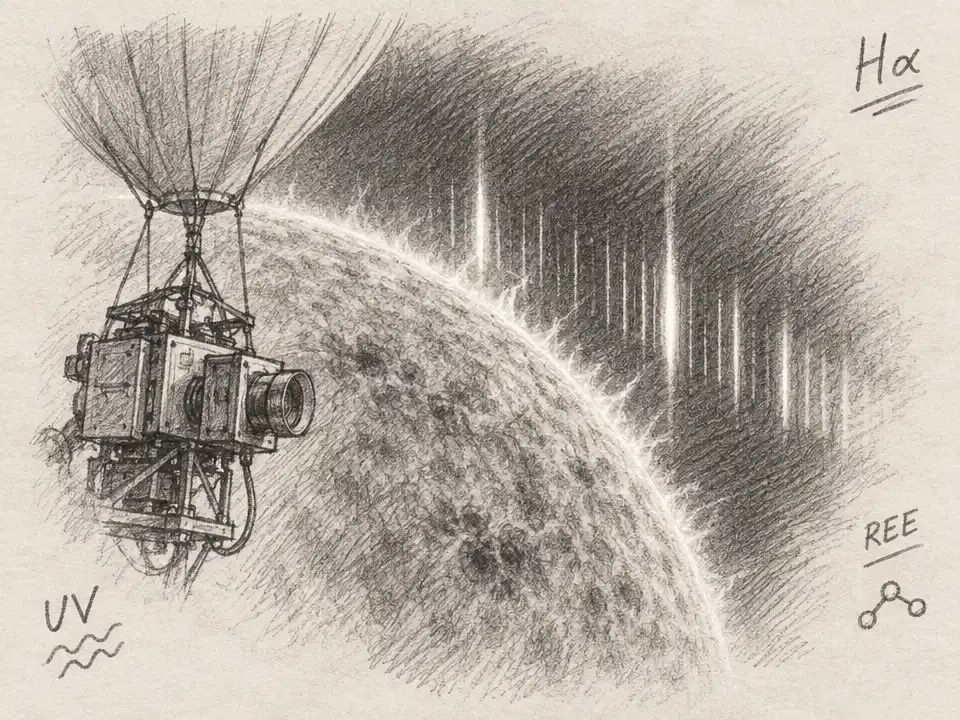
The observations came from Sunrise III, a one-meter solar telescope carried on a balloon high into the stratosphere, above much of the blurring and scattered light that trouble ground-based observations. On July 16, 2024, its ultraviolet spectropolarimeter scanned a strip of the Sun from just inside the edge, across the limb, and outward into space. The team examined a narrow violet slice of the spectrum, between 407.6 and 410.25 nanometers.
That sliver held more than a simple pattern of familiar iron lines. The researchers identified 199 spectral lines across the on-disk and off-disk views, associated with 41 elements or molecular species. Outside the solar limb, 174 lines appeared in emission—a 2.5-fold increase over earlier reports in the same wavelength range. The surprise was where many of those lines began to glow: 122 were already in emission while the telescope was still looking at the disk, close to its edge.
To understand why, picture the Sun’s atmosphere as a layered landscape seen through a shifting window. Near the center of the disk, bright light from deeper layers travels toward us through gas above it. At particular wavelengths, atoms and molecules in that gas absorb some of the light, leaving dark lines in the spectrum. Near the limb, the viewing angle changes: the sightline passes through the atmosphere at a slant, while the bright background from deeper layers fades sharply. A line that was hard to distinguish against that background can become brighter than its surroundings. The atoms have not changed; the balance between the line and the background has.
The study tracks that change line by line. Most of the lines reached their brightest emission less than 0.5 megameters above the limb. Their behavior was not uniform: for many, weaker absorption lines began glowing and peaked closer to the edge than stronger ones. The strong strontium line and hydrogen’s H-delta line did not follow that general pattern. H-delta, in particular, remained visible much higher, beyond 5 megameters, hinting at the extended structures where it forms.
Some of the most unexpected marks came from elements that are easy to overlook in ordinary disk observations. Lines attributed to hafnium and gadolinium were barely visible on the disk, yet appeared in emission up to 800 kilometers above the limb. A molecular line from CH was visible in emission up to 400 kilometers. The team also identified lines from other heavy and rare-earth elements, as well as from the molecules CH and CN. These are not claims that the Sun is unusually rich in exotic material: spectroscopy reveals which transitions show up in this particular view, not a sudden change in the Sun’s inventory.
There are limits to what the barcode can say. Thirty-four of the 199 lines remained unidentified, and assigning elements to faint or blended lines can be difficult. The authors note that some exotic line identifications may be misclassified. Even so, the spectra show that a familiar patch of the Sun contains more structure than a disk-center view suggests. In 46 blends—places where neighboring lines overlap—the weaker line on the disk often became the stronger one in emission near or beyond the limb.
That reversal is useful precisely because it complicates a simple reading of the spectrum. A dark line is not just a label stamped onto the solar surface; its appearance depends on where the light comes from and how it travels through the atmosphere. With low stray light and a carefully traced path across the edge, Sunrise III let researchers watch that change unfold rather than infer it from separate snapshots. The 122 lines that brighten before leaving the disk turn the Sun’s boundary into a kind of natural laboratory: a thin, changing strip where the atmosphere reveals itself through the light it first seemed to hide.
The result is exploratory, and the team says more detailed analysis and modeling are needed to explain the different line behaviors. But the unexpected emission forest already points to a practical payoff. Weak lines, hidden blends, and molecular features can become visible when the viewing angle changes. By learning how they brighten, solar physicists may gain new tracers of the chromosphere—the layered atmosphere above the visible surface. At the Sun’s edge, the spectrum does not simply end. It changes its story.