For a fraction of a second, a magnetar can outshine almost anything in its neighborhood. These neutron stars carry magnetic fields so intense that a giant flare can unleash a burst of hard X-rays and gamma rays, then leave astronomers watching the aftermath. One possibility has made the aftermath especially intriguing: a flare might tear material from the star’s crust and briefly turn it into a factory for heavy elements.
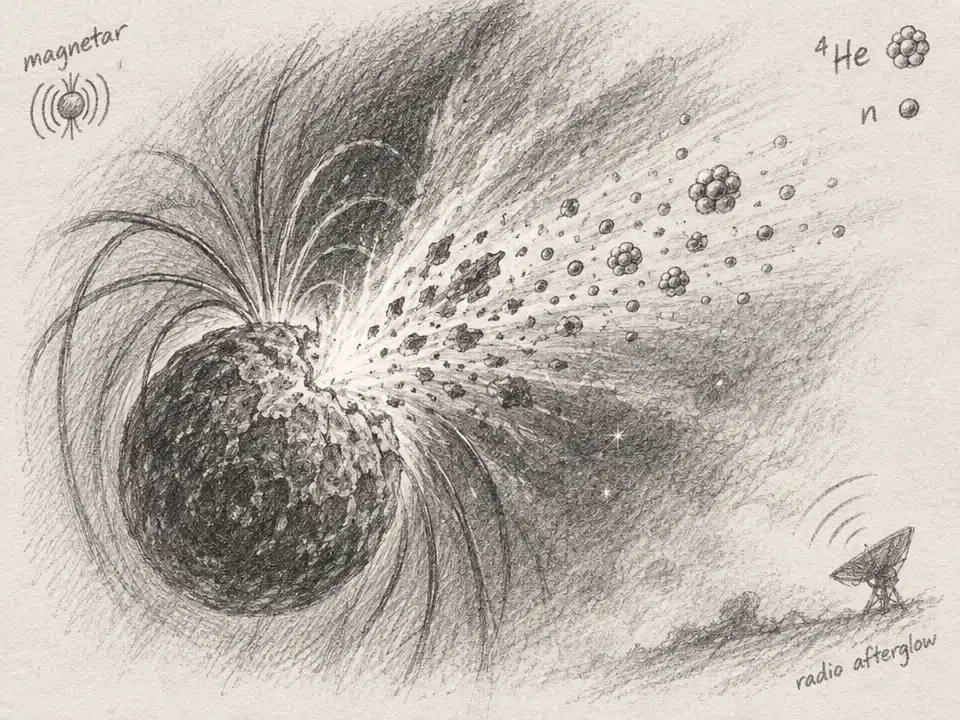
New simulations suggest that factory may be far less productive than expected. Instead of assembling a rich crop of heavy nuclei, the escaping material mostly becomes helium nuclei and free neutrons. The result does not rule out every route to heavy-element production in magnetar flares. But it sharply lowers the yield in the crust-shock scenario—and points to a different ingredient as the likely source of any brief glow from the debris.
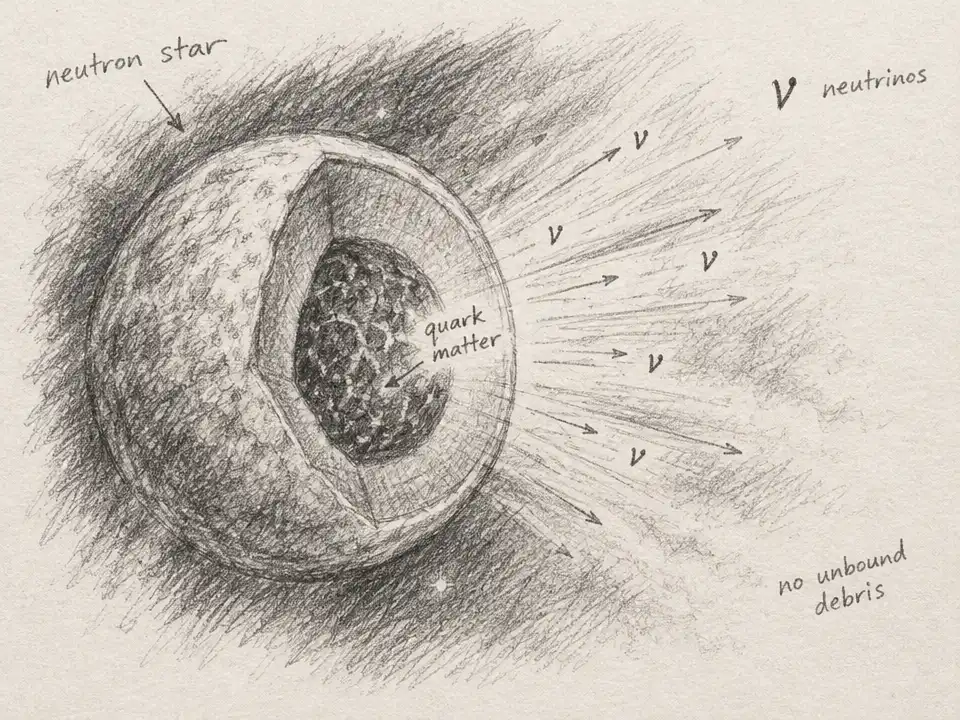
A magnetar is a neutron star, the compact remnant of a massive star, powered in part by the decay of its extraordinarily strong magnetic field. Its outer crust is packed with dense matter. In one proposed flare mechanism, a layer of hot particles and radiation presses down on that crust, launching a shock through it. When the pressure drops, the shock-heated surface material can surge outward and escape.
The idea seemed to connect several clues. Radio observations following the giant flare from SGR 1806-20 in 2004 suggested that matter had been flung into space. And hot, rapidly expanding, neutron-rich debris can sometimes forge heavy elements through the r-process, a chain of nuclear reactions in which atomic nuclei capture neutrons. Earlier calculations suggested magnetar ejecta might make enough of these nuclei to power a short-lived flare of their own.
To test what happens inside the crust, Tetyana Pitik, David Radice, Jacob Fields and Yi Qiu ran simulations that follow the shock, the star’s gravity, neutrino interactions and nuclear reactions. They modeled flare pressures corresponding to magnetic fields from 1015 to 1016.5 G. For each scenario, they tracked the material as the shock heated it, lifted it from the surface and sent it outward.
The shock does not simply blast the crust away. It drives inward, slows in denser layers and weakens as the flare’s pressure fades. The material that finally escapes comes from only the outermost 50–110 m of crust in the models. Much of the crust pushed by the shock remains bound and falls back. Across the simulated cases, the unbound mass ranges from 10−10 to 5 × 10⁻⁸ solar masses, with the escaping material moving at about half the speed of light.
Then comes the surprise. Even though the escaping matter retains a modest neutron excess, it expands and cools so quickly that there is little time to build the first small nuclei that would serve as starting points for further neutron capture. A key seed-building reaction needs three particles to meet, so its rate drops steeply as the gas thins. The neutrons are left with few nuclei to join.
About 90 percent of the ejected mass ends up as helium nuclei. Most of the remaining neutron excess stays in free neutrons. In the strongest simulated flare, nuclei with mass number 90 or greater account for at most about 8 × 10⁻⁴ of the ejected material, or 3.5 × 10⁻¹¹ solar masses. The researchers estimate that this heavy-element yield is three to four orders of magnitude below an earlier model’s prediction. The heaviest groups, including lanthanides and actinides, make up even less.
The difference is not simply a matter of turning the simulated flare up or down. Earlier calculations used an analytic picture that allowed deeper, denser, cooler crust to escape. In the new simulations, the flare’s pressure falls within roughly 10 microseconds; the shock weakens before it can unbind those deeper layers. The escaping material is hotter, more dilute and faster-expanding—the wrong combination for efficiently assembling heavy nuclei.
That distinction matters because the proposed glow from magnetar ejecta need not be powered by heavy elements. The simulations leave 7–10 percent of the ejecta as free neutrons. As those neutrons decay, they could heat the debris and produce a short optical and ultraviolet transient. For one of the modeled cases, the authors estimate a peak after about 40–55 seconds. That is a prediction from the model, not a reported detection, but it suggests a different search strategy: look for a brief glow fueled by neutron decay rather than a heavy-element-rich explosion.
The work also leaves a second problem on the table. At the energy inferred from the 2004 flare’s gamma-ray spike, the simulated crust shock ejects 50–100 times less material than the radio afterglow appears to require. Stronger modeled flares can eject enough, but they assume an energy far above what that spike indicates. So the crust shock may not explain the radio debris on its own—or the real flare may have had geometry or physics the one-dimensional simulations cannot capture.
Those limits are important. The calculations assume a spherical, whole-star flare and omit magnetic fields in the crust; the authors regard their ejecta estimates as upper limits for realistic events. A localized flare, a magnetic field that holds crust down, or sideways expansion could reduce the amount of material escaping. More detailed multidimensional simulations will be needed to test what a real, irregular flare can do.
For now, the unexpected lesson is that a spectacular stellar blast need not be a prolific forge. In this model, the ejecta’s speed outruns the nuclear assembly line: helium forms, neutrons remain largely unclaimed, and heavy elements barely register. The most revealing trace of the flare may not be a harvest of exotic atoms, but the brief heat left behind as free neutrons decay.