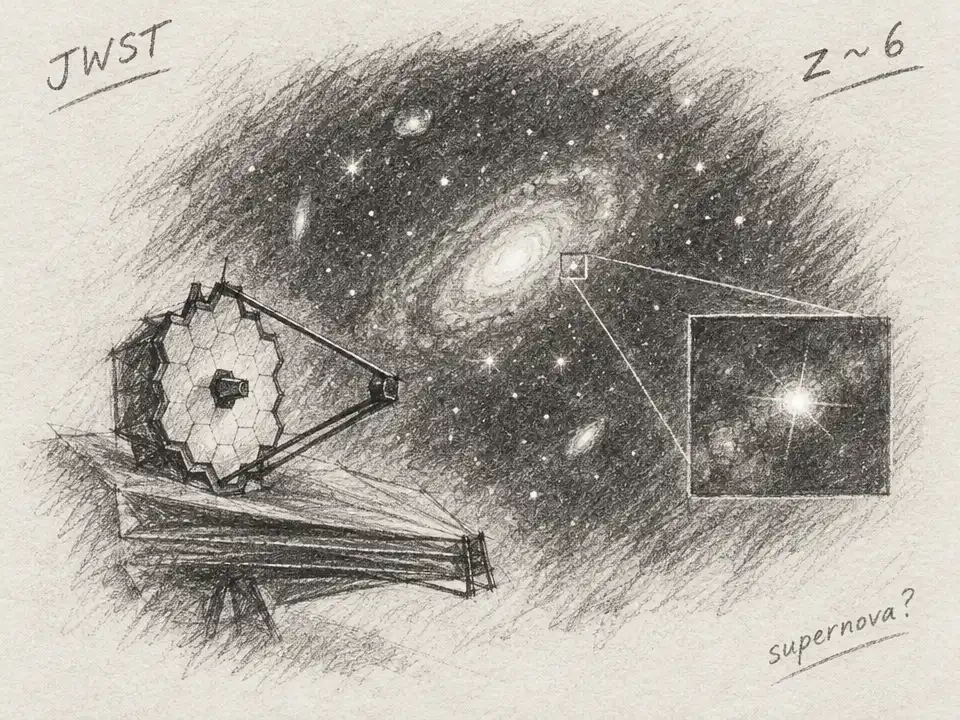
At first, the tiny red fleck in a James Webb Space Telescope image looked like a message from the universe’s earliest eras: perhaps a galaxy from when the cosmos was barely beginning to build stars. Its light vanished in the shorter-wavelength filters, then appeared in the redder ones—the classic pattern astronomers use to flag extremely distant galaxies. A fitting program gave the object a redshift near 16. There was no visible host galaxy to suggest otherwise.
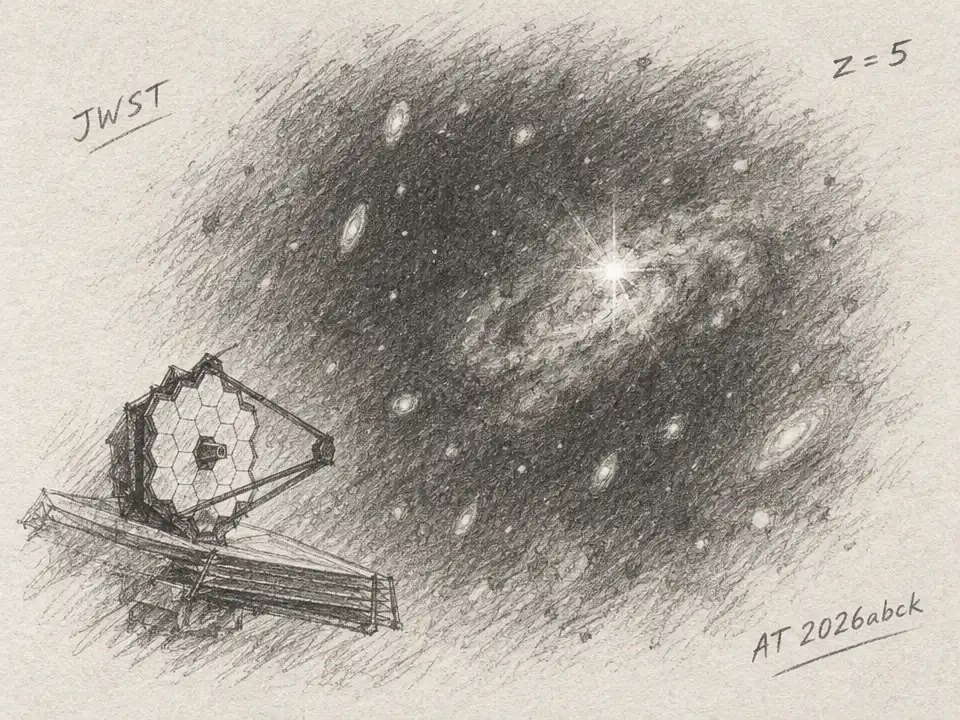
But the source had a crucial property a galaxy should not have: it changed. Once astronomers compared images taken at different times and studied a spectrum, the apparent relic of cosmic dawn turned out to be something more fleeting—a supernova at redshift 3.34, its light bent and magnified by a massive foreground galaxy cluster. The same gravitational lensing that helped reveal the explosion may send another view of it to Earth in the coming years.
The object, named SN Helios, was first picked out in James Webb images taken on July 3, 2026, behind the galaxy cluster RXC J0018.5+1626. In the image, the source was bright in several infrared bands but nearly absent in bluer ones. In particular, the light appeared to break sharply between two filters, a feature that can signal that a galaxy’s ultraviolet light has been stretched by cosmic expansion into longer wavelengths. With only that first set of colors, standard galaxy-fitting software strongly favored a source at redshift 15.8.
That interpretation did not survive new evidence. An earlier Webb image from December 15, 2024 showed no source at the same position. By August 17, 2026, the object had also faded in some filters. Those changes made a static, distant galaxy an increasingly poor explanation. Then a Webb spectrograph spread the object’s light into a detailed spectrum and revealed a broad signature of hydrogen: the telltale fingerprint of an exploding star.
The decisive feature was hydrogen-alpha, detected at a wavelength of 2.855 microns. Its shape was not a narrow, tidy spike. The line was broad, and a notch in it showed hydrogen gas absorbing light as it rushed toward us. That paired emission-and-absorption pattern, called a P-Cygni profile, is characteristic of an expanding supernova atmosphere. Together with other hydrogen and helium features, it established that Helios was a hydrogen-rich Type II supernova, not a galaxy from the universe’s first few hundred million years.
Why did the colors fool the first analysis? The explosion’s spectrum contains a break and a bright hydrogen feature that, after stretching and filtering, can imitate the signature of a much more distant galaxy. In the paper’s test, the observed supernova spectrum, when treated as if it were an ordinary galaxy, produced a sharp apparent redshift of 15.8. Even the best galaxy fit forced below redshift 7 was substantially worse. The impostor was convincing precisely because the first image captured a transient at one moment, without the time information needed to recognize it as transient.
Follow-up observations gave the team a more specific picture. Comparing Helios with well-studied nearby supernovae placed its spectrum 27.5 ± 2.8 days after its peak in the rest frame of the explosion. Its hydrogen absorption indicates gas moving toward us at about 8,800 kilometers per second. Between the two Webb epochs, the source faded in the way expected for a supernova after maximum brightness, rather than behaving like a steady galaxy. These comparisons do not make every detail of the explosion certain: the authors favor a faster-evolving nearby supernova as an analogue, and say further observations should better pin down its light curve.
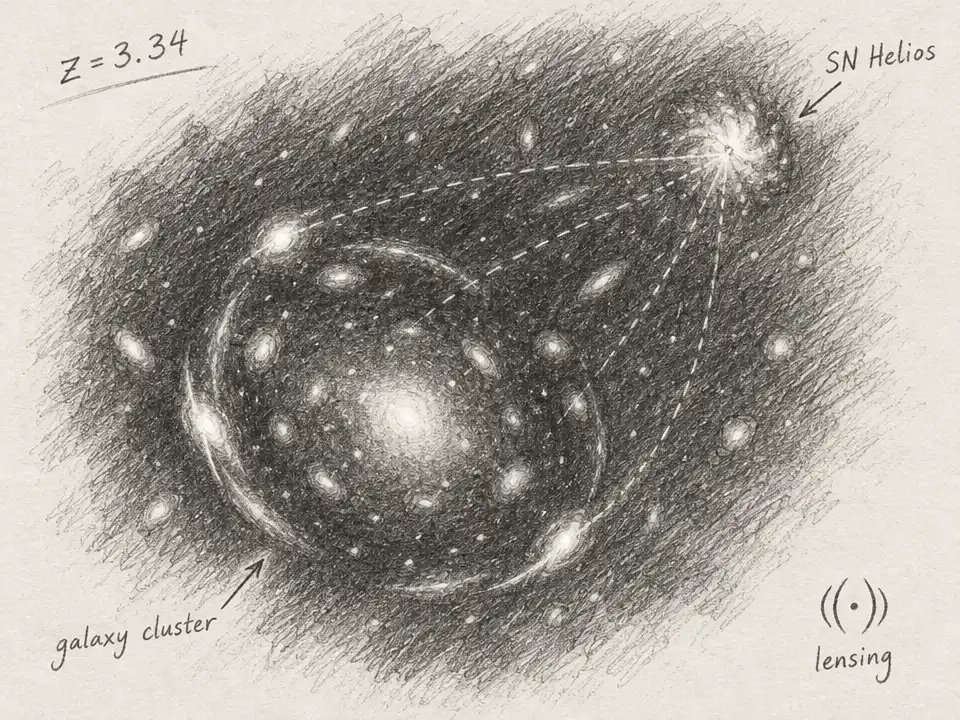
Helios’s path to us adds another twist. The cluster in the foreground acts as a gravitational lens, bending light around its enormous mass. The supernova’s light can travel along multiple routes, producing multiple images that reach Earth at different times. Five independent lens models predict that the image seen now is not the only one. They forecast another appearance roughly 2–6 years after the discovery image—between 2028 and 2032—with the models agreeing on a small patch of sky but not on the exact waiting time.
That forecast is a prediction, not a second image already in hand. The estimated delays vary because astronomers still lack spectroscopic redshifts for many of the background objects used to map the cluster’s mass. The models also differ in their methods and constraints. In the paper, their predicted magnifications for the observed supernova range from about 5 to about 31; the authors adopt 11.2 as a working value. Better measurements of the cluster’s other lensed galaxies should refine where and when the next image ought to appear.
If observers catch that reappearance, Helios could become more than a spectacular repeat performance. Comparing when recognizable features in the supernova’s light curve arrive in different images would turn the lens into a cosmic clock. The delay can help constrain the universe’s expansion rate, measured by the Hubble constant. Because the explosion lies at redshift 3.34, this would extend supernova-based time-delay measurements into a much more distant era than most previous systems. The paper estimates that, after more data improve the lens model, a successful campaign could eventually yield a measurement competitive with existing cluster-lensed supernova systems.
There is a second reason to keep looking at Helios: it shows how a real explosion can masquerade as an ancient galaxy in deep surveys. Webb’s lens magnified the source enough to make it observable and, crucially, to enable follow-up. The supernova’s host galaxy, by contrast, remains undetected; the authors’ limit places it among exceptionally faint systems and suggests that such galaxies may contribute to the population of supernovae. That implication remains tentative, since one event cannot establish how common these explosions are.
The surprise is not simply that a supernova looked like a galaxy. It is that the mismatch exposed two kinds of evidence hiding in the same faint point of light: a short-lived stellar explosion and a gravitationally delayed set of views still on its way. A color pattern alone told a plausible story about the early universe. Time, spectroscopy, and the cluster’s warped geometry told a stranger one—and gave astronomers a chance to test what happens next.