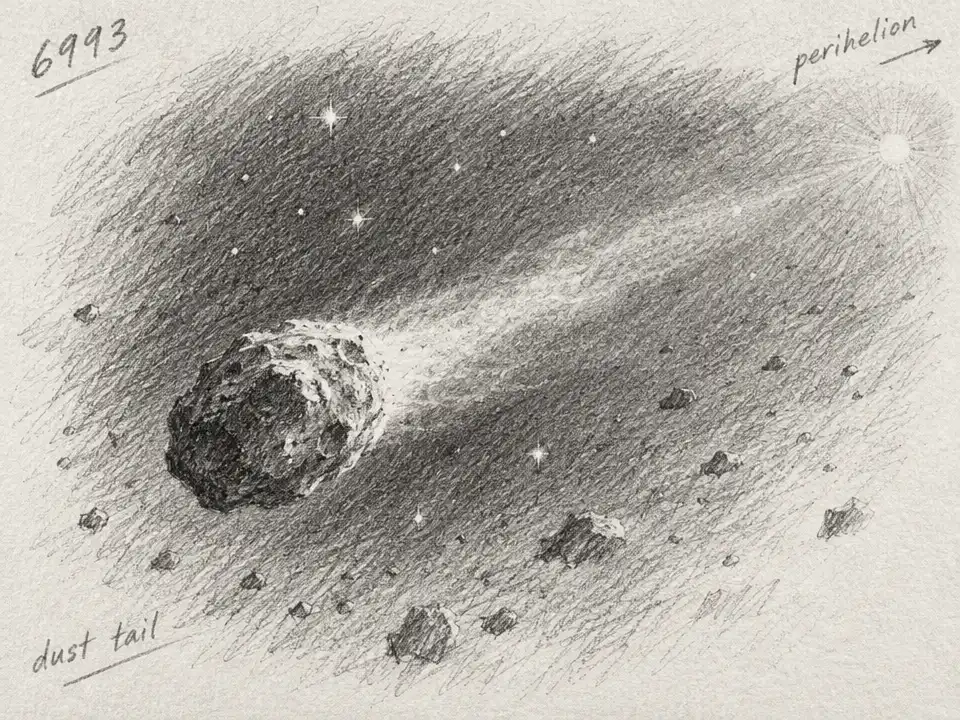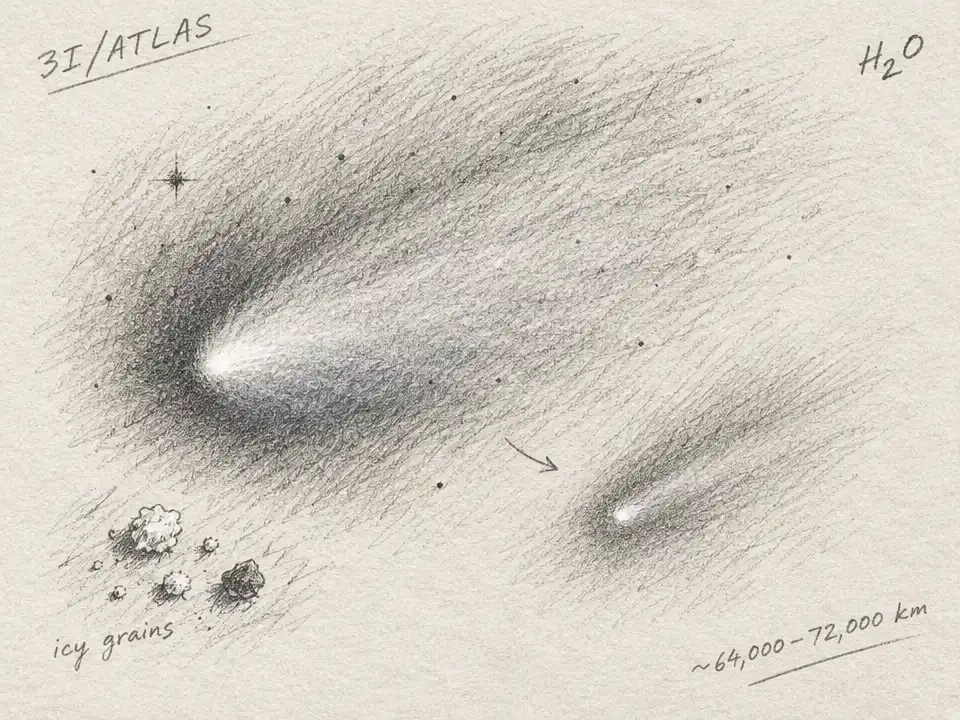
At first glance, an active comet is a bright point wrapped in a blur. Zoom out, though, and that blur becomes a landscape: sunlight scattered by countless grains, spreading hundreds of thousands of kilometers from the nucleus. In that vast, faint cloud around interstellar comet 3I/ATLAS, astronomers noticed a curious feature after its trip around the Sun—a distant region that looked bluer than the material closer in, then faded away.
The clue comes from images taken by the Zwicky Transient Facility, a survey telescope whose repeated views of the sky can catch objects changing over time. Bin Liu, Xiaoping Zhang, Xiaodong Liu and Man-To Hui analyzed observations from before and after 3I passed perihelion, its closest approach to the Sun. Rather than measuring the comet through the same angle on the sky each time, they compared circular regions with the same physical radii, from 5,000 to 80,000 kilometers. That let them follow the coma at comparable distances as the comet moved.
The inner and outer cloud did not behave alike. In the smallest measured region, 5,000 kilometers across from the center, the scattered-light signal faded rapidly after perihelion. Farther out, the cloud retained more of its brightness for longer. A large aperture can act like a memory: it includes grains released earlier, when the comet was more active, as well as newer particles. So the distant coma does not simply report what the nucleus is doing now.
Then came the color. In observations from late November 2025, the inner coma remained relatively red, while the region about 40,000 to 80,000 kilometers from the center appeared unusually blue. By January, that outer color pattern had disappeared. The change was accompanied by a shift in the cloud’s brightness profile. Across the outer region, the profile was exceptionally steep in late November, then became more gradual as the weeks passed.
Why should a comet’s dusty atmosphere briefly turn blue at its outskirts? The team considered whether the changing viewing angle could make an unchanged cloud look different. Their projection test did not reproduce the observed flattening of the brightness profile. A recent burst of dust production was another possibility, but the measured signal was fading in all the apertures, with the inner coma fading fastest. That pattern made a fresh surge an unlikely explanation for the steep outer profile.
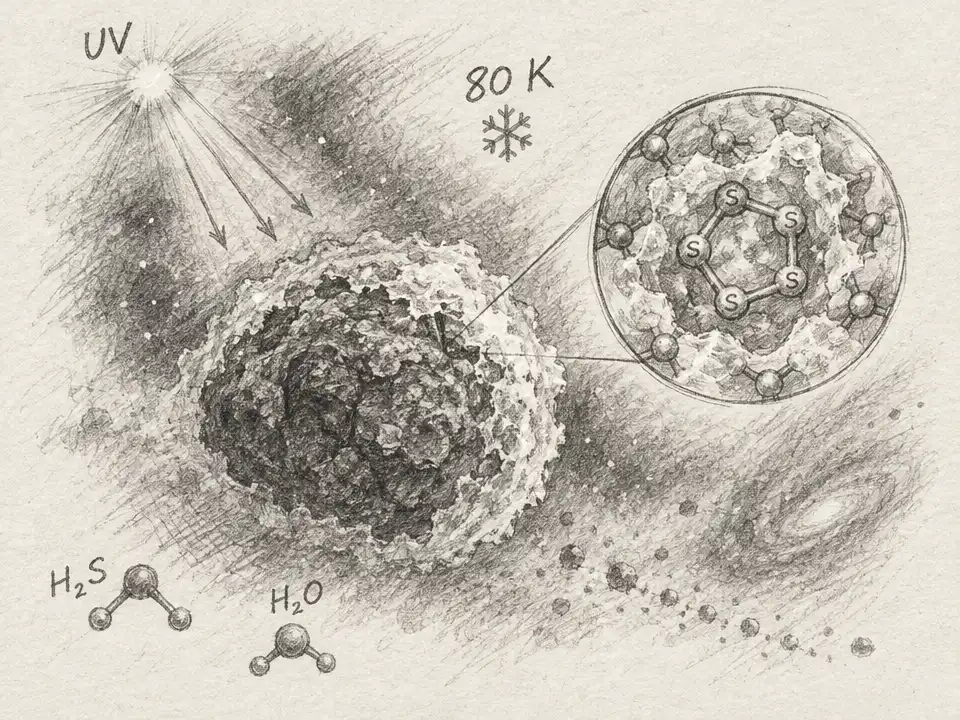
Instead, the researchers explored a more delicate possibility: some grains may have been losing their ability to scatter sunlight as they traveled outward. Imagine a sprinkling of ice grains with just a trace of dark, light-absorbing material mixed in. The ice can release water vapor as it warms, while the absorbing material helps it take in more sunlight. That small change in the grains’ makeup matters: pure ice in the team’s calculations survived too far from the nucleus, while grains with stronger absorption sublimated too quickly to match the observed pattern.
The researchers compared their measured fading scale with models of grains heating up and sublimating. The observed change stretched across roughly 64,000 to 72,000 kilometers. In the models, grains about 5 to 10 micrometers across, with a carbonaceous fraction of about 0.1%, could fit that scale. The calculation does not mean anyone directly saw individual grains or measured their ingredients. It means that this particular combination offered a plausible match to the cloud’s changing brightness and color.
That match also gives the faint color shift a physical interpretation. If a population of icy grains gradually loses material and optical cross-section on its journey outward, it can leave less scattered light at large distances than a steady stream of durable dust would. As the supply of those grains wanes and the comet recedes from the Sun, the unusual outer pattern should weaken. The observations show just such a pattern: the sharp profile and blue outer color were temporary, not permanent features of the coma.
The proposed grains may also help explain some of the water vapor observed around 3I near the same period. In the model, their contribution comes out at the right order of magnitude for measurements in late November. But the fit does not hold for all later water-production measurements. The authors therefore treat the icy grains as one short-lived source, not a complete explanation. Water released directly from the nucleus, newly supplied grains, and grains with a range of sizes or compositions may also contribute.
That distinction matters because the comet’s glow is not a photograph of its solid body. It is the combined light of material with different ages, sizes, paths, and lifetimes. The team’s estimated dust-loss rates depend on assumptions about grain sizes and how long particles remain inside each measurement region; the authors describe those rates as order-of-magnitude estimates. Their grain interpretation is likewise model-dependent. A useful clue, not a final inventory.
Still, the scale of the clue is striking. The suspected grains are microscopic, yet their changing light can be traced across a region tens of thousands of kilometers wide. The telescope does not resolve a tiny icy particle against the dark sky. Instead, it registers the faint collective effect of many particles, then follows how that effect changes with distance from the comet and with time.
And 3I/ATLAS is a visitor from beyond our Solar System, so the changing cloud offers a way to study material formed around another star without touching it. The comparison with other interstellar comets is a reminder not to expect one standard recipe: previous observations of 2I/Borisov have been interpreted differently, with no strong evidence for the same kind of grain fading. In 3I, a barely visible blue edge may be telling us that some of the comet’s smallest travelers are also among its most temporary.