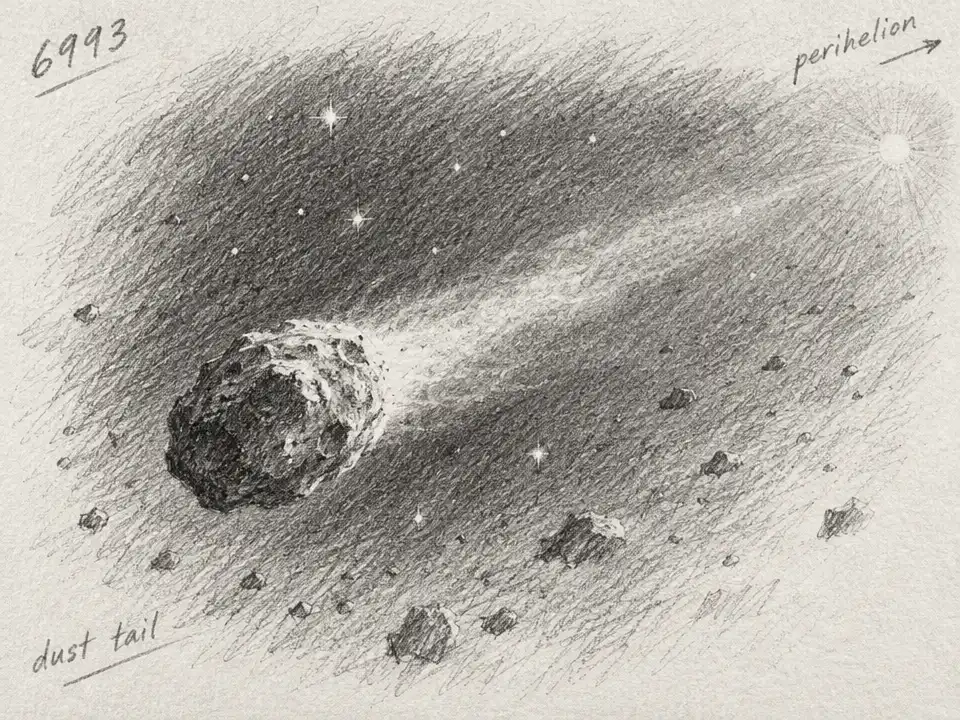
In a telescope image, asteroid 6993 looked less like a quiet rock than a tiny comet: a narrow tail streamed behind it, pointing away from the Sun. The surprise was where it appeared. This object travels in the outer part of the asteroid belt, where sunlight is faint—and where astronomers had not previously seen an incoming main-belt comet show activity so far from the Sun.
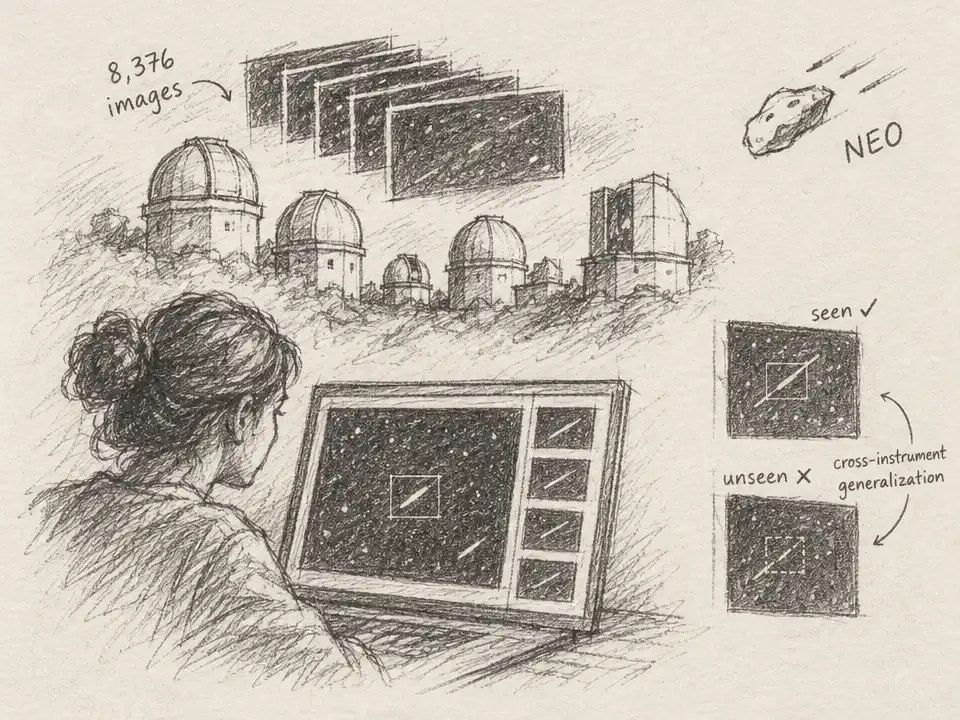
The first clue came from a machine-learning search of the Zwicky Transient Facility’s image alerts. On August 5, 2026, the system flagged an image of 6993 with a 99.9% confidence score for visible activity. That score describes the model’s classification of the image, not a verdict on what caused the tail. Earlier pictures showed the feature too: activity was visible in observations dating back to June 25.
Follow-up checks turned a promising alert into a confirmed case of an active asteroid. Across images from the Zwicky Transient Facility and the Asteroid Terrestrial-impact Last Alert System, the tail extended at least 32 arcseconds beyond the asteroid’s nucleus. Its direction lined up with both the direction away from the Sun and the asteroid’s direction of motion. The tail appeared in all 65 observations taken between June 25 and September 22.
That evidence establishes that material was coming off the asteroid. It does not settle why. For active asteroids, the leading possibilities include ice turning to gas and carrying dust into space, a collision that blasts dust from the surface, or rotation that helps loosen material. The images capture an outflow, but not its engine.
The icy explanation would make 6993 a particularly odd comet. Its closest approach to the Sun, called perihelion, is 2.853 au. Before this discovery, sublimation-driven activity had not been observed on an incoming main-belt object at distances greater than 2.64 au. When the first activity was seen, 6993 was at 2.91 au from the Sun. The object was already shedding material well before reaching its closest point.
At those distances, the Sun’s heat changes only modestly over the asteroid’s orbit. Using assumptions about its shape and surface, the researchers estimated an equilibrium temperature of 248 K when activity was first observed, compared with 231 K at its farthest point from the Sun and 251 K at perihelion. The solar flux at perihelion is 39% greater than at aphelion. If ice is driving the tail, this small, cold world may be releasing gas farther from the Sun than any known main-belt comet.
That “if” matters. The object’s size adds to the puzzle. At 11.85 km across, 6993 is roughly twice the size of the largest main-belt comets previously measured. If its activity is powered by sublimation, it would be the largest known main-belt comet, as well as the one with the greatest perihelion distance. But its measured albedo—the fraction of sunlight its surface reflects—is 0.166 ± 0.030, unusually high compared with some familiar main-belt comets. Its colors and other measurements do not neatly settle what kind of surface it has.
A collision offers a different story. A fresh impact could have thrown dust into space, creating a tail that gradually thins as particles disperse. There is a hint that fits: 6993 faded by about 0.20 magnitudes between June and September, and it was brighter in June and July than in August and September. The paper treats that decline as plausible evidence for an impact, not proof. A collision’s dust cloud could fade; changes in sublimation or a mix of processes could also complicate the pattern.
Researchers also checked whether the asteroid might be spinning so fast that material was flung away. Its measured rotation period is 3.897 hours, slower than the roughly 2.2-hour spin barrier generally used for bodies larger than 200 m. That makes rotational instability an unlikely main cause, though rotation could still contribute. A single mechanism need not explain every detail: impact and sublimation, or rotation and sublimation, might act together.
The next turn in the story is approaching. Asteroid 6993 is expected to reach perihelion in January 2027. Watching how the tail changes as the object draws nearer to the Sun—and whether it appears again on a later orbit—could help distinguish a recurring supply of gas from a one-time burst of impact debris. More observations may also clarify the asteroid’s composition and what its activity can tell us about volatile material in the belt.
For now, the result is not a new record for icy comets so much as a useful challenge to the categories astronomers use. A rock in the asteroid belt has grown a comet-like tail at a distance where that kind of activity had not been seen before. The tail is clear. Its cause remains open—and the next months could reveal whether 6993 is quietly venting ancient ice, still shedding the aftermath of a collision, or doing something in between.