At first, the object near the young star WISPIT 2 looked like a question masquerading as a dot. Astronomers had spotted it about 15 au from the star—roughly the distance between Saturn and the Sun. It glowed unusually red. That could mean a young planet, wrapped in warm dust. Or it could mean a knot of dust in the star’s disk, reflecting starlight in a misleading way. In images of a planet-forming system, where rings and gaps can resemble compact objects, a bright speck is not enough.
The ambiguity mattered because WISPIT 2 was already an unusually useful place to look. The star is only about five million years old, and its broad disk is etched with multiple bright rings and dark gaps. In 2025, observations identified WISPIT 2b, a young gas giant about 57 au from the star, sitting in a gap between rings. Its estimated mass is around five Jupiter masses. The second object, then nicknamed CC1, appeared much closer in, inside the disk’s central cavity. If it, too, were a planet, WISPIT 2 would offer a rare view of more than one giant world in its natal surroundings.
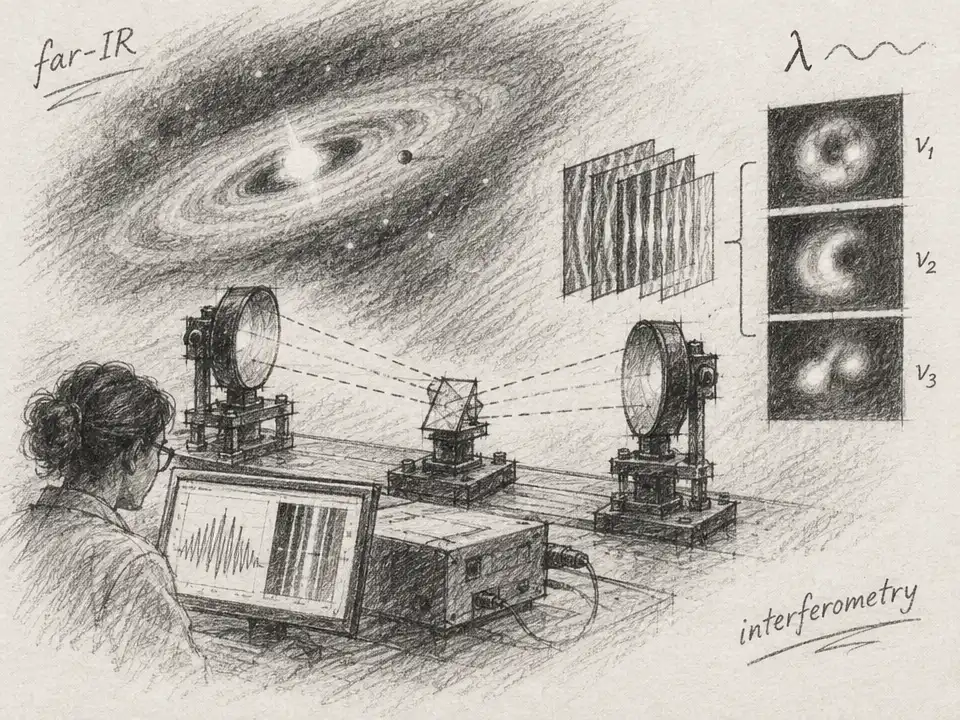
To test the smudge, researchers brought two different kinds of seeing to bear. The SPHERE instrument on the Very Large Telescope captured it in near-infrared light, including observations at two dates in 2025. Then the GRAVITY instrument combined light from the four large telescopes of the Very Large Telescope Interferometer. This technique can tease out a compact source close to a much brighter star, much as coordinated microphones can help isolate one voice from a crowd. Across twelve GRAVITY exposures, the source stood out with a signal-to-noise ratio above ten.
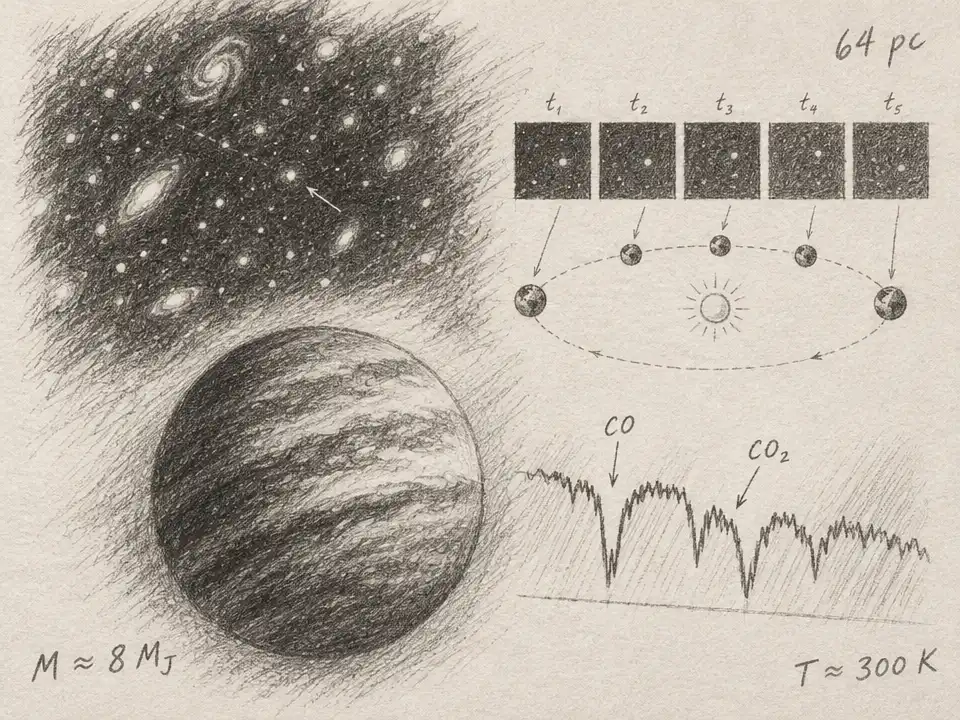
That result helped answer the first question: was the signal a point-like object, or merely scattered light from the disk? Interferometry is particularly sensitive to light from a compact source, while the disk’s extended glow behaves differently. GRAVITY’s detection was consistent with a point, strengthening the planetary explanation. Meanwhile, the source’s measured position changed in a way that the researchers judged inconsistent with a faraway background star. The evidence supports an object bound to WISPIT 2, although the precise orbit is not yet pinned down. Some earlier position measurements do not fit neatly together, so more high-precision tracking is needed.
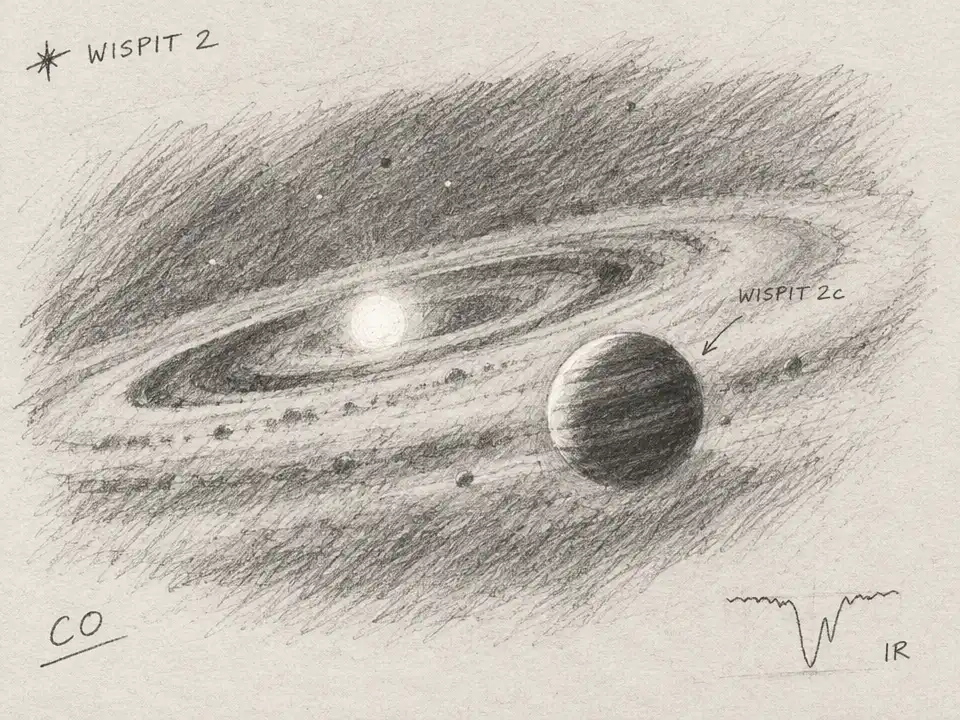
The most telling clue came not from the dot’s shape, but from its light broken into a spectrum. In the K-band infrared data, the researchers found a feature from carbon monoxide: the molecule absorbs light at a characteristic wavelength, leaving a recognizable notch. That feature, together with the spectrum’s shape, is associated with young, low-gravity objects. It is not the expected signature of an ordinary star. The spectrum gave the team something a color alone could not: evidence about the nature of the object itself.
With the new evidence, the researchers named the companion WISPIT 2c. Models that connect a young object’s light to its size and mass suggest it weighs about eight to twelve times as much as Jupiter—roughly twice the estimated mass of WISPIT 2b. That number is an estimate, not a direct weighing. It depends on the system’s age and on models of a young planet’s atmosphere and cooling. Different atmospheric models give a wider spread, but the study favors a mass in that range when the measured luminosity is compared with models for objects of WISPIT 2’s age.
The second planet also refuses to behave like a simple repeat of the first. WISPIT 2b shines in hydrogen-alpha light, a sign of gas falling onto a growing world. The observations did not find a significant hydrogen-alpha signal from WISPIT 2c. That does not rule out accretion: the signal could vary over time, or dust around the planet could hide visible light. The absence is a reminder that one planet can be obvious in one kind of light while another remains quiet—or obscured—in the same system.
Together, the two worlds turn WISPIT 2’s rings from scenery into a research test. Planet 2b sits in a broad gap, and its estimated mass is compatible with models of a planet clearing material from its orbit. Planet 2c lies much closer to the star, inside the central cavity. Their positions give astronomers a chance to compare the planets’ properties with the disk structures around them. That could help test competing ideas about how giant planets form far from their stars and whether they grow where we see them or move outward later. But a planet beside a gap does not prove that it carved every ring in the disk.
When the red speck first appeared, the central puzzle was whether astronomers were seeing a world or a patch of dust. A point-like interferometric signal, the motion relative to the star, and a molecular feature in the spectrum now make the planetary interpretation compelling. What remains unsettled is how WISPIT 2c moves through the system, what its dusty surroundings are like, and why its accretion signal differs from its companion’s. The smudge has become a planet; the system’s history is still being read.