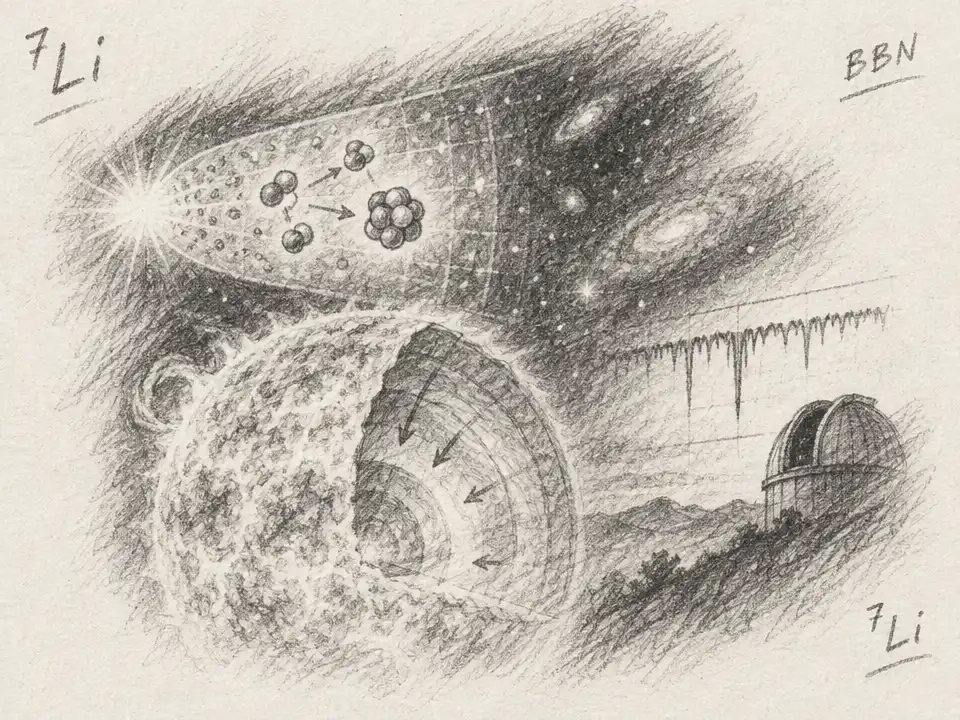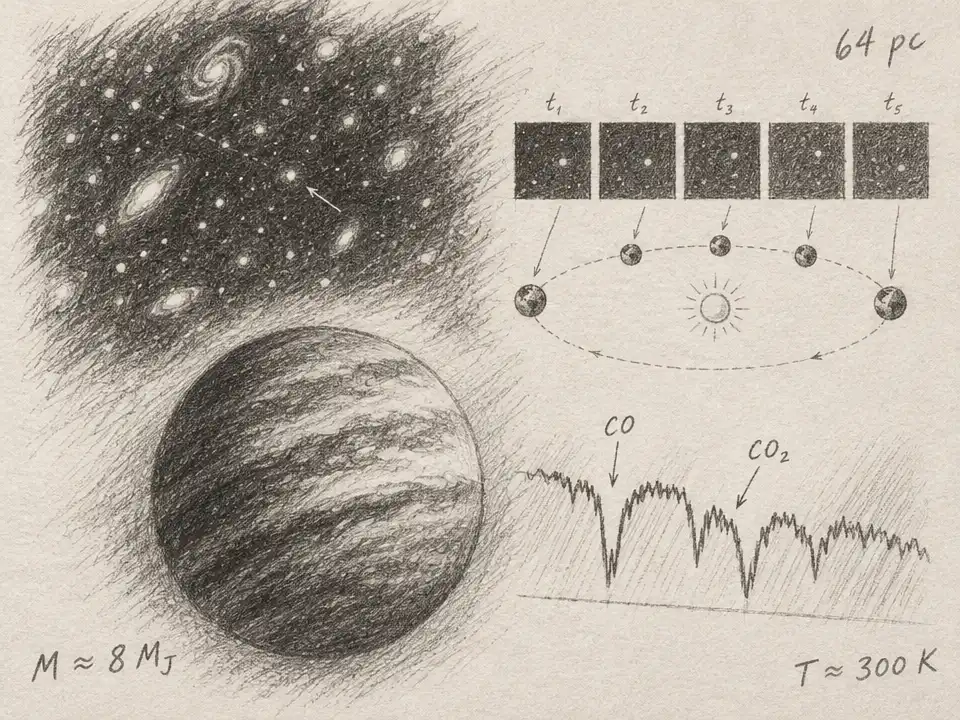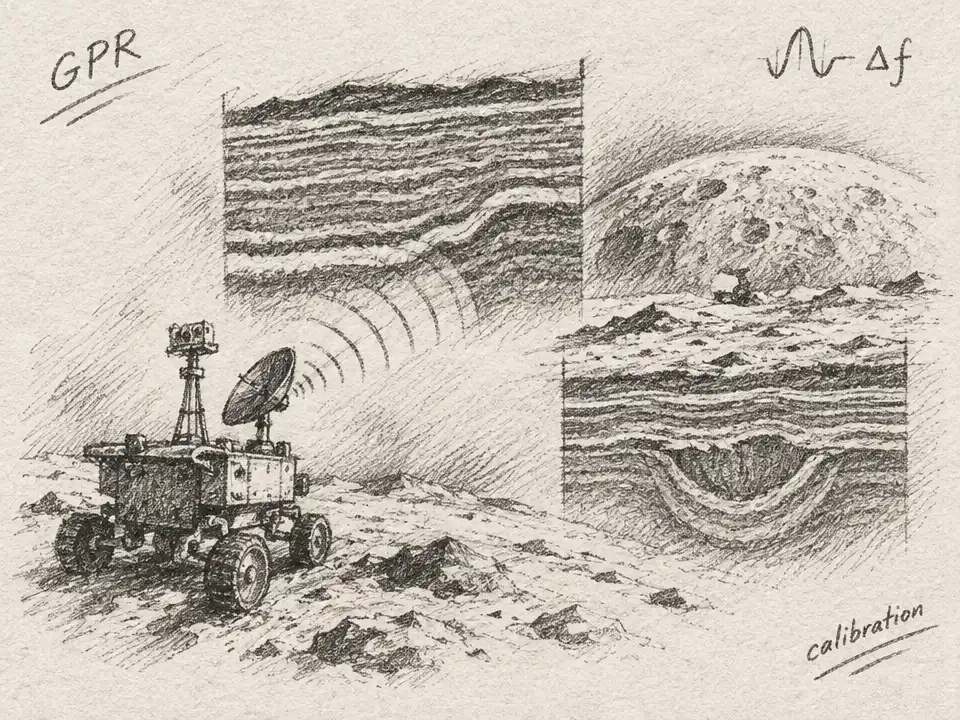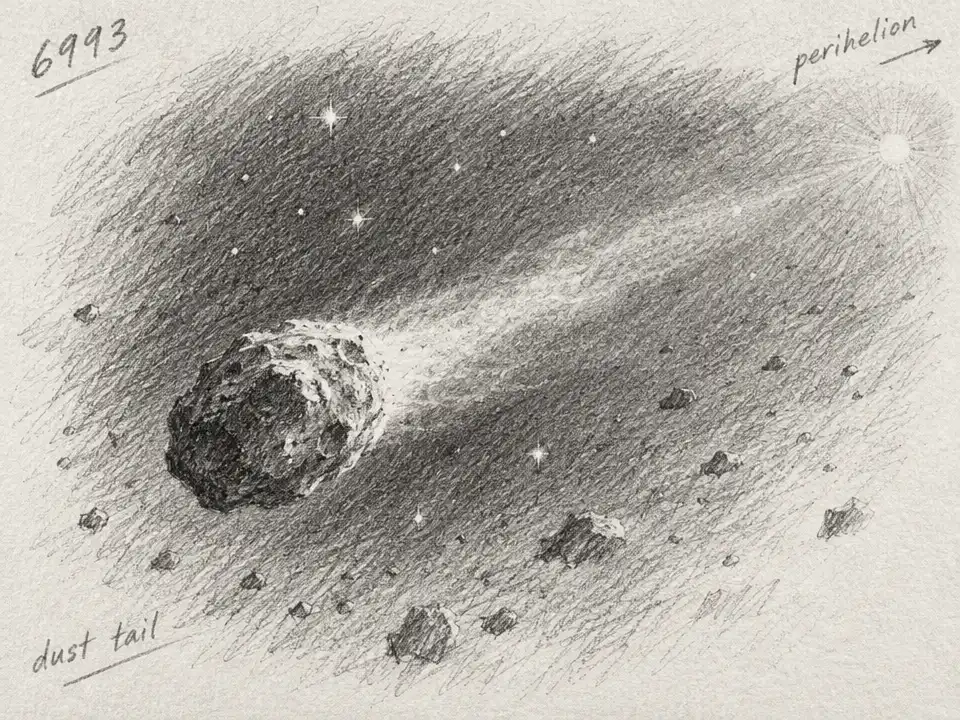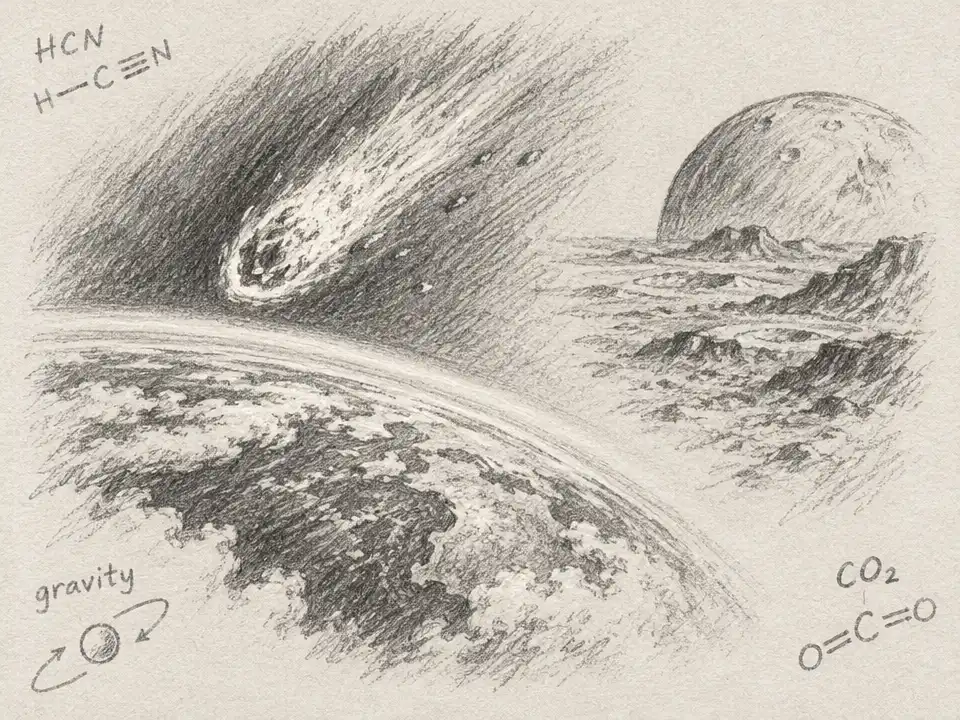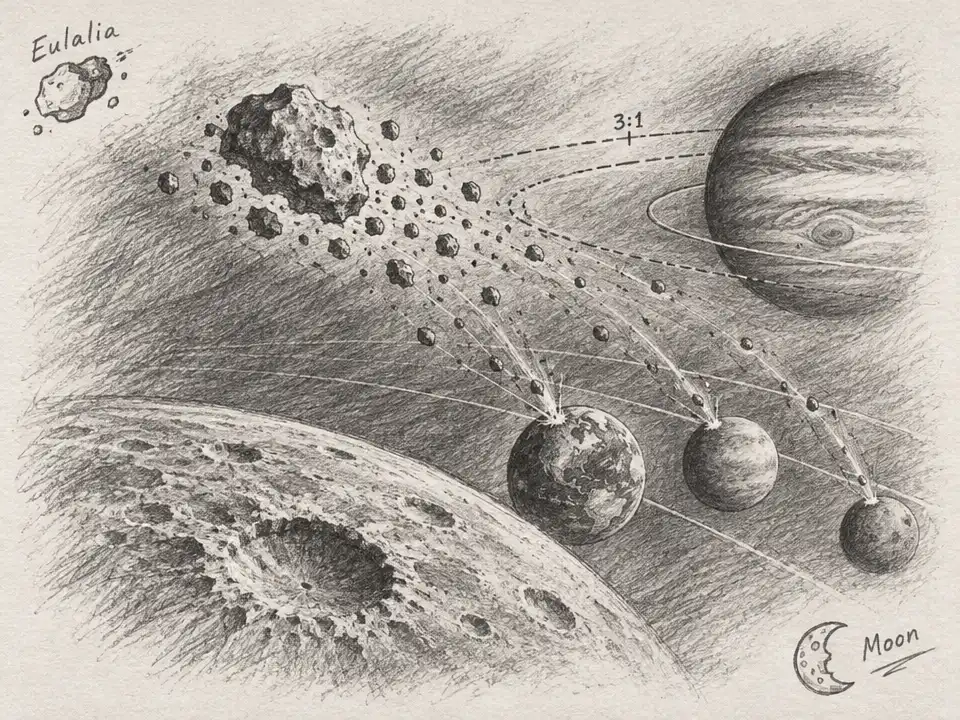
The Moon may be keeping a record of an ancient chain reaction. Around 800 million years ago, a cluster of large impacts appears to have struck its surface. A new reconstruction points to a possible culprit far away: the breakup of a huge asteroid in the main belt, followed by a slow drift of its fragments toward the inner Solar System. If the reconstruction is right, the same shower could have sent sizable objects toward Earth, Venus, and Mars.
The clue begins with a pattern, not a single crater. Researchers have estimated the ages of lunar craters by counting smaller craters that formed on top of them: the more overprinting, the older the surface. In a set of 59 large craters, seven have estimated mean ages between 760 and 820 Ma. One is Copernicus, a 93.1 km-wide landmark whose age is also supported by material collected during Apollo 12. Tiny beads of impact glass gathered at several Apollo landing sites add another kind of evidence: radiometric dates show a cluster of impacts near 800 Ma.
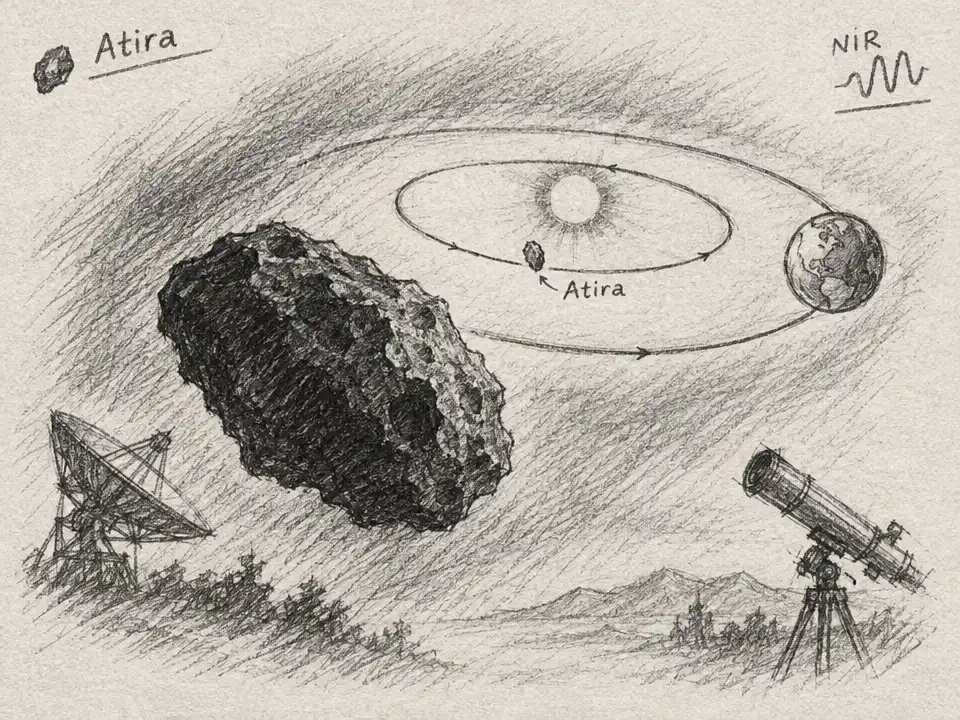
Those dates raise a question with a long journey behind it. The proposed source is the Eulalia asteroid family, the surviving fragments of a parent body that broke apart in the inner main belt. The family sits close to a powerful gravitational boundary associated with Jupiter: the 3:1 resonance. There, an asteroid’s orbit can be destabilized, sending it onto a path that crosses the orbits of planets. The challenge is that the collision happened long ago. Researchers have to work backward from the asteroids still visible today.
That surviving family carries a subtle map of its past. The team compared the fragments’ orbits and estimated sizes with models of how the cluster would change over time. Sunlight supplies part of the engine. An asteroid warms in sunlight and releases that heat back into space; the tiny recoil can gradually shift its orbit, an effect called Yarkovsky drift. Another effect, YORP, changes an asteroid’s spin and helps shape that drift. Given enough time, some fragments can edge toward the resonance instead of being thrown straight into it by the original breakup.
There is no single perfect reconstruction. The family’s original position, the fragments’ physical properties, and the completeness of today’s asteroid surveys are uncertain. The researchers tested several plausible versions rather than pretending those details were known exactly. In their preferred version, the parent body broke up about 865 Ma ago. Nearly three-fourths of the family’s fragments eventually entered the resonance over roughly 150 million years. Once there, some were routed into planet-crossing orbits.
The timing is the striking part. The model places most of the resulting bombardment in a window of roughly 700–850 Ma, close to the lunar crater and impact-glass age cluster. The team then estimated how many fragments might hit each world and how large they could be. In the model, the largest impactors to strike Earth and Venus averaged about 8 km in diameter; the average largest impactor for Mars was 4.5 km. The modeled lunar shower could account for several large craters, though making Copernicus itself requires a relatively large projectile. In 10,000 trial simulations, the modeled lunar impacts generally fell within the one-sigma range of the observed crater pattern. That is a plausible match, not a photograph of the event.
For Earth, the implications are tantalizing—and especially hard to test. The planet’s ancient surface has been repeatedly reshaped, and Snowball Earth glaciations between 650 and 720 Ma likely erased most craters older than 650 Ma. The team therefore considers indirect clues, including a pronounced shift in carbon-isotope records around 800–810 Ma. That shift is evidence of disruption to Earth’s carbon cycle, but it does not identify an asteroid as the cause. The study suggests that impacts might have contributed dust and aerosols to the atmosphere or affected ocean productivity; it does not establish that they drove the changes in Earth’s biosphere or climate.
Mars offers a different possible trace. The researchers revisited age estimates for calderas associated with 36 of the planet’s largest volcanoes and found a peak near 800 Ma. One possibility is that strong shaking from impacts disturbed underground magma systems, helping magma rise. But an overlap in dates is not proof of a trigger. The caldera ages depend on crater-counting methods, and the researchers note that the apparent match could be a coincidence. Their idea is a testable lead, not a verdict on Martian volcanism.
The price of this sweeping picture is uncertainty at nearly every link: how the asteroid family formed, how many fragments escaped, how often they hit each planet, and what happened after impact. Some estimates for the largest asteroids rely on extrapolating beyond the best-measured part of the family. The Earth and Mars connections are more speculative than the lunar case, which has dated glasses and a cluster of crater ages to compare with the model. Even the lunar evidence supports a plausible source rather than proving that Eulalia made every crater in the cluster.
That is what makes the Moon the next frontier. More returned samples, tied to known locations and craters, could sharpen the impact timeline and help test whether separate impacts share an age and composition. The researchers argue that firmer proof may have to wait until lunar sample return is more commonplace. Meanwhile, improved measurements of surviving asteroids and better models of their motion can tighten the reconstruction. The opportunity is to use the Moon as a clock for events whose scars Earth has lost. The cost is patience—and the discipline to keep a compelling planetary story separate from what the evidence can yet show.