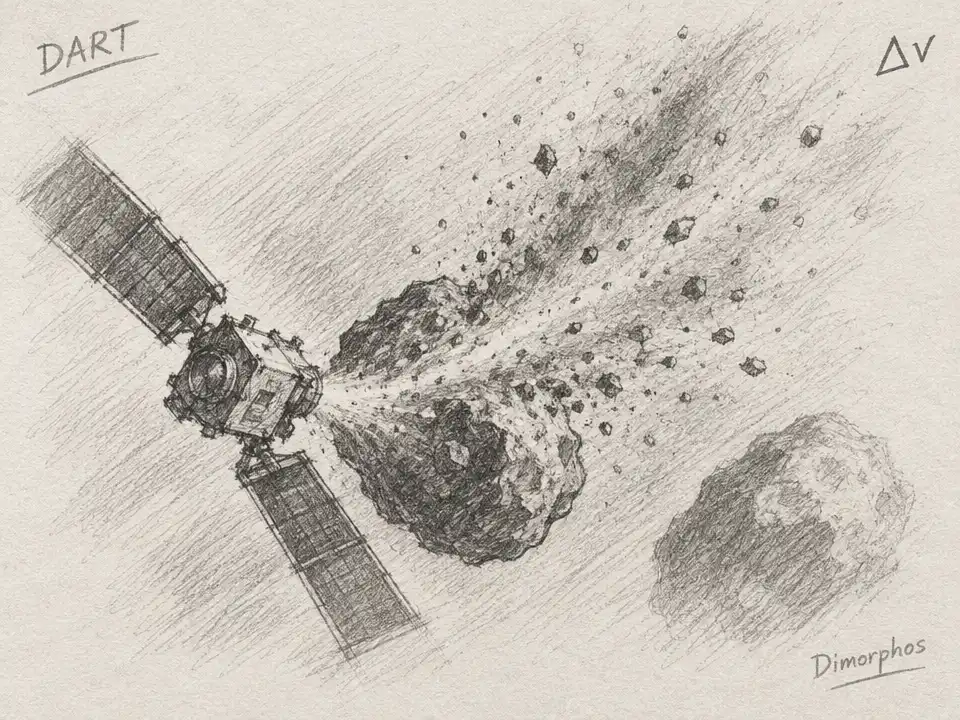
Imagine trying to nudge a moving boulder by throwing a rock at it. The rock hits, the boulder shifts—but then a spray of gravel blasts away from the impact, giving the boulder an extra shove. That surprising second push is what made NASA’s DART mission more effective than a simple collision calculation predicted. The spacecraft struck the asteroid moonlet Dimorphos, and the debris kicked outward helped change its path around a companion asteroid.
The experiment took place on September 26, 2022. DART—short for Double Asteroid Redirection Test—was designed to answer a practical question: could a spacecraft deliberately alter an asteroid’s motion? Dimorphos was a useful target not because it threatened Earth, but because it circles another asteroid, Didymos. That pairing gave astronomers a natural clock. They could measure how long Dimorphos took to complete each orbit before and after the impact.
The clock mattered because the change was tiny in the grand scheme of spaceflight. Nobody needed to watch Dimorphos visibly veer away. Instead, researchers compared its repeated passages and used Earth-based light measurements and radar observations to track the orbit. Two independent approaches arrived at the same result: Dimorphos’s orbital period shortened by about 33 minutes.
That was more than a successful bull’s-eye. It was a result with a built-in surprise. If the spacecraft’s momentum had simply been absorbed by the asteroid in a straightforward collision, researchers expected a change of about seven minutes. The measured shift was much larger. The missing ingredient was the material blasted away from the impact site.
Here is the physics in everyday terms: when debris flies off in one direction, the asteroid gets a recoil in the other. A spacecraft can therefore change an asteroid’s motion not only by hitting it, but also by making the asteroid throw material into space. The ejecta act like a temporary, improvised rocket exhaust. They do not need to be powered by fuel; the impact supplies the energy that sends them outward.
Researchers estimated that the impact reduced Dimorphos’s speed along its orbit by about 2.70 mm/s. That sounds almost comically small. But this was a nudge measured against a moonlet moving through a carefully observed binary system. A small change, repeated across the orbit, altered the time Dimorphos needed to circle Didymos. In asteroid deflection, the goal is not necessarily a dramatic sidestep. It is a slight change made early enough to accumulate.
Scientists describe the extra push using a measure of momentum enhancement: how much momentum the asteroid receives compared with what the spacecraft brought in. The estimate depends on Dimorphos’s mass, which was not precisely known in the studies. For a range of plausible densities, researchers calculated an enhancement between 2.2 and 4.9. The important point is not that one exact multiplier applies in every case. It is that escaping debris added substantial momentum beyond the direct hit.
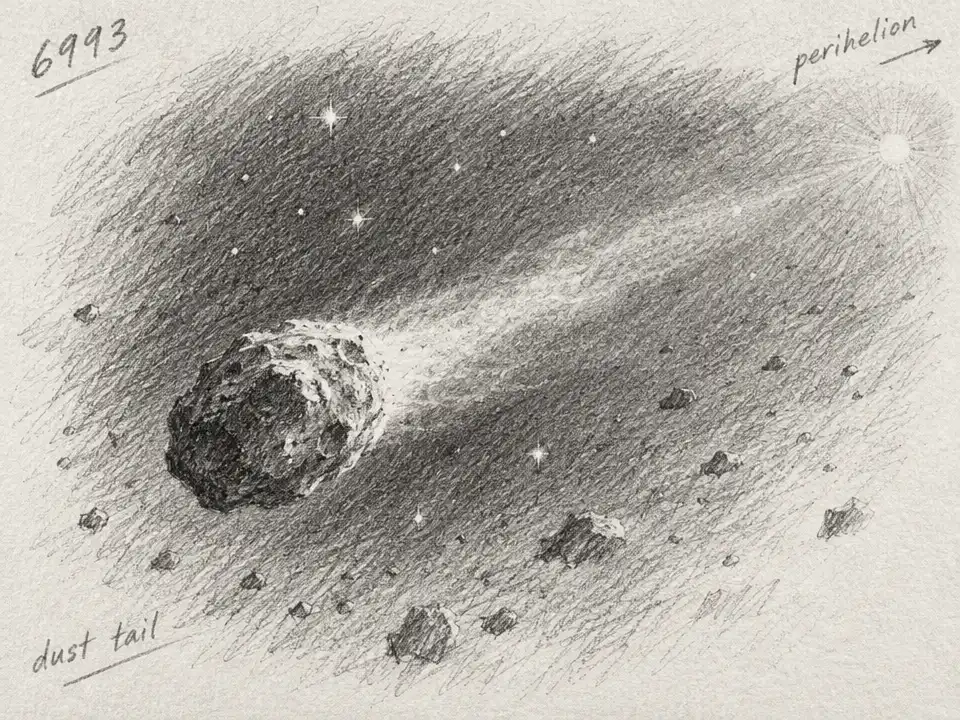
That debris was more than a fleeting flash. The Hubble Space Telescope began observing the aftermath about 15 minutes after impact and kept following it for 18.5 days. Its images captured a complicated cloud and tail changing shape as the dust moved through the Didymos system. At first, the binary asteroids’ gravity helped steer the particles. Later, pressure from sunlight became more important, pushing dust away and stretching the cloud into a tail.
For a little while, the asteroid system became a laboratory for a process usually glimpsed only after the fact. Astronomers have seen active asteroids with tails and suspected that impacts can create them. But those objects are typically discovered after the dust has already spread, leaving the original collision uncertain. DART supplied the missing starting point: a known impact time, a known spacecraft, and telescopes watching the ejecta evolve.
The tail also offered clues about what the collision had dug up. Researchers compared telescope images with computer models of particles moving through the system. One analysis found that a broken power-law distribution—one pattern for smaller particles and another for larger ones—fit the observations. The modeled particles ranged from micrometer-scale grains to pieces several centimeters across. The study estimated a lower limit of about 6 million kg of dust ejected, with roughly half sent out into interplanetary space.
That number is not a direct weighing. It comes from matching observations to models, and estimates depend on assumptions about particle sizes, speeds, and how much material the telescopes could detect. Another analysis cited estimates of 13 to 22 million kg released in the first hours. The figures are not a reason to declare the asteroid’s debris inventory settled; they show how researchers turn a faint, spreading cloud into estimates of unseen material.
The impact’s aftereffects may also reveal what Dimorphos is made of. It is not a solid stone ball in the familiar sense. Simulations designed to match the observed deflection and ejecta suggest that it may be a loosely assembled rubble pile: blocks and smaller grains held together by weak forces and gravity. In the study’s best-fitting scenarios, the material had very low cohesion—less than a few pascals. That is a model-based inference, not a direct measurement of the asteroid’s interior.
This loose structure helps explain why a collision could excavate so much material and keep producing ejecta after the first instant of impact. Some simulations suggest the event may have deformed Dimorphos across a broad area rather than leaving a neat, bowl-shaped crater. The exact reshaping depends on uncertain properties such as the asteroid’s internal strength. In other words, the target was not simply a passive surface. Its structure helped determine how much debris escaped—and therefore how large the extra push became.
That is the plot twist in DART’s result: the impactor did not do all the work. A substantial share of the deflection came from the response of the target itself. The spacecraft supplied the initial blow; the asteroid’s escaping material amplified it. That makes the experiment a demonstration of a possible planetary-defense technique, but not a universal instruction to aim and fire. An asteroid’s mass, shape, surface, and internal structure would affect the outcome, and the response measured at Dimorphos cannot automatically be assigned to every other space rock.
Still, DART converted a long-standing idea into a measurable experiment. The orbit supplied the clock, ground-based observations measured its change, and the widening dust tail revealed the recoil behind it. A spacecraft struck a small world—and the world answered by throwing its own material back into space. In that answer lay much of the force of the nudge.