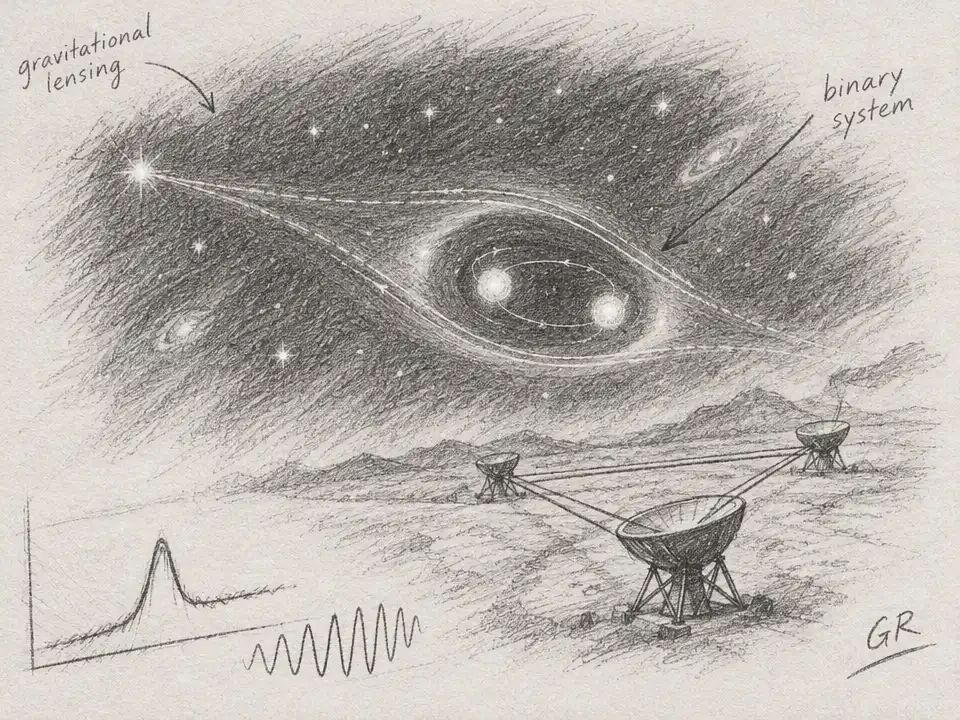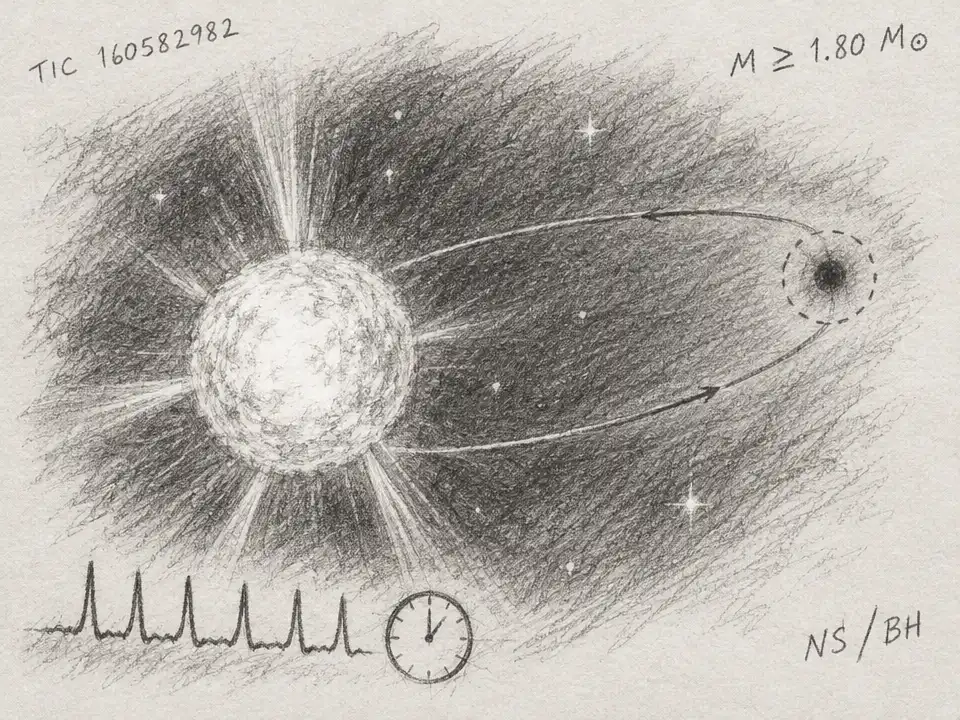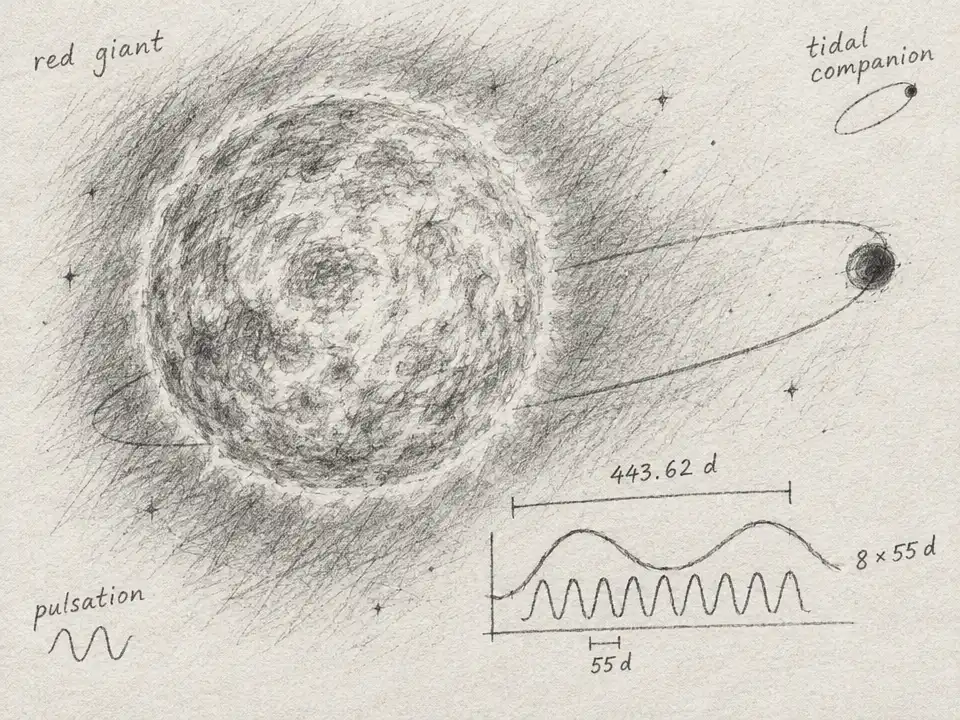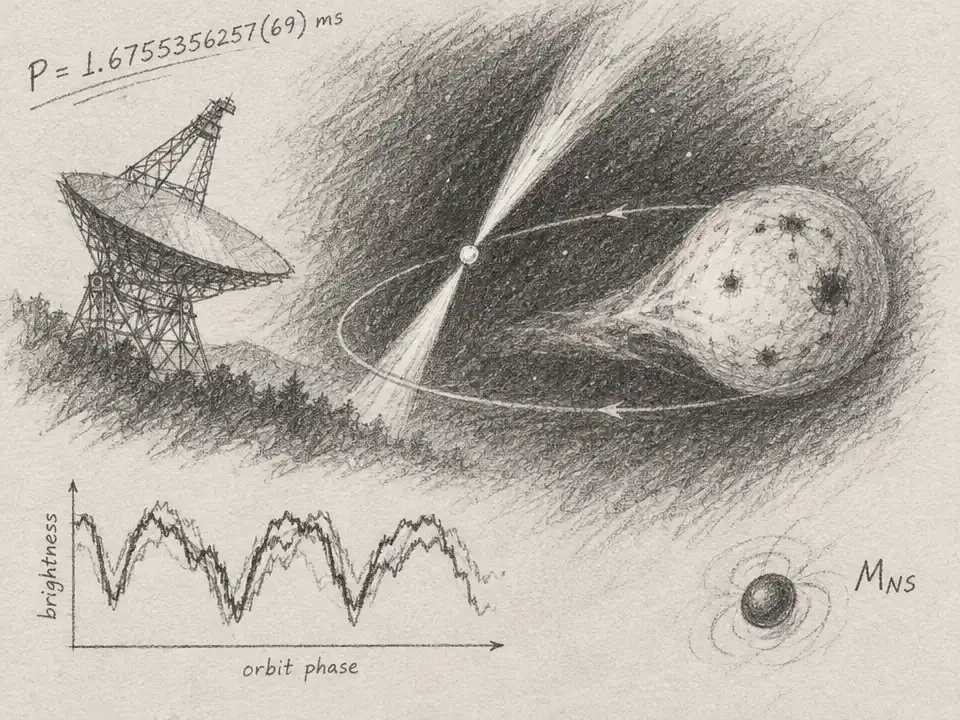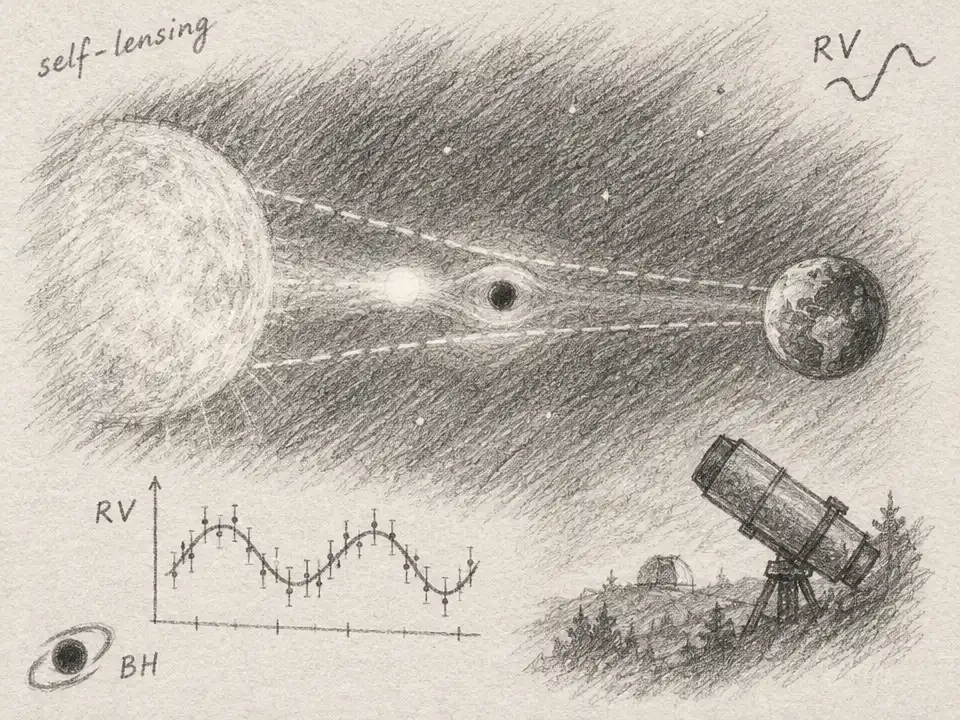
Imagine watching a star for weeks when, instead of dipping as a planet passes across it, the star briefly brightens. The flash may come from something dark moving between the star and Earth: a compact remnant whose gravity bends and magnifies the star’s light. If the pair’s orbit is nearly edge-on, this “self-lensing” can recur once per orbit. It offers astronomers a way to look for black holes and neutron stars that give off little light of their own.
The clue is striking, but it does not solve the whole mystery. A lensing brightening can reveal that a compact object is probably there without telling us exactly what it is, how massive it is, or how it moves. Just five self-lensing binary systems had been confirmed when the researchers wrote their paper, all with white dwarf lenses; none were known to contain a black hole or neutron star. The possibility of finding those darker companions is tantalizing. The challenge is separating a genuine signal from lookalikes—and then getting enough information from the star’s motion to identify its unseen partner.
That is the problem Adam McMaster and colleagues set out to test in a new study. They did not report a newly discovered black hole. Instead, they simulated self-lensing events and asked a practical question: after a telescope catches a candidate brightening, how many follow-up measurements would it take to work out what caused it?
Brightness alone can leave several explanations in play. Different combinations of the lens’s mass, the orbit’s tilt, and the companion’s motion can produce similar-looking flashes. The star itself complicates the picture: its surface activity can cause small changes in brightness and motion that obscure the signal. And for a widely spaced pair, astronomers may witness just one lensing event—not a repeating series that neatly reveals the orbital period.
The team generated simulated light curves lasting 27 days, the duration of a TESS observing sector, and added modeled stellar variability and measurement noise. They then fitted the curves to find different possible versions of the hidden binary. A key step was to use the moment of the brightening to choose when to measure the visible star’s radial velocity: its movement toward or away from us, inferred from shifts in its spectrum. The researchers tested schedules with three to ten measurements spread across a five-year campaign, choosing times designed to distinguish between competing orbital solutions.
This pairing of clues matters. The flash marks a particular point in the orbit. Later radial-velocity measurements show how the visible star is moving under its companion’s gravity. Even if the orbit takes decades or longer, a handful of measurements across only part of it can help constrain the system. In the simulations, fitting the brightness and velocity together generally worked better than relying on either alone. The improvement in the combined fits tended to level off after about five to six radial-velocity measurements.
The exact mass, however, can remain slippery. The researchers found that a compact object’s broad category—such as a black hole rather than a white dwarf or neutron star—could be easier to identify than its precise mass. In their adopted categories, lenses with fitted masses above five solar masses could often be classified as black holes even when the mass estimate itself was imprecise. Their estimates, mapped onto a modeled population of potentially detectable systems, put broad-class recovery at roughly 60 to 100 percent depending on the mass range and observing strategy. That is a simulation-based projection, not a demonstrated success rate from a real survey.
The study also offers a counterintuitive lesson: greater instrumental precision did not always improve the mass estimate. In some simulated cases, the modeled stellar noise—fixed at 10 m/s—could interfere with the fitting when the assumed instrument error was smaller. The result underscores that exquisite measurements are not automatically useful if the analysis does not handle the star’s own variability well. Lower-mass lenses were especially difficult, and the authors found that the precision of velocity measurements mattered more for those systems.
So the proposed route to discovery is a triage system, not an exhaustive campaign on every flickering star. Start with a small number of follow-up measurements across many candidates; use those to identify likely binaries and sort their companions into broad classes; then reserve intensive observing for the most promising or ambiguous cases. That could make it feasible to spend more telescope time on systems that may contain black holes, rather than trying to measure every candidate to the same level of detail.
There is a substantial price of admission. The study’s simulations begin with lensing events that have already been detected and timed; the researchers did not test a search method against real survey light curves. They also assumed the visible star’s properties and the precise timing of the brightening were known, and did not model observing seasons, weather, or bad seeing. The team expects false positives to outnumber true self-lensing systems by many orders of magnitude. Finding the flashes reliably—and deciding which deserve scarce follow-up time—remains a separate, essential step.
If future surveys and analysis methods can clear that hurdle, a brief rise in starlight could become the opening move in a longer investigation. The flash would point to gravity at work; the star’s shifting spectrum would help reveal the partner doing the pulling. For now, the study shows how a few carefully timed measurements might turn a promising glimmer into a stronger identification—and why the road from candidate to confirmed dark companion still runs through noisy data, patient observation, and careful skepticism.