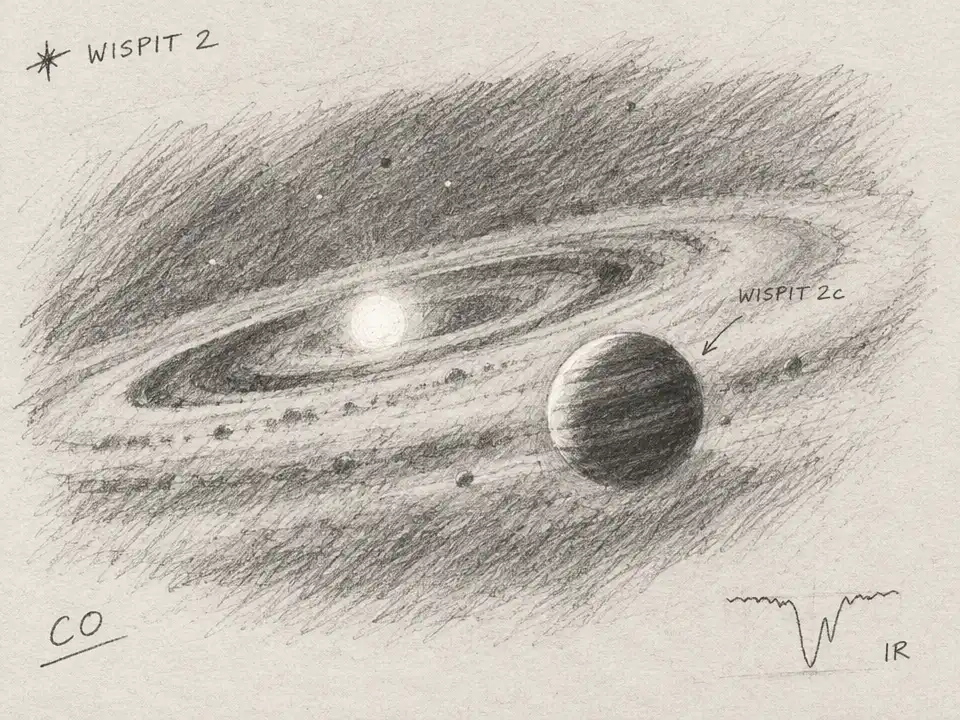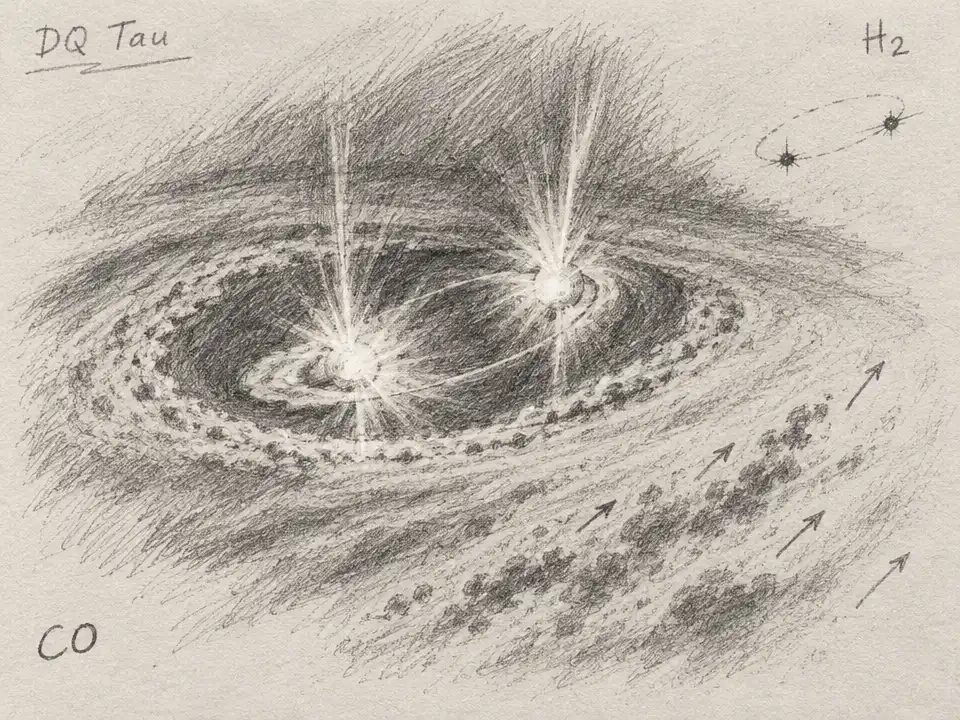
Two young stars in the system DQ Tau keep time with a clockwork beat. They orbit one another every 15.71 days, sweeping from a separation of 0.063 astronomical units at their closest approach to 0.22 astronomical units at their farthest. Each close pass stirs gas from the disk surrounding them and sends an accretion burst toward the stars. But the gas does not all answer the same way. Some traces the beat; some seems to retreat. What is moving through this young planetary system—and why?
The question matters because the disk is not a smooth, quiet ring. The pair’s gravity is expected to carve a low-density cavity around its orbit, while streams of gas can still cross that region and reach the stars. Such disks are potential planet-forming environments, and the moving gas is both raw material for the stars and a changing chemical landscape. A burst of light might change the chemistry. Or the disk itself might be rearranging beneath the flare.
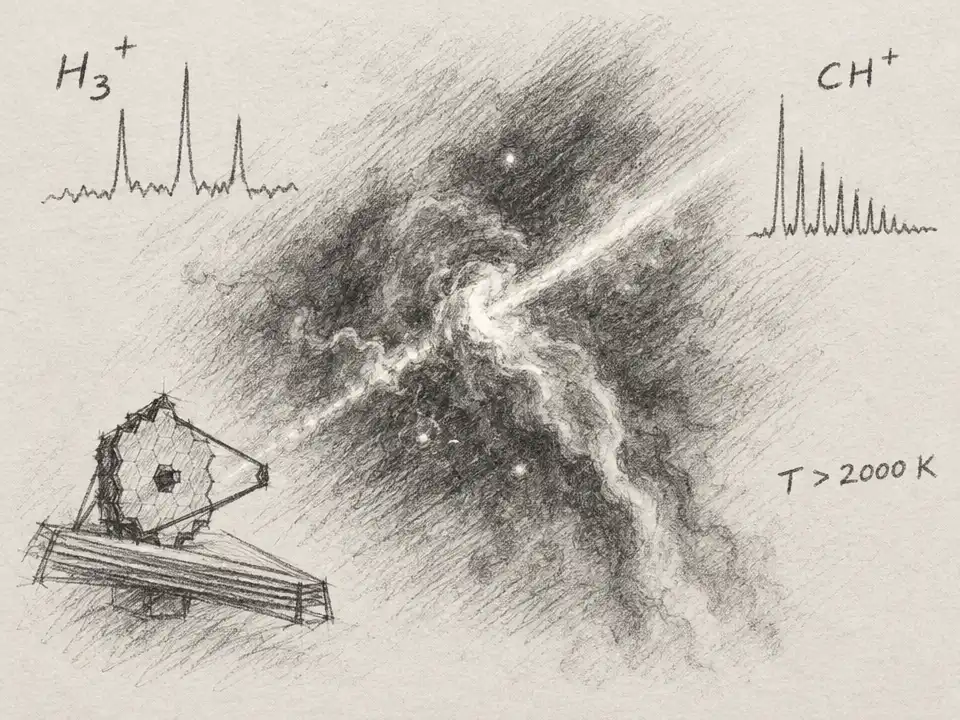
To sort out those possibilities, Jacob Hyden and colleagues assembled a coordinated campaign across space and ground. They monitored DQ Tau with seven instruments; the new study focuses on nine sets of spectra from the James Webb Space Telescope’s MIRI instrument and nine from the iSHELL spectrograph at the NASA Infrared Telescope Facility. Across 40 days, the observations caught three successive bursts. The bursts varied sharply in strength, with accretion luminosity pulses increasing by factors of about 9 to 80.
The first clue came from comparing different kinds of light. Atomic hydrogen lines and the infrared glow near five micrometers rose and fell with the accretion bursts, as expected if they were closely tied to material falling onto the stars. Hot molecular gas told a different story. Emission from carbon monoxide and water generally weakened across multiple orbits instead of reliably brightening at every close approach. Meanwhile, cooler water features and longer-wavelength continuum emission increased.
That split is a puzzle in itself. If a burst simply heated a fixed patch of disk and rapidly changed its chemistry, molecular emission might be expected to track the changing energy input. But chemical models predict that reactions in the relevant infrared-emitting gas can take roughly 0.1 to 10 years to settle, while the bursts in DQ Tau last less than 10 days. The molecules may not have time to adjust chemically before the next change arrives.
A second clue came from the shapes of the spectral lines. Gas moving rapidly around a star spreads its light over a wider range of wavelengths; slower-moving gas makes a narrower line. Assuming the observed broadening is mainly caused by Keplerian rotation, the team could estimate where the emitting gas was orbiting. Over roughly 30 to 35 days, the hot molecular lines narrowed as their luminosities fell. The inference is not that the researchers watched gas travel in a picture, but that the gas dominating the emission appeared to shift outward, toward cooler, slower-moving regions within the inner cavity.
This combination helps distinguish a dimming source from a changing one. Fits to the water spectra suggest that the hot component’s emitting area shrinks while the warmer component spreads over a larger area. In the team’s interpretation, the inner part of the cavity begins relatively full of hot molecular gas; over the following weeks, less of that gas emits from the tight, hot region, while emission from cooler material farther out grows. The changing spectrum may be a map of a disk rearranging itself.
Yet this is no simple story of an emptied ring. The line profiles indicate that some carbon monoxide can orbit very close to the binary, even within the region occupied by the stars’ orbit. And line widths are an indirect ruler: turning them into distances depends on the assumption that rotation dominates the motion. Without direct images of the gas and longer monitoring, the authors caution that parts of their interpretation remain speculative. The disk may be draining inward, being swept outward by the binary, or doing both at once.
The most intriguing clue may be a slower rhythm beneath the 15.71-day orbital beat. When the new observations are considered alongside longer records, the strength of the bursts and the molecular emission show a tentative modulation over about four to five binary orbits. One possible explanation is a “lump” of gas building up near the cavity’s outer edge, then feeding a stronger burst when it becomes unstable. The study estimates that this region lies near 0.4 astronomical units, close to where disk models place the cavity edge.
There is a snag: the lump idea is best known from simulations of circular binaries, while DQ Tau’s orbit is strongly eccentric. Most models for systems like DQ Tau do not predict a stable repeating lump cycle. The observed modulation is not strictly periodic either, and historical records do not show a steady four-to-five-orbit clock over long times. A few models hint that burst strengths can vary over several passes, but the cause is not settled. The proposed reservoir is a promising explanation, not a solved one.
That leaves researchers with a more revealing question than “What made the stars flare?” The pair’s orbit already explains why bursts happen near close approach. The harder mystery is what controls how much gas is available from one pass to the next—and why the hottest molecular emission migrates even while the accretion clock keeps ticking. Longer campaigns could track whether the apparent outward shift reverses as material builds up again. Spatially resolved observations could test whether the gas really gathers near the cavity edge.
For now, DQ Tau offers a reminder that a planetary disk can be dynamic on the same timescale as an observing campaign. A single spectrum might catch it in one phase and make that moment look like the whole story. Follow the light over successive orbits, and the hidden structure begins to move: bursts rise and fade, hot gas recedes, cooler regions brighten, and a possible reservoir starts to refill. The clock is clear. What keeps winding it is not.