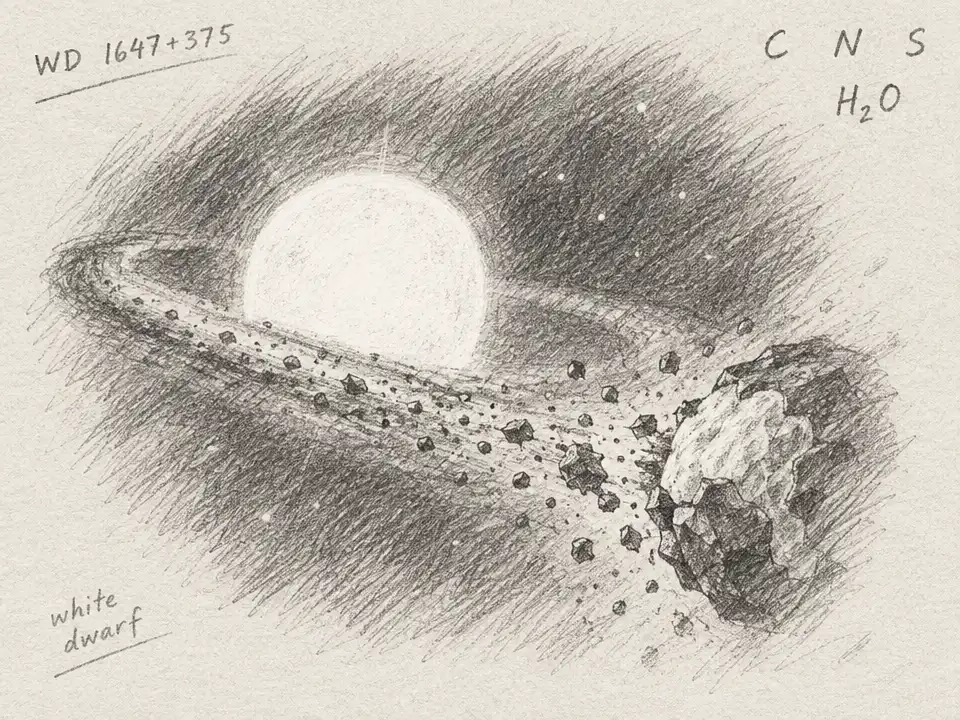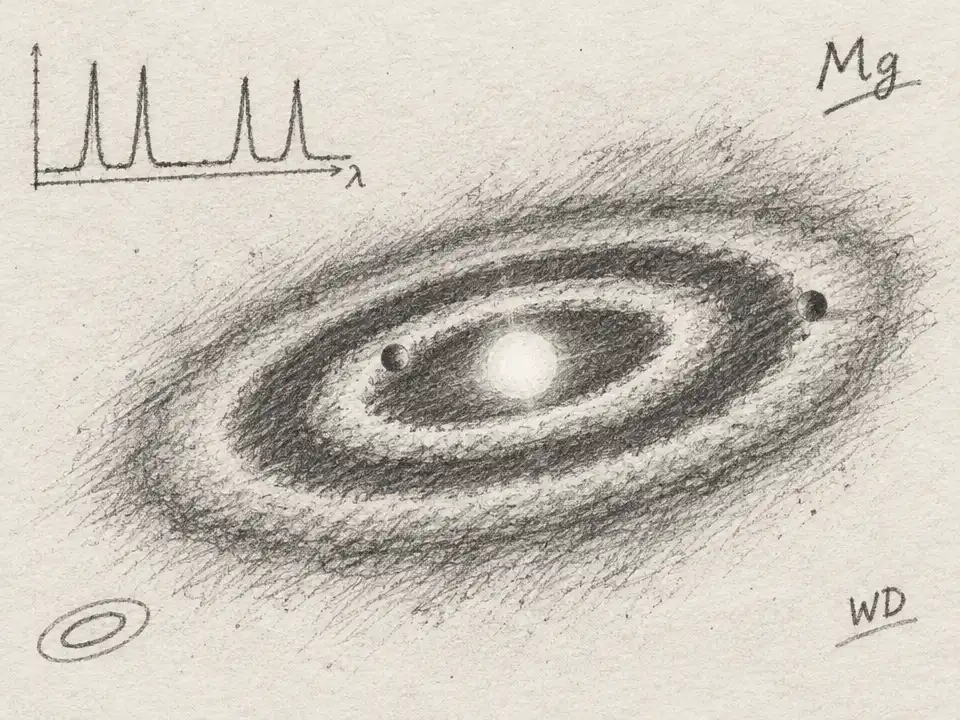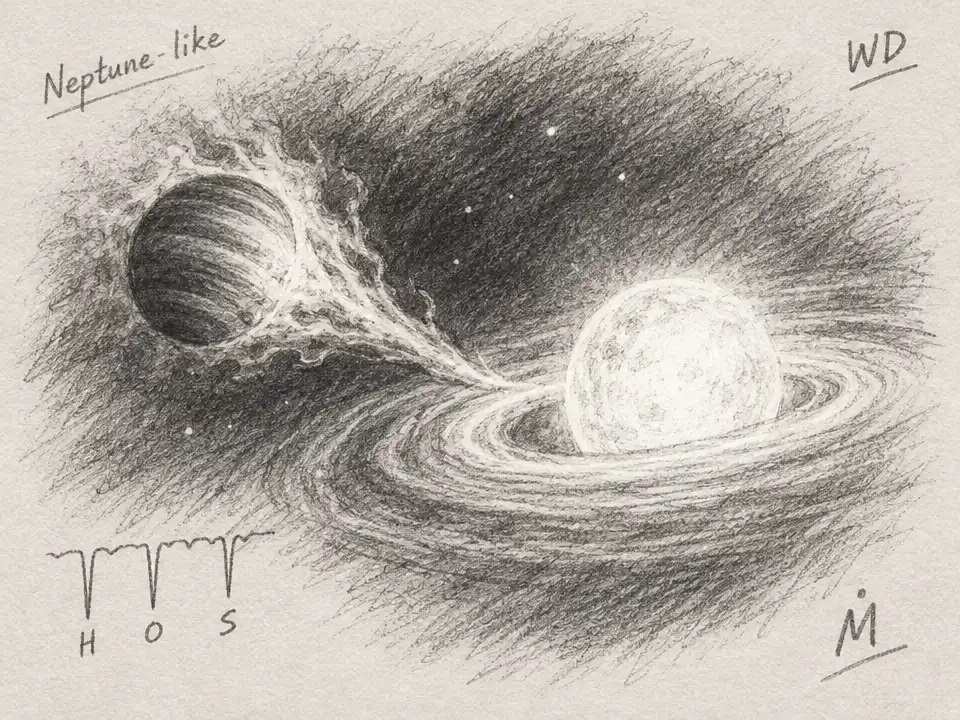
A white dwarf is not supposed to wear a veil of fresh planetary gas. This one does. Its spectrum carries clues to hydrogen, oxygen, and sulfur in a surrounding disk, while other lines suggest material from that disk is falling onto the star. What could keep supplying it? One answer is startlingly ordinary in one sense and extraordinary in another: a planet may be losing its atmosphere under the glare of a stellar remnant.
The star, WD J0914+1914, is a white dwarf with a surface temperature of 27,743 K and a cooling age of about 13.3 million years. The gas around it has been interpreted as the remains of a Neptune-like planet being heated and stripped. But interpretation is not a measurement of the planet itself. The planet has not been directly seen, and the story has some hard clues to reconcile: how much gas can escape, whether it can reach the star, and how a planet got so close so quickly.
The proposed orbit is especially awkward. One estimate places the planet about 0.07 au from the white dwarf, where it would circle in 8.9 days. Yet the star is young enough that there may not have been much time for a distant planet to migrate inward and settle into that orbit. A companion star could help push a planet onto an extreme path, but none has been identified. Other ideas invoke tides that gradually shrink a planet’s orbit. A closer orbit, around 0.04 au, could make tidal settling easier, but it changes the details of the case. The mystery is not only what is feeding the disk; it is how the suspected feeder arrived.
To test whether the planet idea can supply the observed gas, Carolina Villarreal D’Angelo and colleagues built the problem in two stages. First, they used three-dimensional simulations to follow a planet’s hydrogen atmosphere under the white dwarf’s intense high-energy radiation. Then they fed the calculated escape rate into a separate model of a disk, tracking how gas spreads and drifts toward the star. The two-stage approach let them model the near-planet flow in detail without having to calculate the entire disk in three dimensions for hundreds of years.
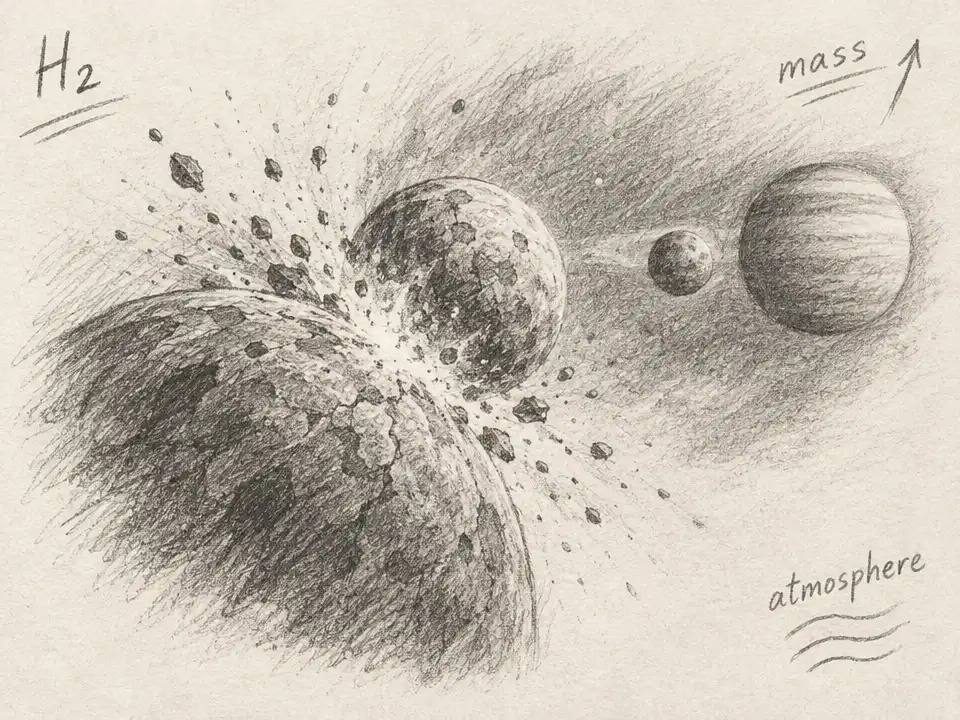
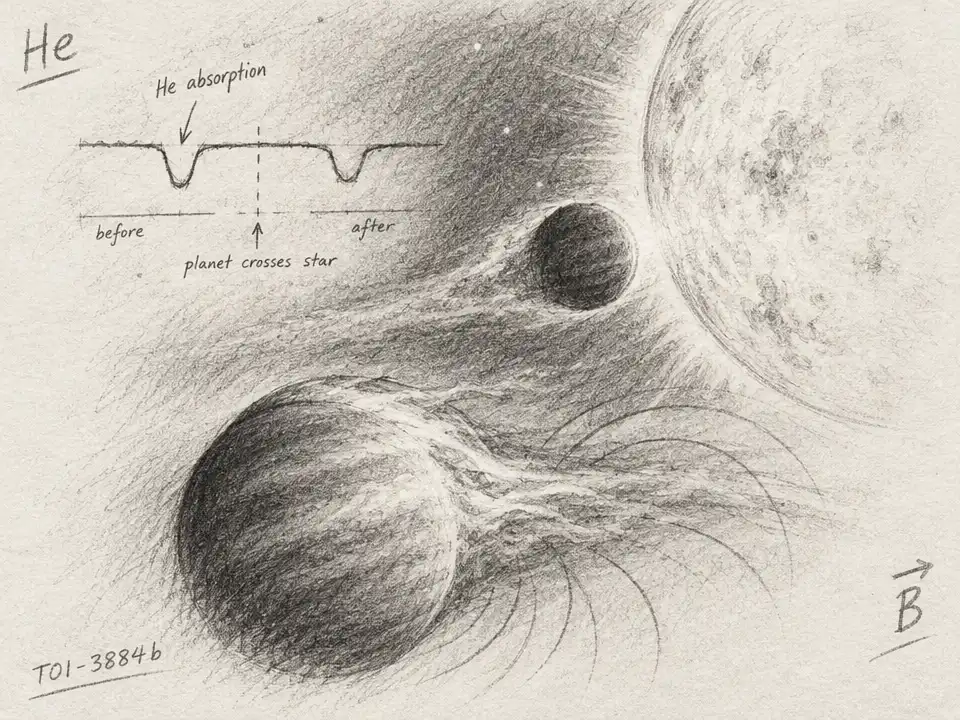
The simulated atmosphere does not peel away evenly. On the planet’s sunlit side, incoming radiation heats and ionizes gas, launching a fast outflow. On the dark side, cooler, mostly neutral material trails behind in a narrow, comet-like tail. In the models, sunlit gas reaches about 40 km s−1; the night-side flow stays below 10 km s−1. The researchers’ simulations follow this changing plume until it reaches a steady pattern. With no stellar wind to sweep it away, the escaping gas remains bound to the system and can continue toward the white dwarf.
Here comes the first strong clue. Across three modeled possibilities—a Neptune-like planet at 0.04 au, a Neptune-like planet at 0.07 au, and a puffier, lower-mass planet at 0.07 au—the atmosphere loses mass at rates between 1.8 × 10¹² and 4.01 × 10¹² g s−1. Those estimates carry an uncertainty of about 30%, largely because the incoming high-energy radiation is uncertain. Even so, the simulated rates are consistent with the earlier estimate used to explain the system’s observations. The planet, if present, appears capable of supplying the raw material.
But gas leaving a planet is not yet an explanation for gas falling onto a star. The next test is whether the flow can form a disk and feed the white dwarf at the rate inferred from its spectrum. In the simulations, the escaping material first gathers into a ring near the planet’s orbit. The ring then spreads both inward and outward, much as a stirred-up crowd gradually occupies more of a room. Within about 200 years, gas reaches the model’s inner edge and accretion onto the white dwarf becomes important.
Then the process begins to regulate itself. The growing disk absorbs some of the white dwarf’s high-energy radiation, shielding the planet and slowing further atmospheric escape. Gas continues to drift inward, while the planet supplies less new material. In the modeled puffier-planet case, the disk settles into a balance in less than 105 years. Its predicted accretion rate is 4.25 × 10⁹ g s−1, close to the 3.3 × 10⁹ g s−1 inferred from observations. That match does not prove a planet is there, but it makes the planetary explanation physically credible.
A mismatch remains. The models predict that the disk spreads beyond the planet’s orbit, while earlier interpretations of the observations suggested a smaller disk. The authors offer a possible way out: a spectral line does not necessarily reveal the full boundary of a disk. It shines most clearly where the gas has the right temperature and density to produce it. Farther out, gas could be present but too faint to show up in those lines. So the apparent size conflict may be a limit of the clues, not a fatal flaw in the explanation.
The case still has open questions. The simulations treat the escaping atmosphere as pure hydrogen, though the observed gas includes heavier elements; the authors argue that some heavier atoms could be carried along with the hydrogen. They also model circular orbits, leaving more complicated, highly eccentric histories outside this calculation. And their next step is to model the disk’s formation in three dimensions, so its structure can be compared more directly with the observed spectrum.
For now, the answer to the puzzle is a plausible chain of events, not a planetary portrait: intense radiation lifts gas from a close-in world, the gas builds a disk, and the disk feeds the star while shielding the planet that supplies it. Each link can reproduce an important clue. The harder riddle—how a planet reached that precarious orbit, and whether it is truly the source—waits for better tests.