In the deepest view of the early universe, the surprise is not simply that some galaxies shine fiercely. It is how many seem to be caught doing so. A new study of galaxies seen across cosmic history finds that by redshift 8.3, roughly half belong to a class whose oxygen-and-hydrogen emission lines are exceptionally strong. The result points to a young universe where star formation may have surged in short, uneven bursts far more often than it does nearby.
The clue is a contrast between a galaxy’s bright emission lines and the softer glow of its surrounding stars. The lines come from gas energized by young, massive stars; the broader light includes stars that have been around longer. Astronomers describe the line strength relative to that surrounding glow as equivalent width. Think of it as measuring how prominent a bright stripe is against the background beneath it. When the stripe dominates, the galaxy may have formed many massive stars very recently.
The study focuses on the combined [O III] and Hβ lines. Those signals can reveal vigorous recent star formation, but they are not a simple live counter of newborn stars: the nebular emission responds to changes over roughly 10 Myr, while the galaxy’s continuum reflects a longer-lived population. Together, the line and continuum offer a kind of snapshot with a short memory and a longer one layered on top of each other.
To make that comparison, the researchers combined JWST NIRCam observations from the PRIMER and MINERVA surveys with earlier imaging. Their catalog covers 19 filters spanning 0.4–5.0 μm. The different filters act like narrow windows onto a galaxy’s light, helping separate emission lines from the underlying glow and estimate how far away each galaxy is. The combined data also improved photometric redshifts: among the tested sample, the outlier rate fell by 42 percent compared with PRIMER imaging alone.
From this survey field, the team built a sample of 1,964 galaxies, selected to be bright enough for a consistent comparison across redshift. They modeled the galaxies’ light with several assumptions about their stellar populations and star-formation histories, then checked the approach against [O III] and Hβ measurements from NIRSpec spectra for 115 galaxies. The best-performing setup used BPASS stellar-population models and a flexible, non-parametric account of how star formation changed over time. The spectra provide an important check, but the larger survey’s line measurements come from fitting the multi-filter light.
The trend is striking. At redshift about 3.2, the median equivalent width was about 350 Å, and the estimated fraction of extreme emission-line galaxies was 0.14 ± 0.02. At redshift 8.3, the median reached about 1100 Å. The estimated extreme-emitter fraction climbed to 0.50 ± 0.10. In this study, an extreme emitter has an equivalent width above 1000 Å. Earlier work already showed that strong lines were common in the early universe; this survey traces their rising prevalence across several redshift ranges with one consistent method.
That last fraction deserves a closer look. The highest-redshift bin, covering redshifts 8.0 to 8.5, contained 49 galaxies. The researchers did not simply count half of those objects and call the result exact. They estimated the fraction from the modeled distribution of line strengths, including its uncertainty. So 0.50 ± 0.10 means that about half of the population appears to cross the extreme-emitter threshold, with a meaningful margin of uncertainty—not that every galaxy was watched switching on.
The evidence for bursts comes from several clues that fit together. The strongest emitters have the signatures of very young stellar populations and high specific star-formation rates, meaning they are forming new stars rapidly compared with the mass of stars they already contain. When the researchers combined the light from groups of galaxies, the extreme emitters showed a prominent Balmer jump associated with young, nebular-dominated systems. Weaker emitters tended to show a clearer Balmer break, consistent with older stellar populations and lower recent star formation.
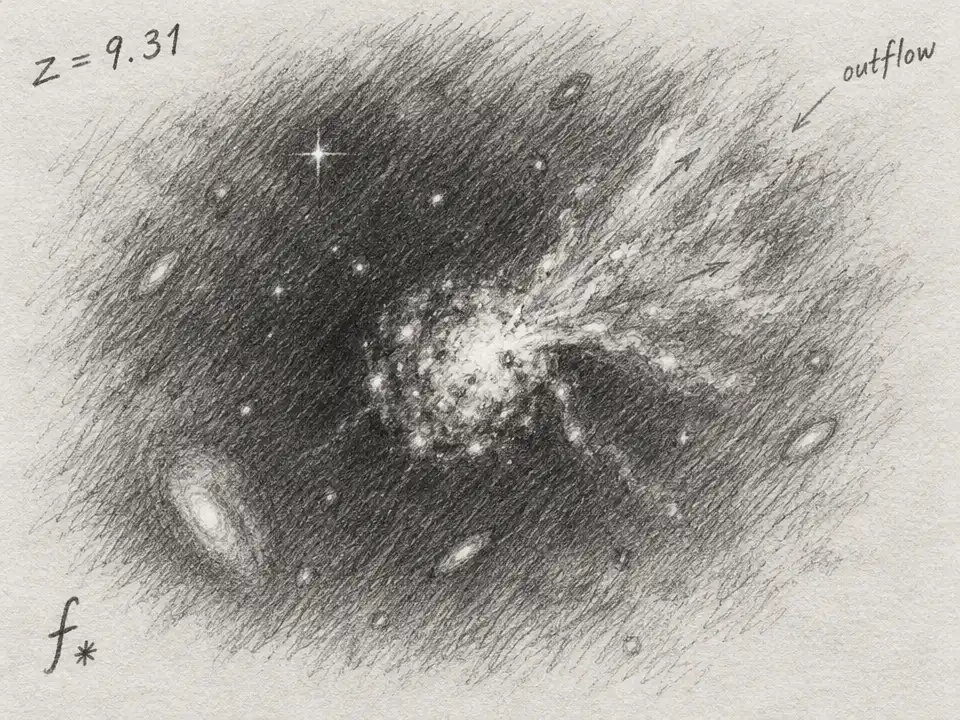
The shape of the population matters, too. At lower redshift, the distribution of line strengths is more nearly balanced. At higher redshift, it becomes increasingly lopsided, with both a strong-emission population and a tail of galaxies with much weaker lines. That pattern is what researchers might expect if galaxies spend time in intense bursts, then fall into quieter phases. Because the line emission fades and brightens on shorter timescales than the underlying stellar light, a burst can temporarily make the galaxy’s lines stand out dramatically.
But a telescope does not film these galaxies over millions of years. The burst explanation is an interpretation of snapshots and modeled light, not a direct movie of individual galaxies changing. Nor does weak emission automatically mean that a galaxy has just finished a burst. Very low metallicity, escaping ionizing light, or dense gas that suppresses some oxygen emission could also help produce weak lines. The authors say deeper, medium-resolution JWST spectroscopy will be needed to distinguish among these possibilities.
That caution does not drain the result of its force. The unexpected finding is that extreme emission appears to be a common phase, not a rare cosmic oddity, by redshift 8.3. The rising line strengths and the uneven distribution together suggest that early galaxies were not all building stars at a steady pace. Many may have flickered between intense activity and quieter intervals, while their light traveled across the expanding universe to JWST’s detectors.
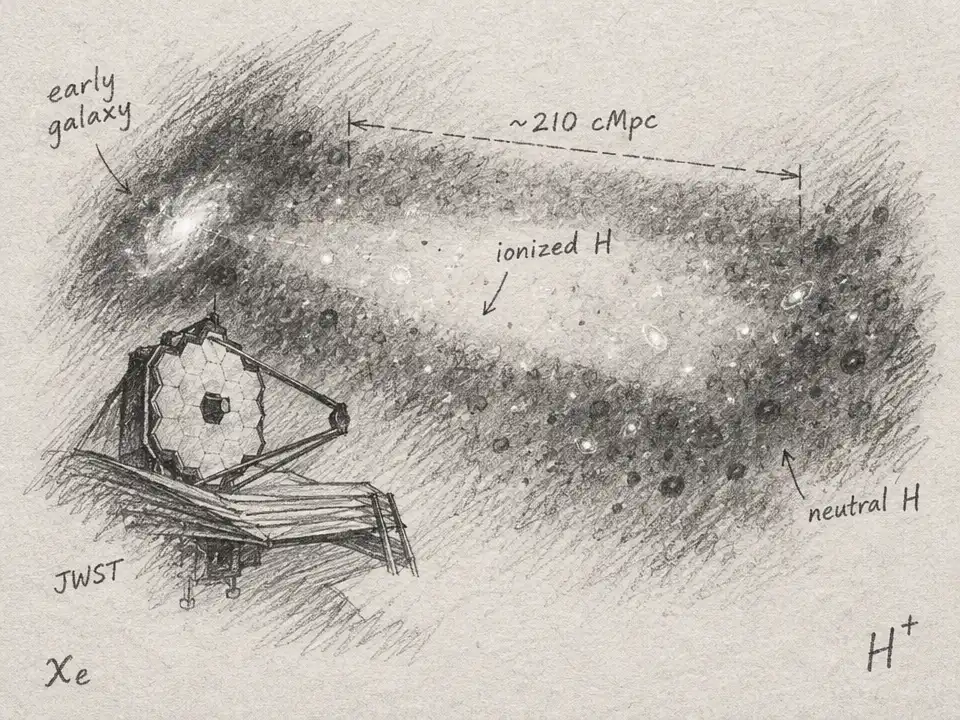
Learning when those galaxies formed stars—and when their output quieted—matters beyond a census of bright lines. Young stars produce energetic light that can affect the gas between galaxies. A clearer picture of their changing activity can therefore help astronomers understand the early universe, including the sources that helped transform it. For now, the survey offers an evocative clue: in the first chapters of cosmic history, the loudest stellar episodes may have been common enough to shape what a whole generation of galaxies looked like.