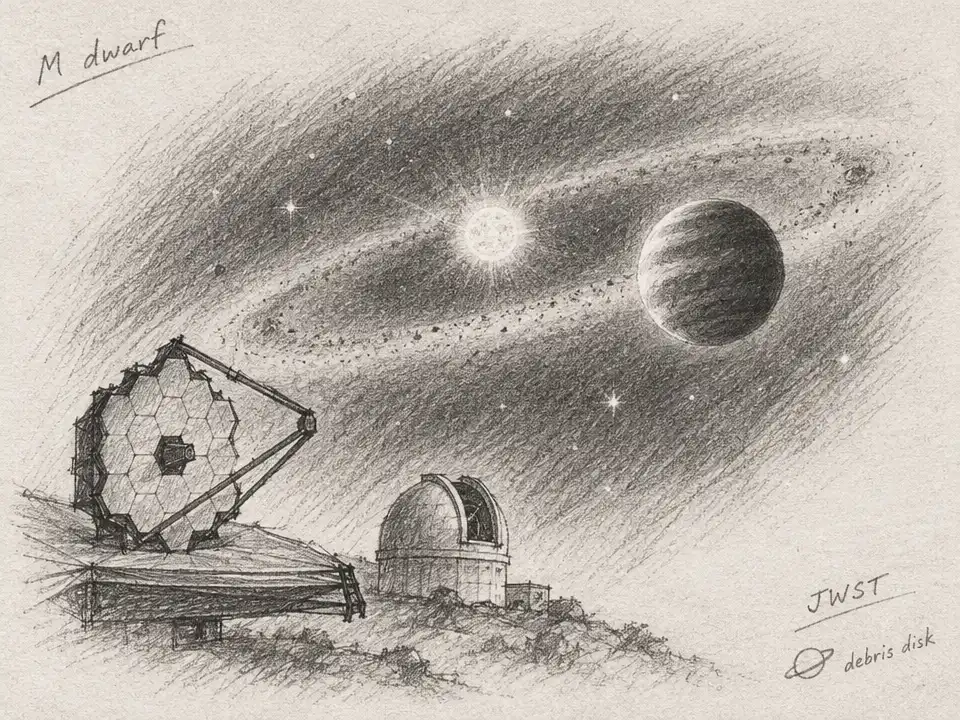
About 34 parsecs away, a young, low-mass star has a companion that seems to pose a simple question: How did a giant planet get there? The star, RX J0534.0-0221, is an M dwarf in the 18–26 Myr-old β Pictoris moving group. A new image revealed a faint point of light about 14 au from it. That point may be a rare clue to how giant planets form around stars much smaller than the Sun—and to how much we still have to learn before the clue becomes an answer.
The first evidence came from JWST. In one infrared filter, F444W, the point source stood out at a signal-to-noise ratio of about 17.5. In another, F200W, it did not appear. That red color is consistent with a warm planet, but a single image cannot establish that a faint speck belongs to the star. It might instead be a background object that only happens to line up in the telescope’s view.
So the team returned to the system about 16 months later with the Large Binocular Telescope Interferometer. The source appeared again. Its position was inconsistent with a stationary background object at about 6–7σ, strongly favoring a companion moving with the star. The follow-up detection was fainter than the JWST one, but it appeared across four observing nights and both telescope apertures. The team also tested whether its image-processing method could have created a false point of light; the source survived those checks.
The result is RX J0534 b, one of the lowest-mass planets directly imaged so far. Direct imaging means catching light from the planet itself, rather than inferring its presence from a star’s wobble or a brief dip in starlight. That is especially valuable here: the planet is far enough from its star to be seen separately, yet its host is the kind of small, faint star that has been difficult for many ground-based planet searches. JWST’s infrared sensitivity is opening a window onto this territory.
And the territory is scientifically awkward in an interesting way. M dwarfs are the galaxy’s most numerous stars, but their planet-building disks are expected to contain less material than disks around more massive stars. Their longer orbital timescales can also make it harder for growing planets to gather material quickly. Giant planets around M dwarfs are uncommon, and astronomers do not yet know which formation route can best explain them.
One route, core accretion, builds a solid core that later gathers gas. It is expected to work most efficiently nearer a star’s snow line, where conditions favor assembling icy material. Another route, gravitational instability, lets a massive disk fragment directly into clumps. But models have difficulty producing a planet as light as RX J0534 b inside about 100 au around an M dwarf. Its present separation—about 14 au—therefore falls in a useful, uncomfortable middle ground: not an obvious fit for either story.
The planet’s atmosphere offers another clue, though not yet a verdict. Its measured color is inconsistent with models of a low-metallicity atmosphere in chemical equilibrium. The data instead allow two possibilities: an atmosphere enriched in elements heavier than hydrogen and helium, or chemistry out of equilibrium, in which vigorous mixing brings gases such as carbon monoxide into layers where they would not ordinarily remain. Those explanations point to different histories, but the available colors cannot distinguish them. Spectroscopy across more wavelengths could.
JWST also picked up a faint, extended structure around the star, consistent with a debris disk: a broad belt of leftover material from planet formation. Modeling places its peak density radius at 79+3−3 au and its inclination at 56.5+1.5−1.5 degrees. The planet’s fitted orbit is consistent with the disk’s plane, a possible hint that both preserve something about the system’s birth. But the disk feature is faint, and its far side and outer edges were not detected; its measured shape should therefore be treated as tentative.
The disk also complicates the story. Its inner edge lies around 76 au, far beyond the known planet. At roughly 35 Hill radii from that edge, RX J0534 b is unlikely to be carving it directly. The researchers’ modeling instead points toward a chain of lower-mass planets as a more likely explanation. That is not a detection of hidden worlds; it is a suggestion from the disk’s shape, and other explanations remain possible. Still, the system may hold more than the one planet that first caught the eye.
There is a further catch: the planet’s mass depends on its assumed birth. Models that suppose it began hot give a mass of 2.8+0.5−0.5 MJup. A cold-start model, in which it began with less heat, instead gives 7.3+3.6−2.5 MJup. Both can fit the planet’s measured light. In other words, the observations constrain how warm and bright it is better than they constrain how much matter it contains. A direct mass measurement could help break that degeneracy.
That is the price of this promising new view: one detection cannot settle the origin question. The planet’s orbit is poorly constrained after just two observing epochs, and the fitted periods are long—about 100+113−39 years in one fit and 78+71−28 years in a disk-informed fit. More orbital monitoring will take patience; atmospheric spectroscopy and broader wavelength coverage will take precious observing time. But each could turn this faint companion into a sharper test of how planets grow.
For now, RX J0534 b is a small star’s outsized challenge to planet-formation models, paired with a disk that may preserve clues to the system’s architecture. If future observations can pin down its atmosphere, mass, and path around the star, astronomers may learn not just how this planet formed, but how often giant worlds can emerge around the galaxy’s smallest stars.