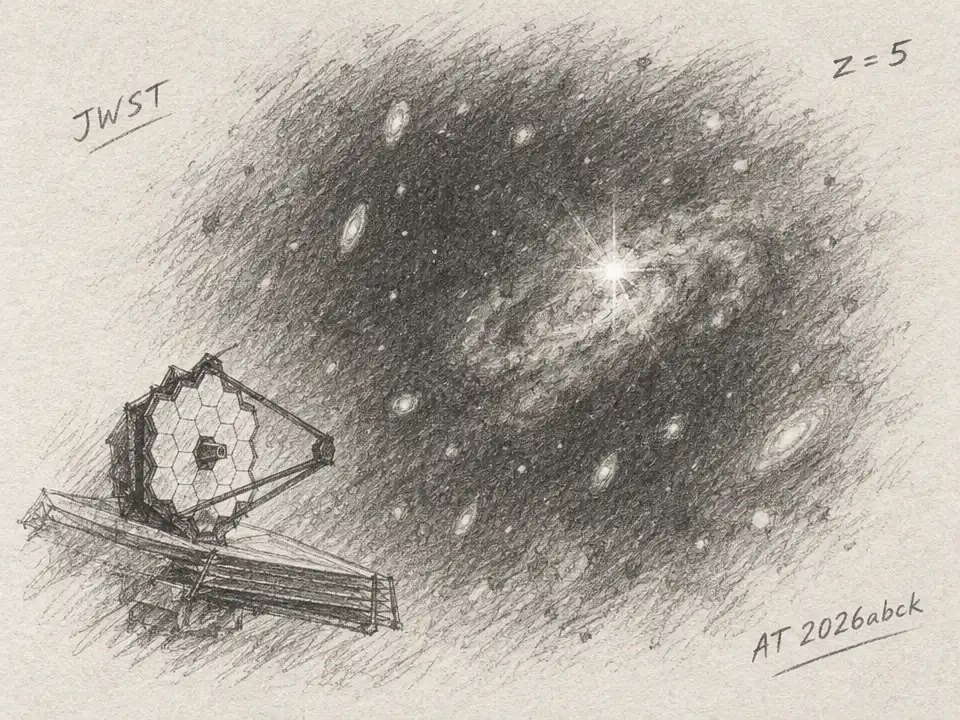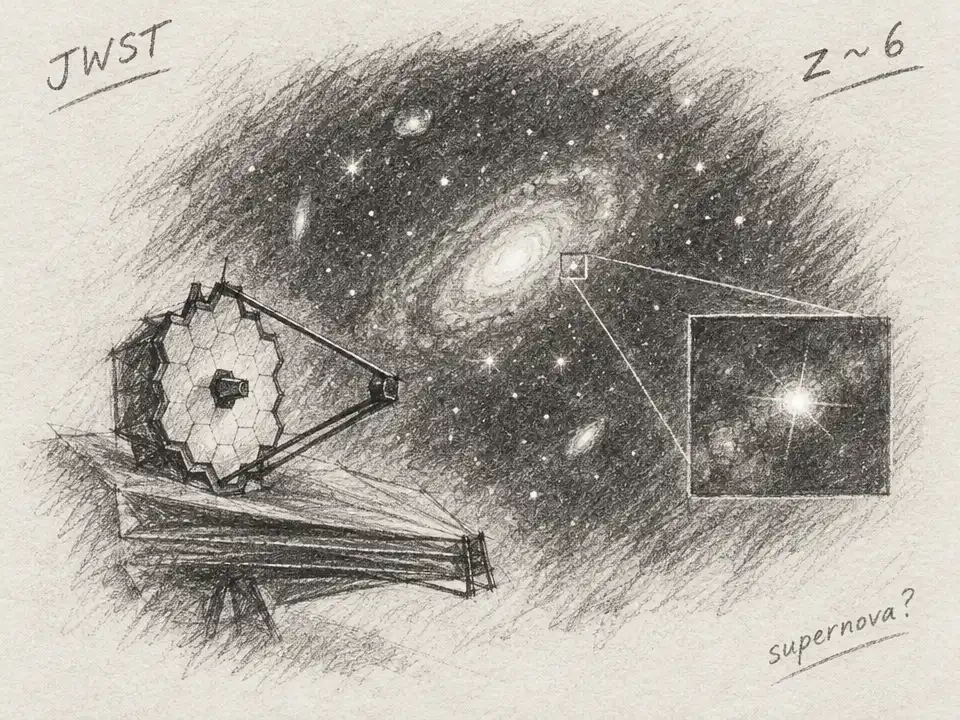
At first, there was nothing. In an image of a distant galaxy taken on May 28, 2026, one small patch of sky showed no sign of a transient. Then, in images from August 7, a new point of light appeared. It was not a star switching on in real time for anyone watching from Earth. The flash had traveled across the universe for billions of years before reaching the James Webb Space Telescope. But the gap between those two images holds a clue to what happened at the source: a brief stellar event, stretched out by cosmic expansion.
The transient, named AT 2026abck, lies in a galaxy at redshift 5.017. As the universe expanded during the light’s journey, it stretched the light’s wavelengths—and the apparent timescale of the event. The telescope’s two observations were 71 days apart. At the galaxy, that interval corresponds to about 11.8 days. It is a kind of cosmic slow motion: a little under two weeks in the event’s own frame spread across more than two months in ours.
When the new source appeared, it was more than 1.4 magnitudes brighter than the earlier image’s detection limit, meaning it had become more than 3.6 times brighter in the near-ultraviolet light JWST measured. That sudden rise places the event in a fleeting phase. The team estimates it was seen about 4 to 10 days after its explosion—just after a massive star may have torn itself apart.
The galaxy itself helped establish the distance. The researchers detected signatures of hydrogen and doubly ionized oxygen in its light, giving a spectroscopic redshift of 5.017. That is the host galaxy’s measurement, not a spectrum that definitively identifies the transient. The distinction matters: the team has a strong case for a supernova, but not a final classification.
Still, the flash has the telltale qualities of an unusually hot, powerful explosion. A blackbody fit to the transient’s colors suggests a temperature of about 17,000 kelvin, a photospheric radius of roughly 46 astronomical units, and a brightness of about 3.1 × 1043 ergs per second. The photosphere is the glowing outer layer from which light escapes; the 46-AU estimate describes the scale of that emitting surface, not a solid ball of material. At this early stage, the source was bright in ultraviolet light and compact by astronomical standards.
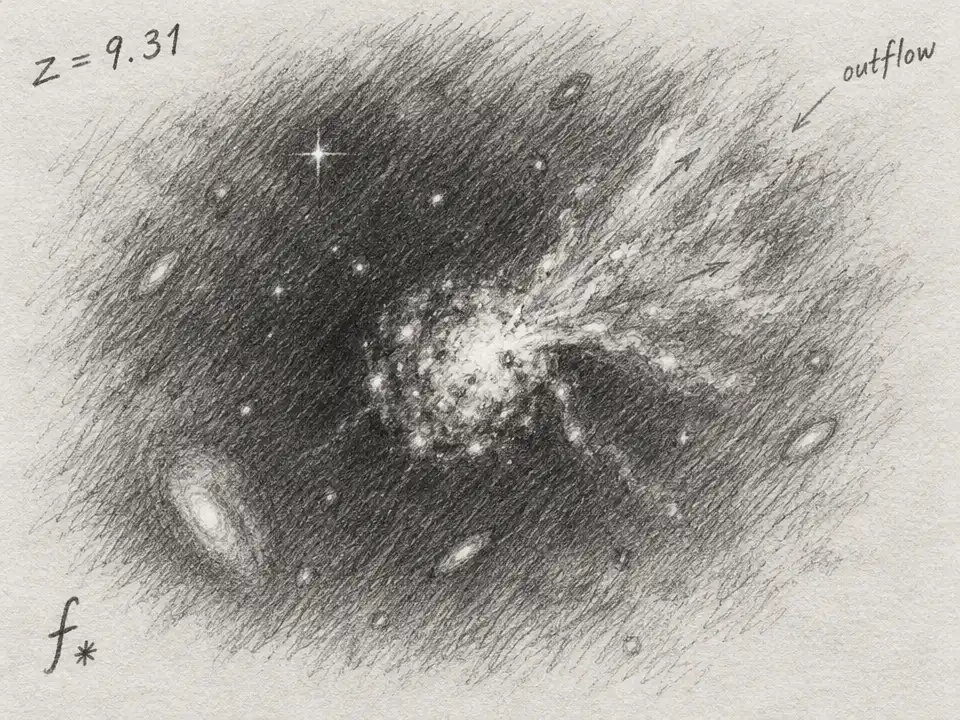
Its position offers another clue. The transient sits between two components of its host galaxy, about 1.1 kiloparsecs from the brighter one’s center. That off-center location makes a flare from a central black hole less likely. The galaxy is actively forming stars, a setting where short-lived, massive stars are expected to end in core-collapse supernovae. The evidence points that way, though an unusual event away from the galaxy’s center cannot be ruled out entirely.
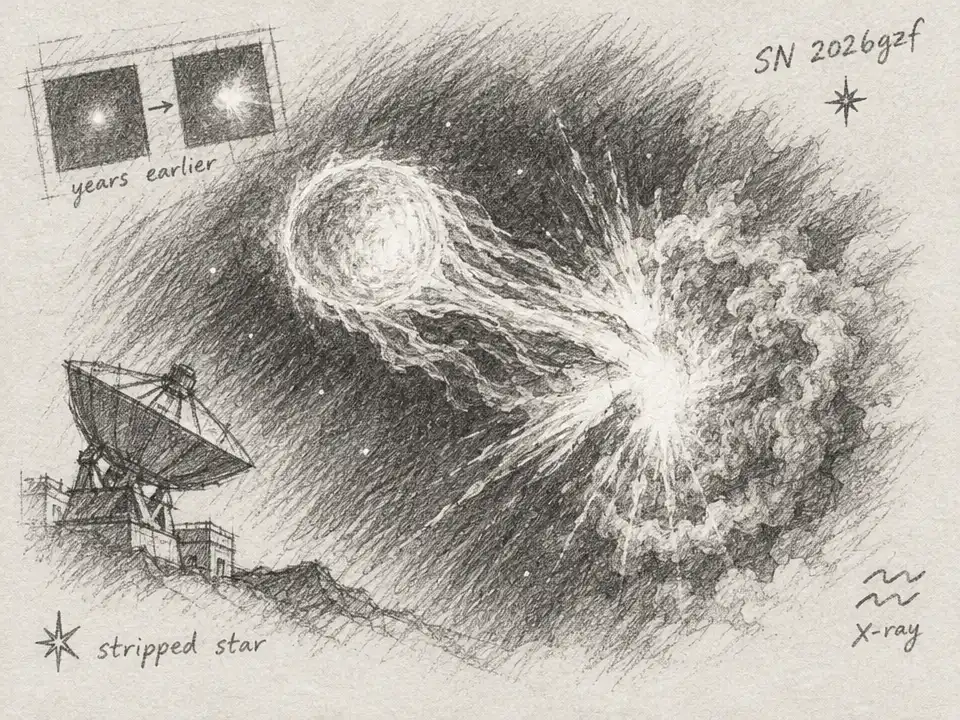
What powered the extra brightness is less clear. The first light from a stellar explosion can come from the shock wave heating and then cooling the star’s outer layers. A star with an extended envelope could produce an especially strong flash. Another possibility is that the blast slammed into dense gas the star had shed before exploding, converting some of the collision’s energy into light. The observations also leave room for a superluminous supernova caught while still brightening. A single set of images cannot yet decide among these stories.
The brightness is striking even compared with ordinary Type II supernovae—the hydrogen-rich explosions of massive stars. In a sample of 34 nearby examples with early ultraviolet observations, the researchers found none that reached this combination of heat and luminosity at a comparable stage. AT 2026abck sits near the extreme upper edge of the familiar population. That could mean it is an unusual member of a known class, or that the young universe hosted explosions with different properties. More observations are needed before either interpretation can carry much weight.
The key test is how the light changes. A typical Type II supernova should cool and fade quickly in ultraviolet bands, then settle into a longer-lasting plateau at redder wavelengths. A superluminous event could keep brightening across several bands. If interaction with surrounding gas is sustaining the glow, the source may stay unusually hot and ultraviolet-bright. Follow-up images and a spectrum of the transient—not just its host—could distinguish these possibilities.
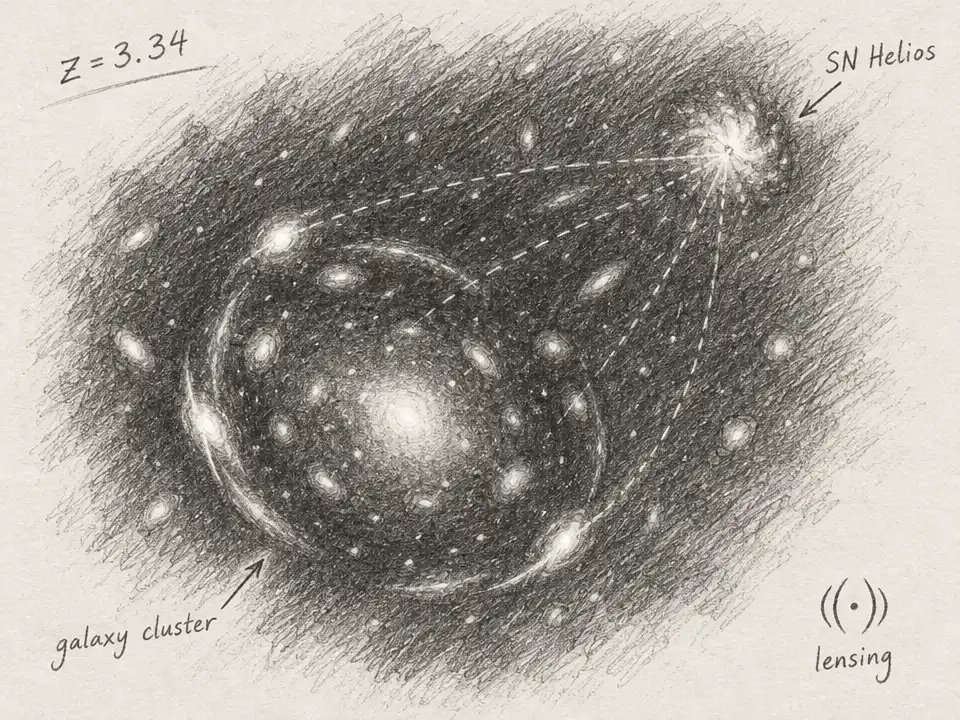
AT 2026abck is also notable for being detected without the aid of a gravitational lens, a massive foreground object that can magnify a more distant source. An earlier supernova at a similar redshift, SN Eos, was found through such magnification. This new event shows that a carefully timed survey can catch a bright stellar death directly, even at a distance where the universe’s expansion has blurred its quick opening into a much longer interval for us.
For astronomers, the payoff is not simply a more distant explosion. The first days after a star dies can reveal its outer layers and the gas it cast off before death—details that fade as the blast expands and cools. By catching this transient near the beginning, JWST has opened a narrow window onto how massive stars ended their lives in a young galaxy. The flash is still being interpreted, but its stretched-out arrival has made a fleeting event possible to study from across cosmic time.