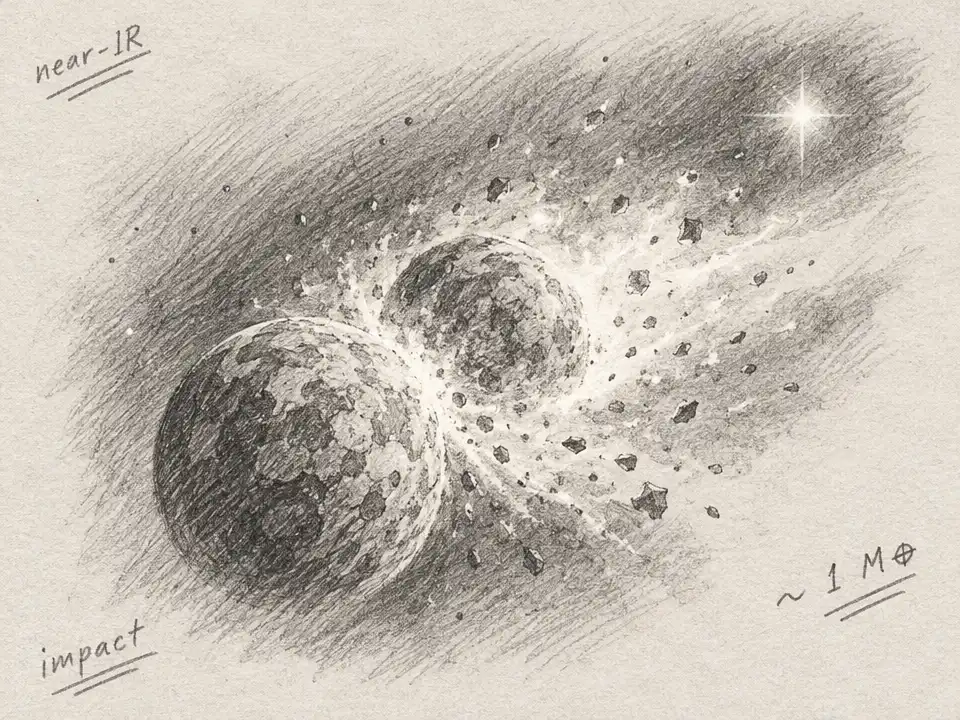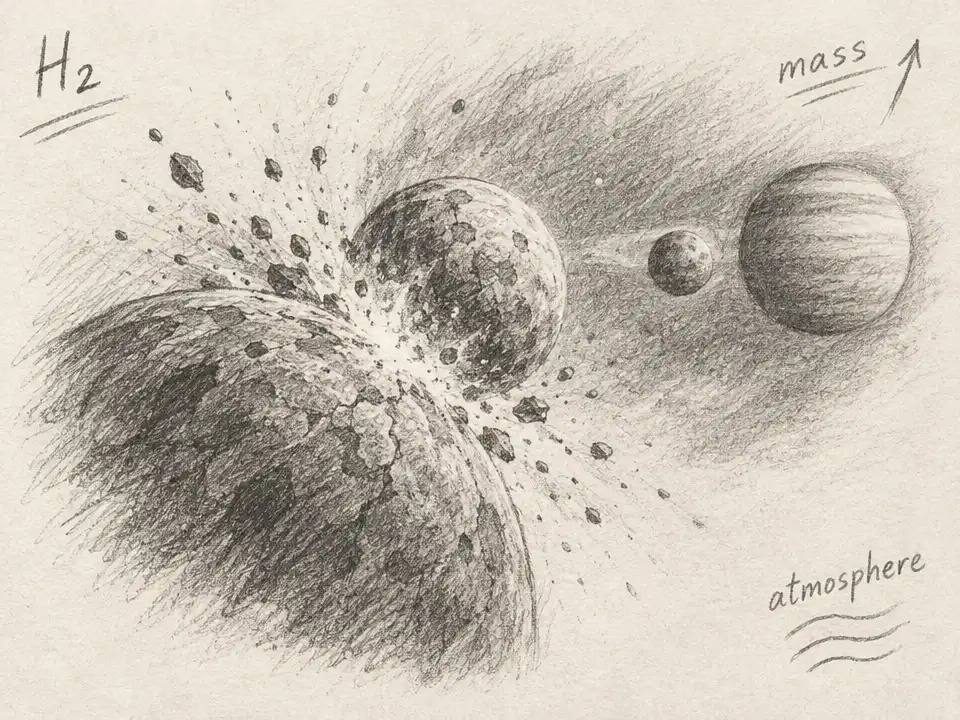
A planet is still growing when a world the size of another planet slams into it. The collision melts rock, sends a shock through the interior and can blast some gas away. That sounds like a recipe for stripping a young world bare. But a new model suggests the impact may do something less obvious: help the planet hold on to the rest of its hydrogen-rich atmosphere.
The key is that a collision changes two things at once. It heats the planet, which can encourage gas to escape, but it also adds mass, strengthening the planet’s gravity. The new study follows both changes together—and finds that the added gravitational grip can outweigh the heat that actually drives atmospheric loss. If that balance holds, some of the violent collisions thought to thin planetary skies could instead help preserve them.
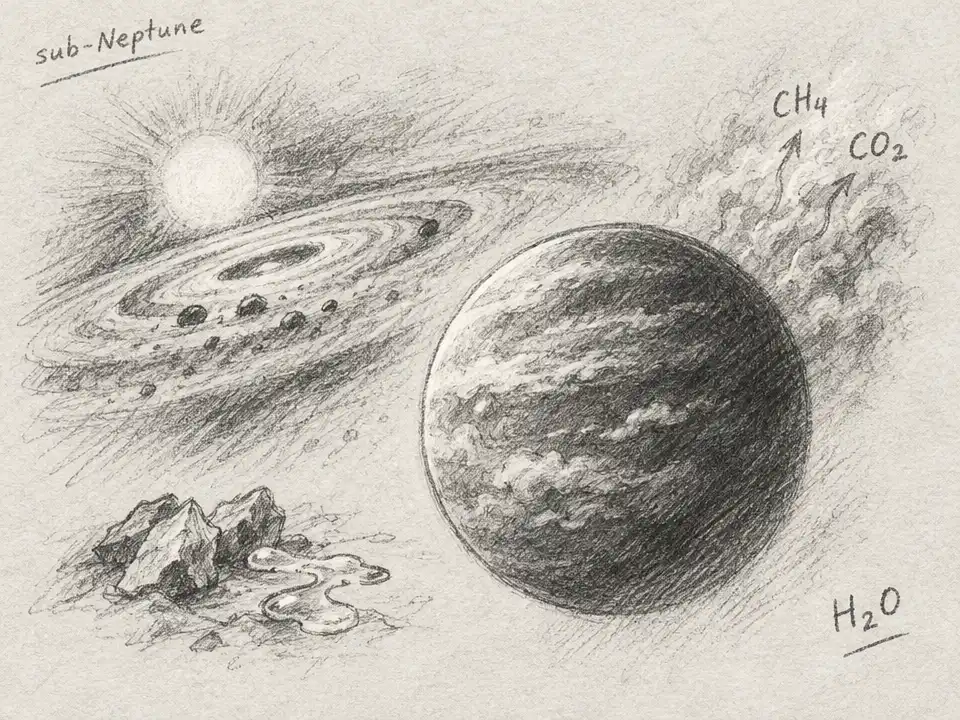
The question matters because small exoplanets do not come in a smooth range of sizes. Their radii cluster around two peaks: roughly 1.3 and 2.4 times Earth’s radius, with a relative shortage near 1.75 Earth radii. Astronomers call the smaller group super-Earths and the larger one sub-Neptunes. One widely discussed explanation is that some planets begin with hydrogen-rich envelopes and later lose them, shrinking into the smaller group. What causes that dividing line remains an active puzzle.
Giant impacts seemed like a plausible part of the answer. They can heat a planet’s surface, and hot gas can flow away. But the study’s authors argue that surface heat is not the whole story—or even necessarily the part that matters most. The thin upper atmosphere where gas escapes is separated from the hot interior by layers that limit how much the interior’s heat reaches it. Under the conditions they model, the temperature governing escape is usually set by starlight, not by the freshly heated surface.
Meanwhile, the collision’s added mass deepens the gravitational well surrounding the atmosphere. And not all the impact energy becomes useful heat. Some goes into melting the rocky mantle, where it is absorbed as latent heat. Much of the impactor’s metallic core sinks toward the planet’s center, carrying energy deep inside rather than efficiently heating the mantle. The result, in the model, is an uneven contest: gravity gains from the added mass, while only part of the collision’s energy can raise the heat that might push gas away.
This does not mean an impact leaves every molecule untouched. Shocks can directly eject atmospheric gas; earlier work discussed in the study finds losses often around 10%–20%, with larger losses possible in some collisions. The new claim concerns the planet’s longer-term balance: after that immediate damage, the larger, more massive world may be better able to retain what remains than it was before the impact.
To explore what this could mean across planetary systems, the researchers evolved a synthetic population of 108 planets. They compared atmospheric loss with the cooling of a post-impact magma ocean and with the planets’ later evolution under stellar irradiation. Their model reproduced the broad observed pattern of planet sizes, including both peaks and the dip between them, across the impact probabilities and impact-size distributions they tested.
The comparison also makes the proposed role of collisions clearer. In a control population with no late giant impacts, too many planets lost their hydrogen atmospheres, leaving an excess of super-Earths and too few sub-Neptunes. In the opposite control, where every planet experienced such an impact, too many kept their atmospheres. In the model, impacts help regulate the mix by pushing some growing planets across a threshold: massive enough to hold on to hydrogen, rather than losing it during the long stretch of stellar irradiation that follows.
That suggests a different origin story for at least some sub-Neptunes. Instead of being simply the survivors of planets that escaped destructive collisions, they may be worlds whose collisions helped them grow massive rocky interiors and retain a thin, puffing layer of primordial gas. The authors point to a possible mass distinction, too: statistical analyses find that sub-Neptunes tend to exceed roughly 4–5 Earth masses, while super-Earths tend to fall below that range. The model links that transition to the ability of a planet’s gravity to hold an atmosphere.
But the possibility comes with a price: the collision’s role is inferred through a population model, not watched directly on a young planet. The calculations focus on the largest giant impact after the gas-rich planet-forming disk disperses. They assume the impactor is fully accreted, use a simplified treatment of atmospheric loss over time, and adopt representative starting distributions for planet masses, atmospheres and collisions. The authors also note that their model does not include every process that can remove gas; for example, stellar X-ray and ultraviolet heating after the impact can further erode atmospheres. These choices make the result a testable proposal, not a final census of how planets form.
The next step is to find out whether the predicted difference appears in real worlds. The study points to measurements of planetary masses and atmospheres as ways to test whether sub-Neptunes really have more massive rocky interiors and commonly retain hydrogen-rich envelopes. Future observations could turn a population-level pattern into a physical history: which planets grew through major collisions, which lost their gas, and which emerged from a wreckage of rock with a sky still clinging on.