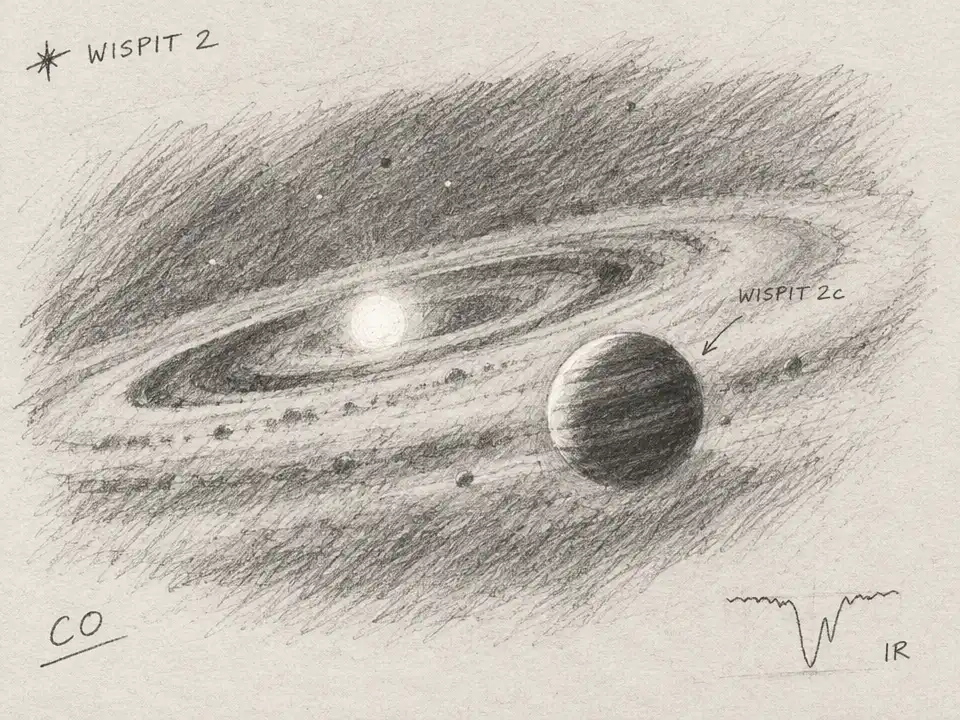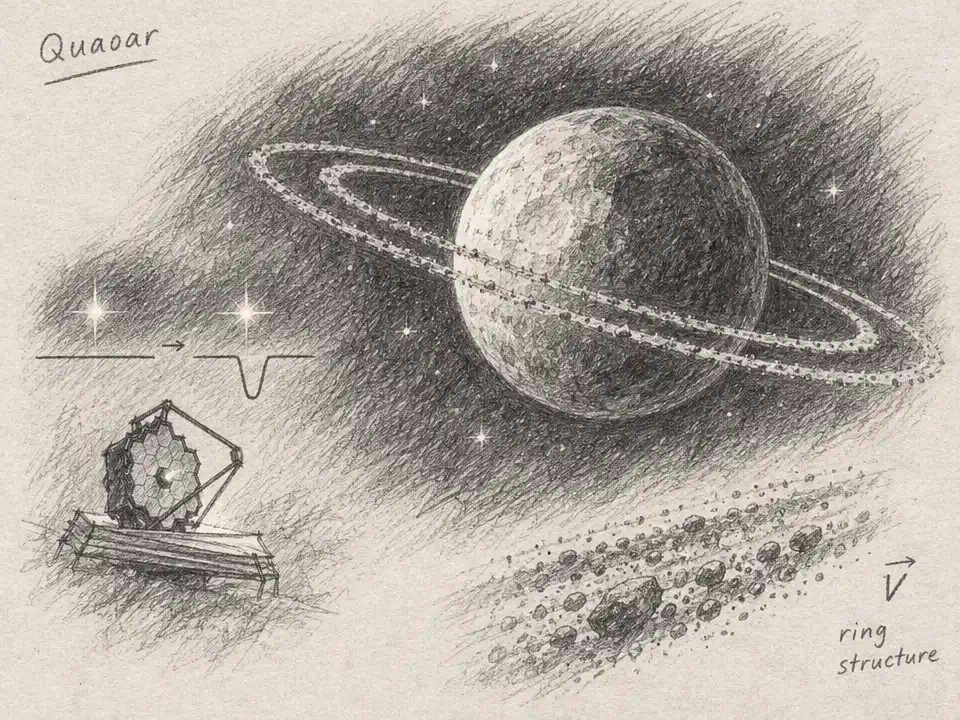
Imagine a distant planet appearing as a single faint point beside its star. It brightens, dims, then brightens again in a pattern that seems too strange for a bare world. The surprise may not be on the planet. It may circle around it: a broad ring, reflecting starlight into our telescopes.
That possibility carries a catch. In reflected-light images, a planet and its rings may blur together into one unresolved speck. The extra light could help astronomers find a planet they would otherwise miss—but also make the world seem bigger or more reflective than it really is. Two recent studies model how those rings might announce themselves in observations with the Nancy Grace Roman Space Telescope’s Coronagraph Instrument, or CGI. They predict a new kind of target and a new source of confusion.
The studies do not report a ring discovery. They ask what a ringed planet might look like as it moves around its star. The basic trick is to watch the combined light change over time. A bare planet presents different illuminated portions of its atmosphere as it orbits, producing a gradual brightness curve. A ring adds a broad, tilted surface. As the system’s orientation changes, the ring can catch more starlight, turn edge-on, or cast a shadow across the planet.
In one study, researchers built a detailed model of a Jupiter-like planet with an icy ring based on Saturn’s, using Cassini observations of Saturn’s rings to represent their reflectivity. In favorable viewing geometries, a Saturn-equivalent ring raised the modeled peak visible-light signal by a factor of 3.1. Rings extending farther out could boost it by more than an order of magnitude. That extra reflected light could lift a planet toward—or above—the threshold where CGI might detect it.
But the ring is no simple spotlight. In this study, the model treats it as fully opaque: it reflects light from the star-facing side but not through the other side. As the planet travels along its orbit, the face seen by the observer can switch from illuminated to dark. The modeled brightness then drops sharply. In some geometries, the ring also blocks or shadows the planet, making the whole system fainter than the same planet without a ring. A ring could help a world stand out, or help hide it.
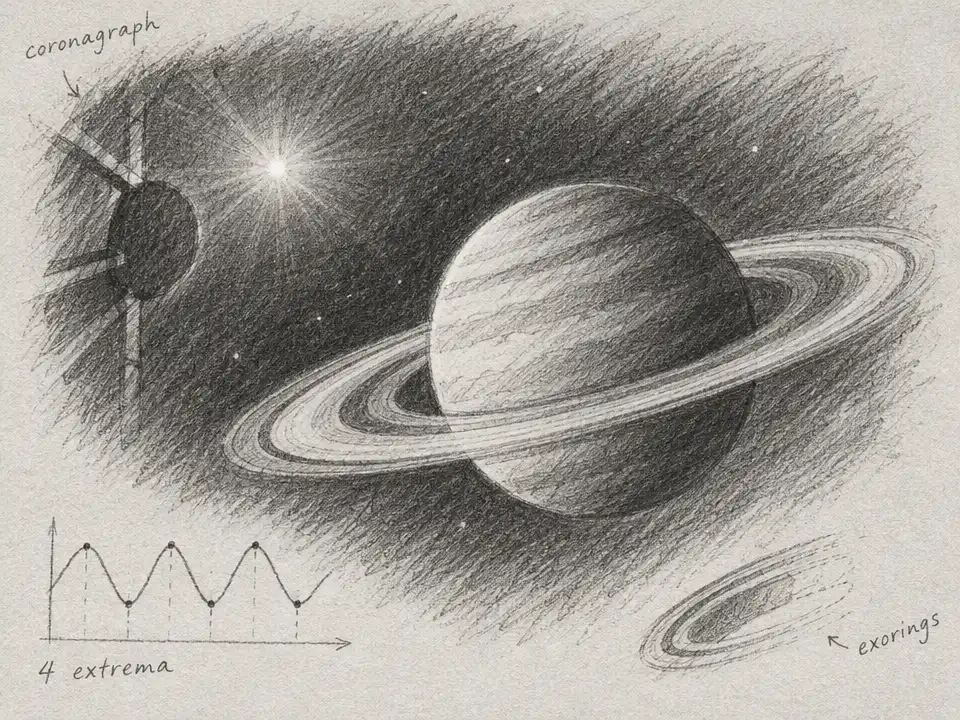
A second study explores a different kind of ring: one that is partly transparent, like Saturn’s rings in the model. That difference changes the light curve. The partly transparent ring can both reflect starlight and transmit some of it, producing a pattern with four brightness peaks or dips across an orbit, rather than the two expected for a ringless planet. The shape matters as much as the amount of light: repeated observations could reveal that the point of light is not just a planet changing phase, but a planet-plus-ring system changing angle.
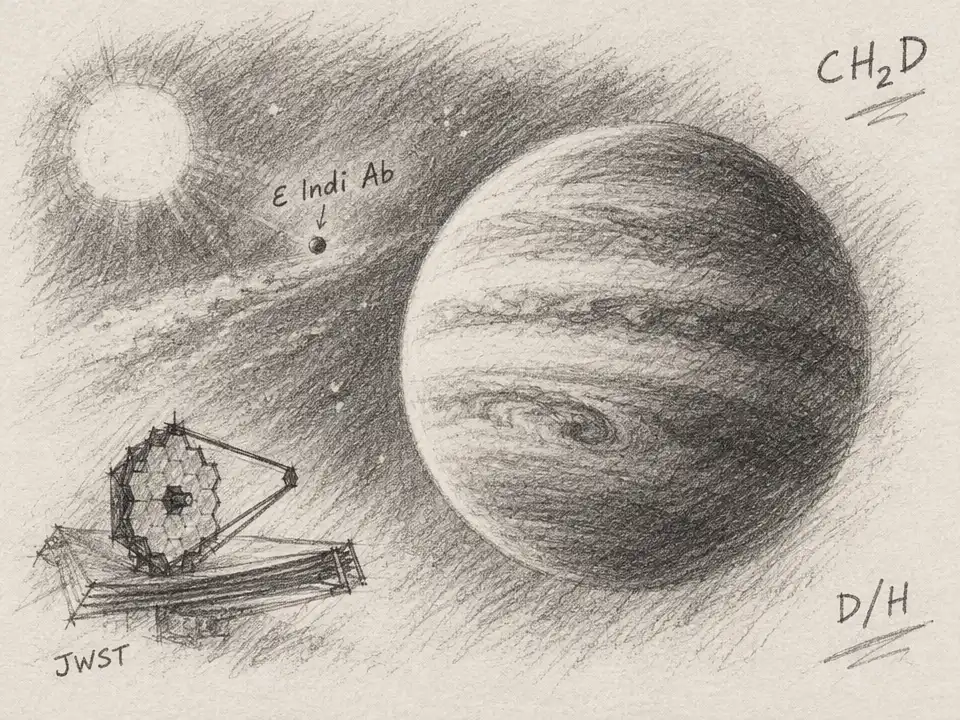
The authors test this idea with simulated observations of Epsilon Eridani b, a known giant planet about 3.5 astronomical units from its star. Without a ring, their model puts the planet near CGI’s detection limit: it would be detectable mainly when close to its brightest phase. Add a Saturn-like ring, and the simulated planet can appear up to twice as bright, with a distinctive four-extrema pattern. In the model, the ringed planet remains detectable over much more of its orbit. These are forecasts from simplified simulations, not observations of a ring around Epsilon Eridani b.
That distinction is crucial because extra brightness can masquerade as a different planet. If astronomers assume all the light comes from the planet itself, they might infer a higher reflectivity or a larger radius. In the opaque-ring study, a Saturn-sized ring could make a one-Jupiter-radius planet appear to require a radius about 2.5 times as large under one set of assumptions. The ring can also soften atmospheric features: light reflected by the ring may dilute the planet’s methane absorption, making the planet’s atmosphere seem to contain less methane than it does.
So the prize is bigger than a new class of detections. If astronomers can identify rings around mature exoplanets, they could begin measuring how common those structures are and learn something about the histories of distant planetary systems. Rings may form through collisions, disrupted moons, or material left from a planet’s formation. Their composition and shape could preserve clues to those events. For now, however, no mature exoplanet ring has been confirmed, and these studies show how to look—not what has already been found.
The price is time and careful interpretation. A single image is unlikely to settle the question: the planet and ring remain blended, and their brightness depends on viewing angle, ring tilt, and the ring’s ability to scatter or transmit light. Astronomers would need to revisit targets at different points in their orbits. For Epsilon Eridani b, the modeled orbital period is 2,680 days, so following the full brightness pattern is a long campaign, not a quick snapshot.
The models themselves are also first steps. One study assumes an opaque, icy ring and leaves out detailed scattering and ring stability. The other uses a simplified model of a partly transparent ring and omits effects such as shadows between the planet and ring. Real rings may have gaps, different particle sizes, or changing thickness. Those details could reshape the signal. A strange light curve would be a clue to investigate, not proof on its own.
Still, the idea is elegant: a ring that cannot be seen as a shape may be recognized by the way it changes the planet’s light. The same structure that makes a distant world easier to find can distort our picture of that world. To push the frontier, astronomers will need to watch patiently, model the whole system, and treat every bright point as a possible duet.