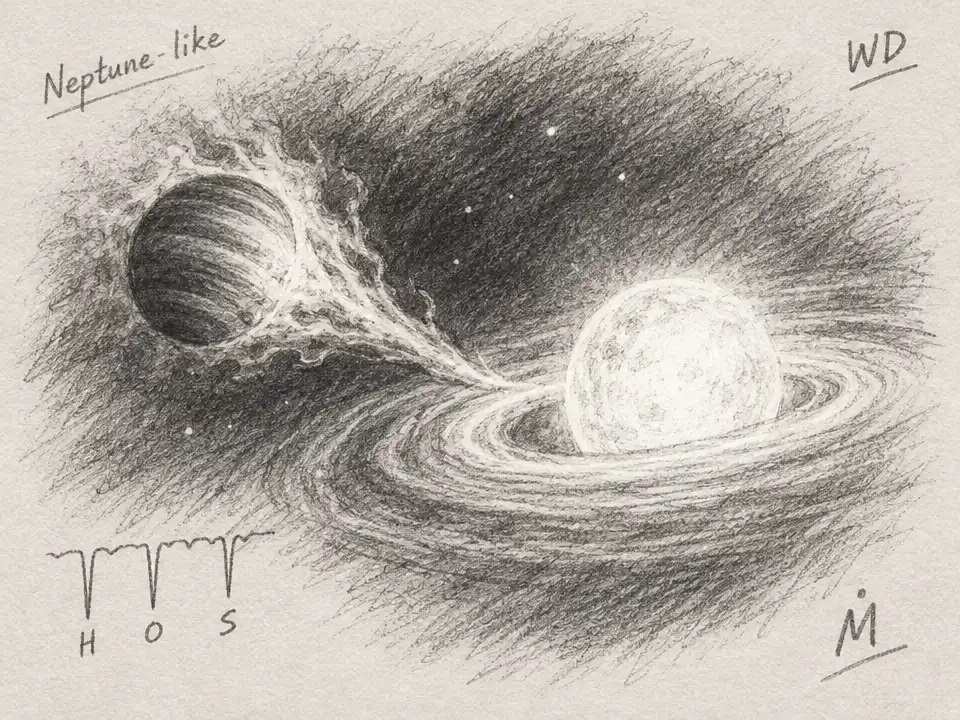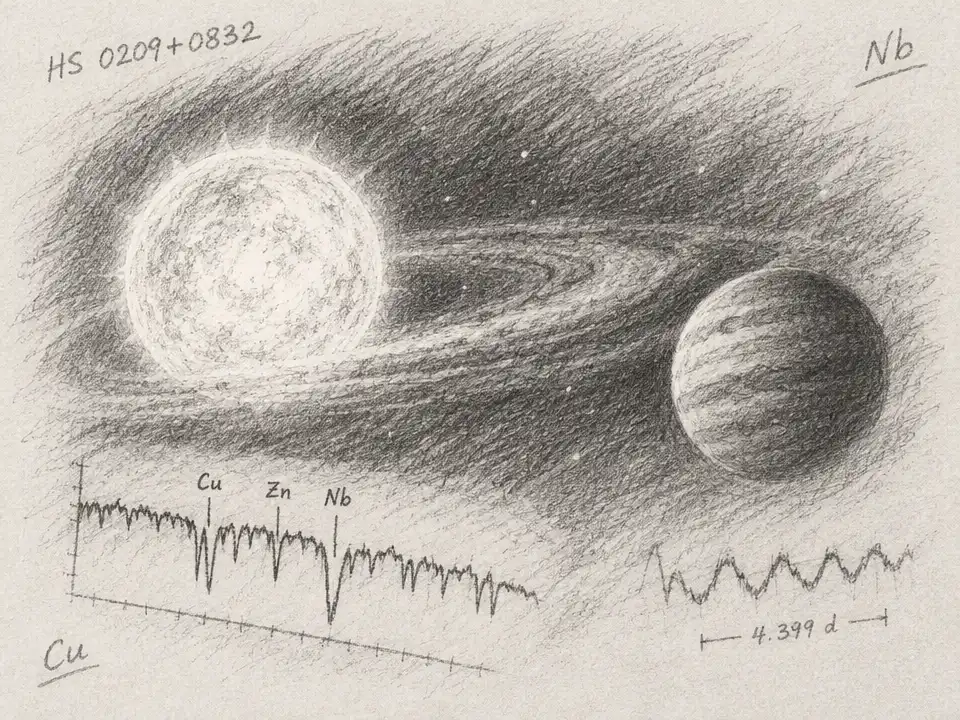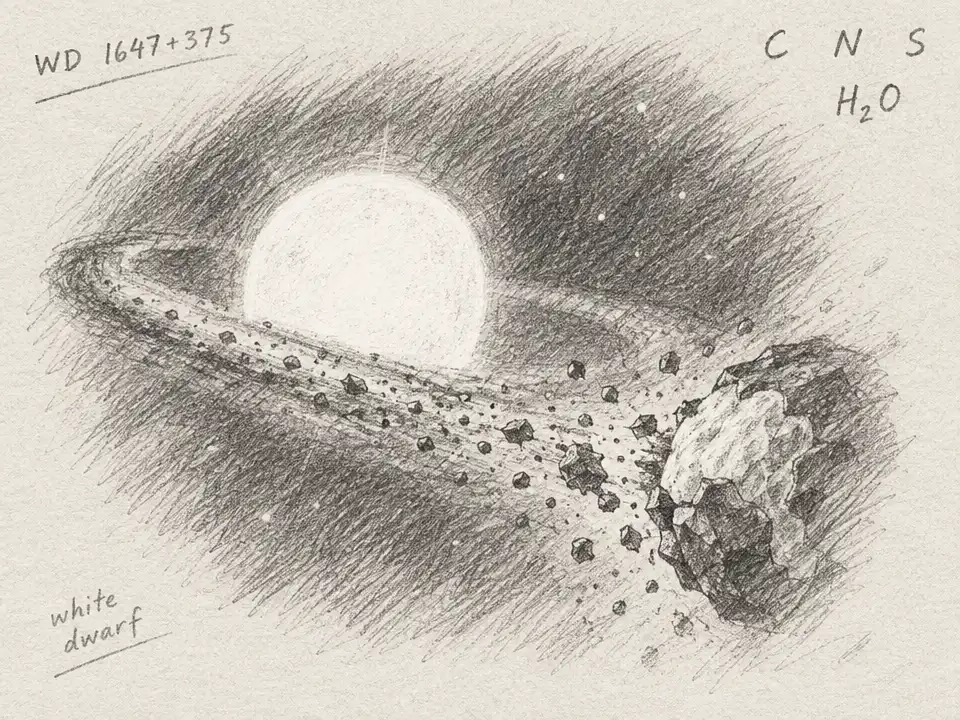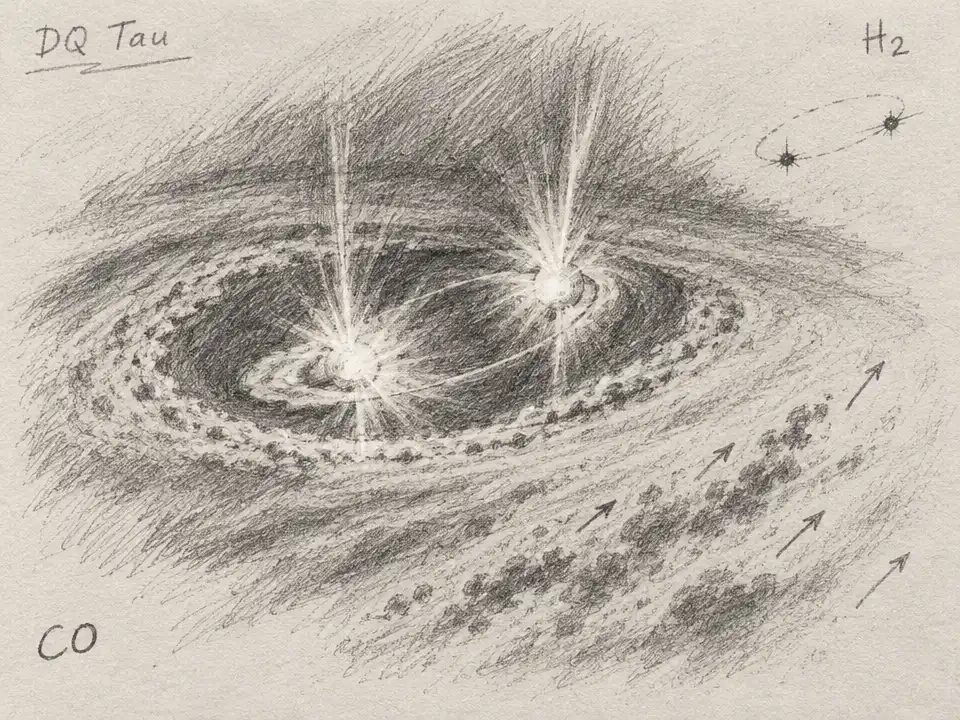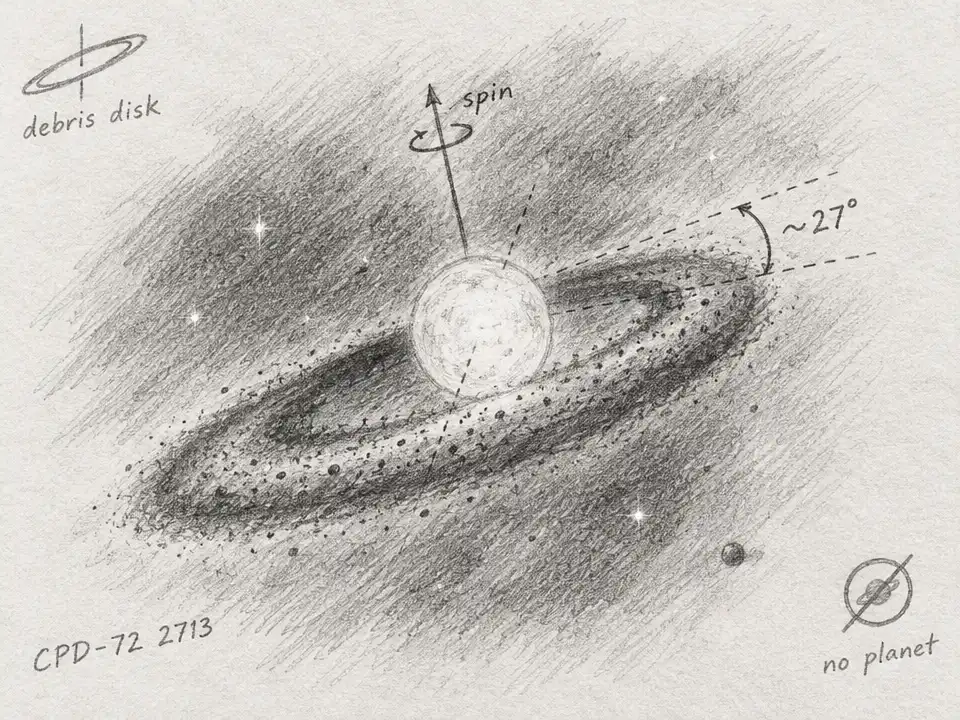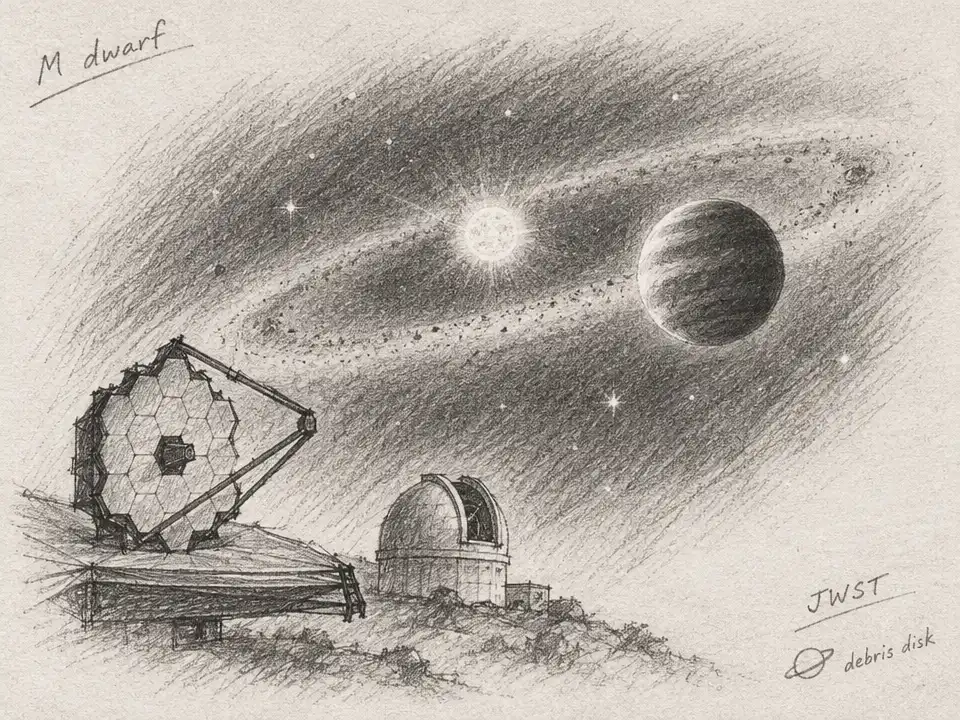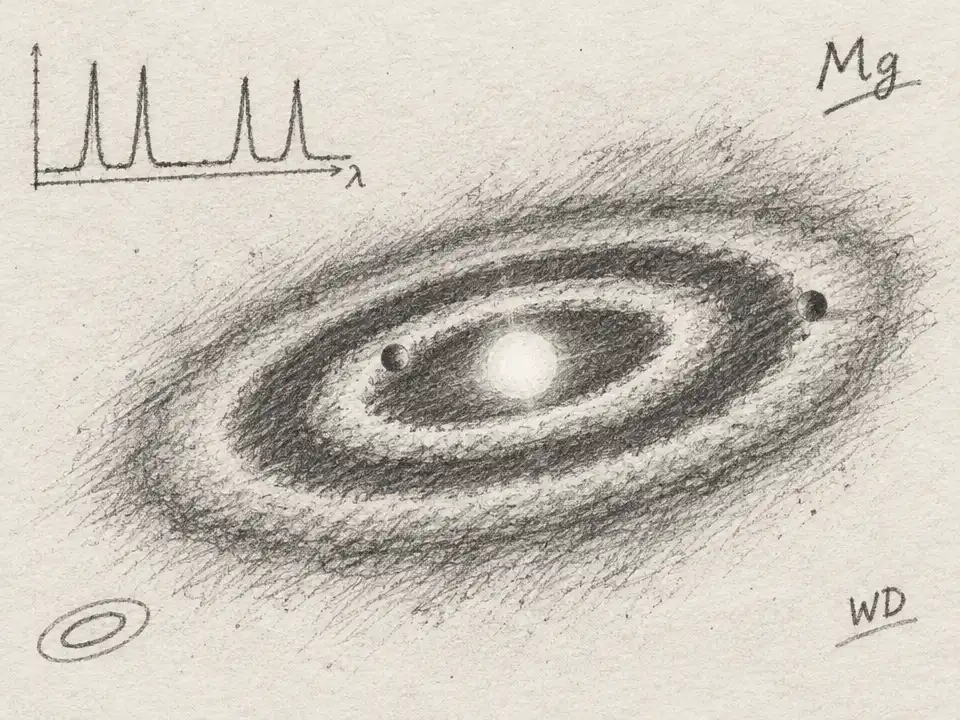
A white dwarf’s light arrives with a peculiar signature: not the two bright peaks astronomers expect from a rotating gas disk, but four. The extra pair is a clue that something around this stellar remnant may be divided into two rings. But what keeps the rings separate—and what keeps supplying their gas? A new study turns those sharp spectral peaks into a puzzle about planetary bodies that may have survived their star’s transformation.
The star, WD J132800.85−145019.95, is a white dwarf: the compact remnant left after a star has exhausted its fuel and shed its outer layers. It is not a planet-maker in the usual sense. Yet astronomers have found dust disks and rocky material around white dwarfs, evidence that some planetary systems persist through the star’s dramatic end. The evidence is indirect but striking: elements such as calcium, magnesium, and silicon pollute the star’s atmosphere, while infrared light reveals dust nearby.
In this case, the telltale clue came from spectra gathered with the X-Shooter instrument on the Very Large Telescope. The team first noticed an infrared excess, then examined the star’s light for signs of debris. They found absorption from metals in the white dwarf’s atmosphere and emission from gas around it. Crucially, several gas-emission lines had an unusual shape: four peaks instead of two. The pattern remained essentially unchanged across observations spanning more than 2 years.
Why do the peaks matter? Gas in a disk orbits the star. One side moves toward us, shifting its light toward shorter wavelengths; the other moves away, shifting light toward longer ones. Those opposite motions usually produce a pair of peaks in an emission line. The researchers’ model reproduces the four peaks by adding together the light from two separate, concentric gas disks. In the model, the inner ring extends from 0.14R☉ to 0.34R☉; the outer one, from 0.54R☉ to 1.93R☉. Between them lies a gap in the gas that emits the observed light.
These are not photographs of rings. They are estimates derived from how the lines spread and split, and the outer ring’s boundaries are less tightly constrained than the inner ring’s. Still, several different emissions fit the two-ring picture. Calcium and oxygen show the four-peak structure, while a magnesium line shows just two peaks, consistent with emission from the inner ring alone. The inferred disk angle is about 77 degrees: tilted toward an edge-on view, where the approaching and receding sides leave especially clear marks in the spectrum.
The first mystery is how gas can remain in two distinct zones. Dust collisions or heating can produce gas in a debris disk, but gas can also spread outward. As it moves away from the white dwarf and cools, it may condense again below about 1,200–1,500 K, helping confine it near where it formed. That could help preserve separate rings once gas is present. It does not, by itself, explain why gas would be generated in two separated locations, or how the gap stays clear.
One proposed answer is that solid bodies orbit inside the rings, stirring nearby dust and helping release gas at particular locations. The idea has a precedent: in another white-dwarf system, a repeating change in emission lines has been interpreted as a possible sign of a surviving planetesimal interacting with dust. Applying that idea here would mean two bodies, one associated with each ring. The spectra do not reveal those bodies directly; they make them plausible suspects.
The suspected objects would have to endure an extraordinary neighborhood. The rings lie very close to the white dwarf, where its gravity can pull apart bodies that venture too near. The paper estimates the largest bodies that might survive at different locations, given assumptions about their density and internal strength. Near the outer edge, a rocky object with moderate strength could be as large as roughly 3,500 km. That is a survival limit from the model, not a measurement of an object’s actual size. Depending on where it orbits, the outer body could range from a large asteroid to something comparable in scale to Pluto.
A chemical clue complicates the neat picture of two ring-shaping bodies. If the outer ring had the same magnesium-to-calcium abundance as the inner one, the team expected a magnesium emission feature there at more than 6σ significance. It was not detected. The outer ring therefore appears strongly depleted in magnesium relative to the inner ring. Perhaps two different parent bodies supplied the material. Or perhaps the rings contain material from different layers of a single differentiated body—for instance, magnesium-rich mantle and magnesium-poor crust. The composition points to distinct histories without choosing between them.
There are other ways to make four peaks. A puffed-up inner edge could cast a shadow across part of one continuous disk, suppressing emission from the shaded zone and making the spectrum resemble two bright rings. The authors consider that possibility, but note that no direct evidence for such self-shadowing has been found in this system, and similar disks have not shown the same signature. An unresolved pair of white dwarfs, each with its own disk, is another alternative; the researchers judge that scenario unlikely. A single body clearing a gap also faces problems: it would not readily explain the bright infrared glow or how gas is produced in both rings.
So the spectrum offers a leading explanation, not a final answer. The data show a stable, unusual arrangement of gas-emitting regions and a difference in their chemistry. Two surviving planetary bodies could account for how gas is generated in both rings, but they have not been seen, and a shadowed disk could imitate part of the pattern. Further observations that track the line shapes and compare the rings’ chemical signatures may help separate these possibilities. For now, the four peaks are a kind of celestial fingerprint—clear enough to identify a system unlike the others, but not yet clear enough to tell exactly who left it.