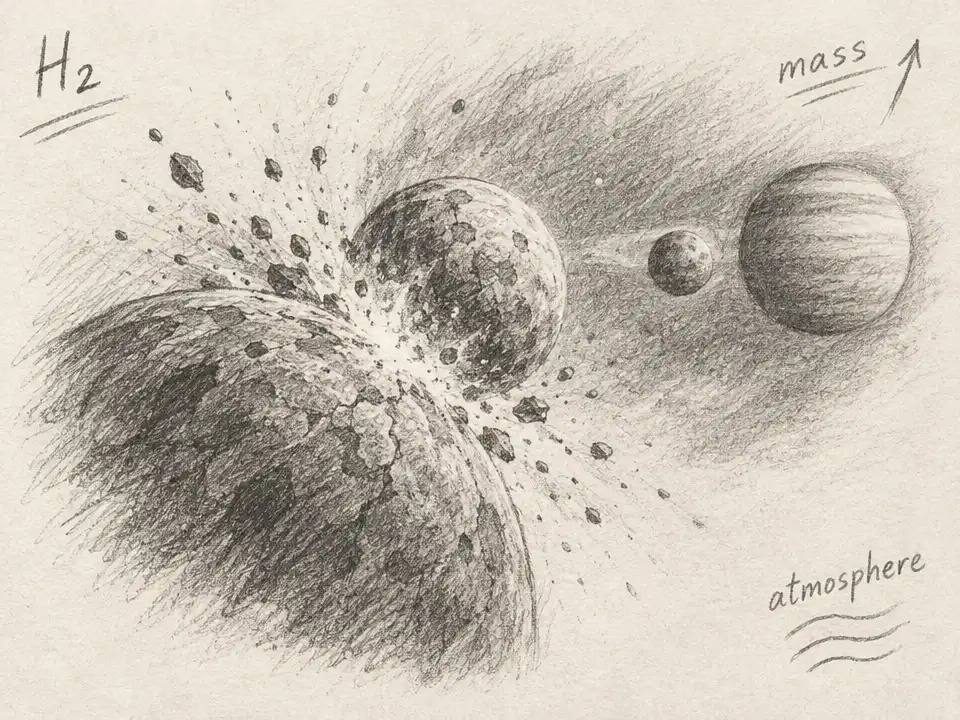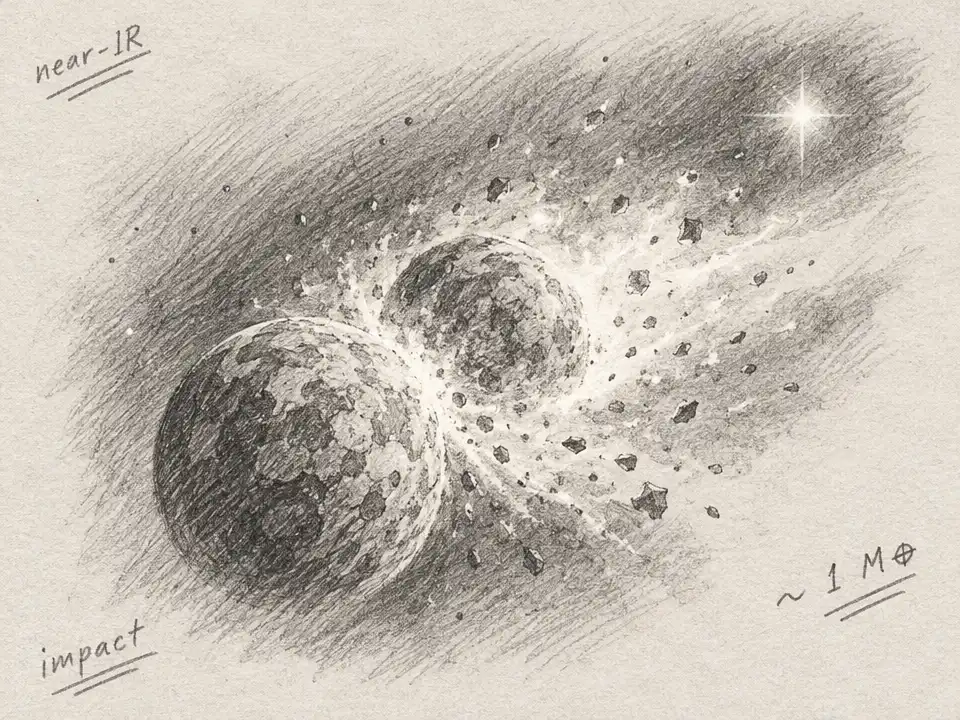
Imagine scanning the sky and finding a familiar star abruptly joined by a new point of light. It is not a companion star switching on. It is the debris from two rocky planets colliding, flung outward in a cloud hot enough to shine like a small star—for a little while.
That scene is not an observation. It is a possibility emerging from simulations by planetary scientist Lucy Taylor and colleagues. Their work asks a striking question: could astronomers catch the first, fiery aftermath of a collision between planets around another star, rather than inferring the impact long after its debris has cooled?
Planetary collisions are thought to have helped shape our own Solar System. A giant impact is one leading explanation for the Moon’s formation, and collisions have also been proposed to explain other planets’ unusual properties. But seeing one unfold elsewhere would offer something different: a chance to watch a process that may help determine what kinds of worlds a planetary system ends up with.
The team modeled an oblique collision between two proto-Earth-like rocky bodies, each about 0.9 times Earth’s mass and roughly Earth-sized. They then developed a way to estimate where the expanding material would become opaque enough to glow outward—the collision’s visible “surface,” though it is vapor and debris rather than solid ground.
That calculation runs into a problem hidden in the simulations themselves. The researchers used a method that represents a planet as a vast collection of computational particles. To keep calculations manageable, the simulation places limits on how spread out each particle can become. But the most distant, thinnest material in an impact’s aftermath matters: it can help define the outer glowing edge, while being too diffuse for the original simulation to describe well.
The researchers’ workaround was to reprocess the simulation output, estimating how that low-density material would behave beyond the imposed limit. They also built a method to calculate conditions between the simulated particles, so they could map the boundary between material that lets light through and material that traps it. In effect, they tried to reconstruct the collision’s glowing outline from a simulation that had blurred some of its faintest edges.
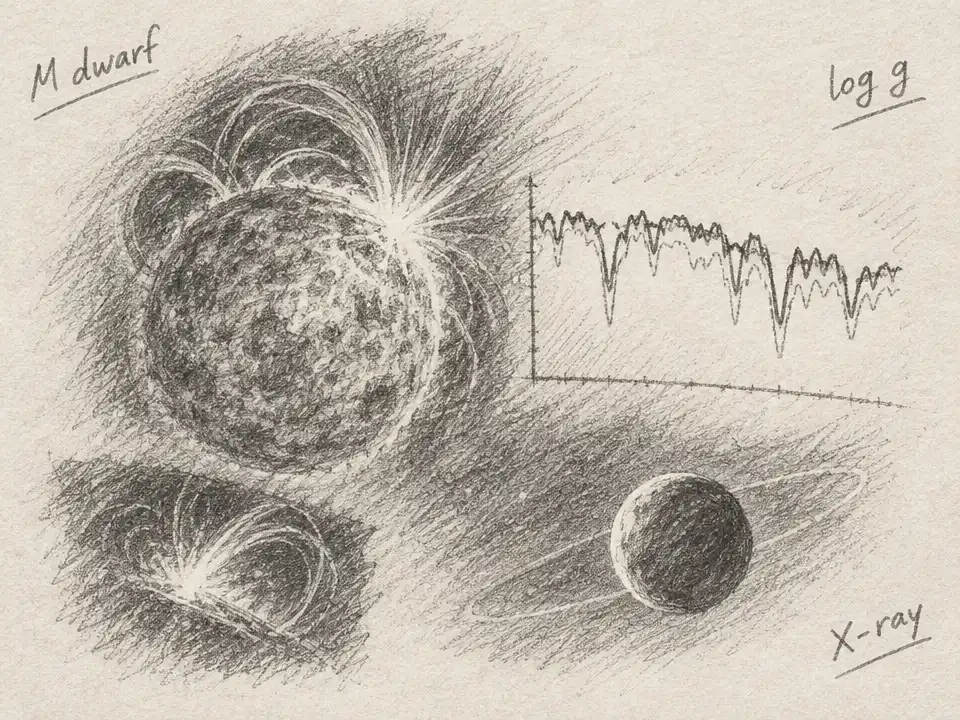
The result is a rapidly expanding, uneven cloud. In the modeled collision, the emitting surface spans hundreds of Earth radii within 24 hours. Hot vapor forms plumes; cooler material containing condensed droplets makes a broader, dimmer-looking background. The details vary with the simulation’s resolution, but the overall estimate is startling: the debris’s temperature and luminosity can be comparable to those of an M-dwarf star.
At 24 hours, the modeled light peaks at wavelengths between 0.963 and 1.38 micrometers, in the near-infrared. The simulated luminosity reaches about 10−2 times the Sun’s luminosity, with the exact value depending on the model settings. That does not mean the whole planetary system would suddenly outshine its star. It means the collision’s own glow could resemble the light from a small star—an unusually bright, temporary clue that something violent has happened.
That clue could help answer a basic question about planet formation: how often do worlds grow through giant collisions? Different formation scenarios predict different roles for such impacts. Catching the aftermath would let astronomers compare those predictions with real events, rather than relying only on the final planets left behind. The authors suggest that high-cadence, wide-sky surveys, including the planned Legacy Survey of Space and Time, could have a chance to catch some collisions while they are still bright.
But the observing opportunity comes with a price: the predicted flare may be brief, and the model cannot yet say how brief. The simulations do not include radiative transfer—the way energy travels through and escapes from the expanding cloud—or fully capture how vapor and condensed droplets move separately. Those processes could cool the outer material, slow its expansion, and reduce or reshape the glow. The team therefore cannot reliably follow the signal beyond roughly the first day.
There are other limits. The paper examines one example collision, not the full range of planetary masses, impact angles, or viewing directions. Its results are not fully converged, meaning greater computational resolution could change the estimated light. And at the wavelengths where the modeled emission is strongest, surveys need suitable coverage and repeated observations. A collision might be bright in theory yet still slip past if the right patch of sky is observed at the wrong time.
The next step is not simply to point a telescope and wait. Researchers need better simulations that include cooling and the changing behavior of vapor and droplets, as well as models covering a wider range of impacts. Astronomers will also need to work out how to distinguish a collision’s brief glow from other sources of changing light. The payoff, if those pieces come together, could be a new way to watch planetary systems in the act of becoming.
For now, the result is a forecast, not a captured collision. Its promise is that planet formation may sometimes announce itself with a flash bright enough to resemble a little star. Its warning is that the flash lives in a difficult frontier between simulation and observation: the faintest debris, the fastest changes, and the physics most likely to dim the signal are exactly where the current models are least certain.