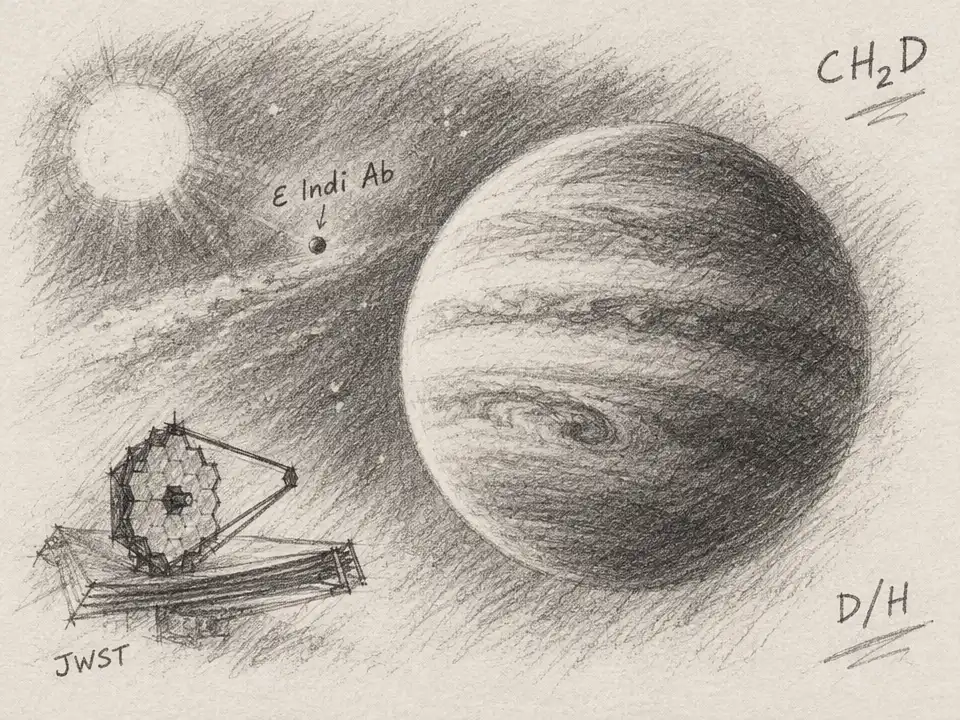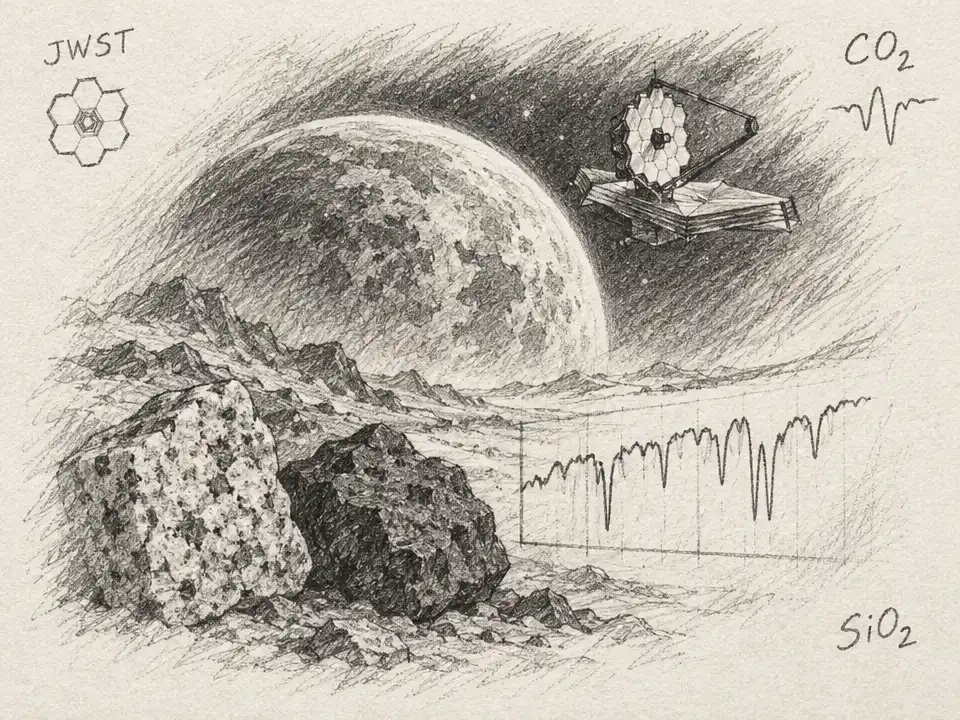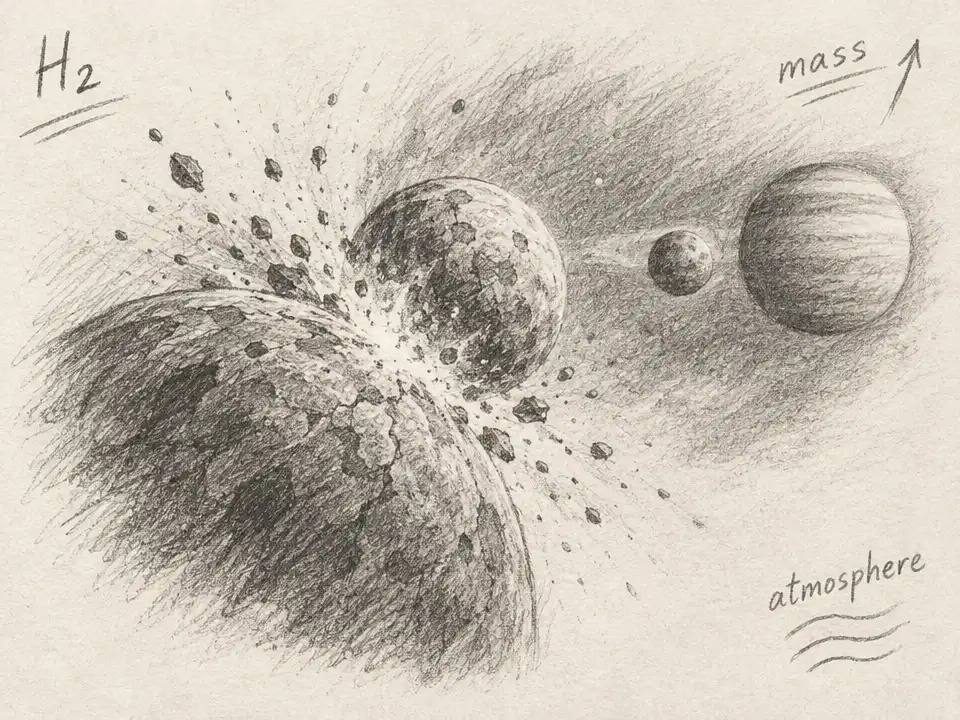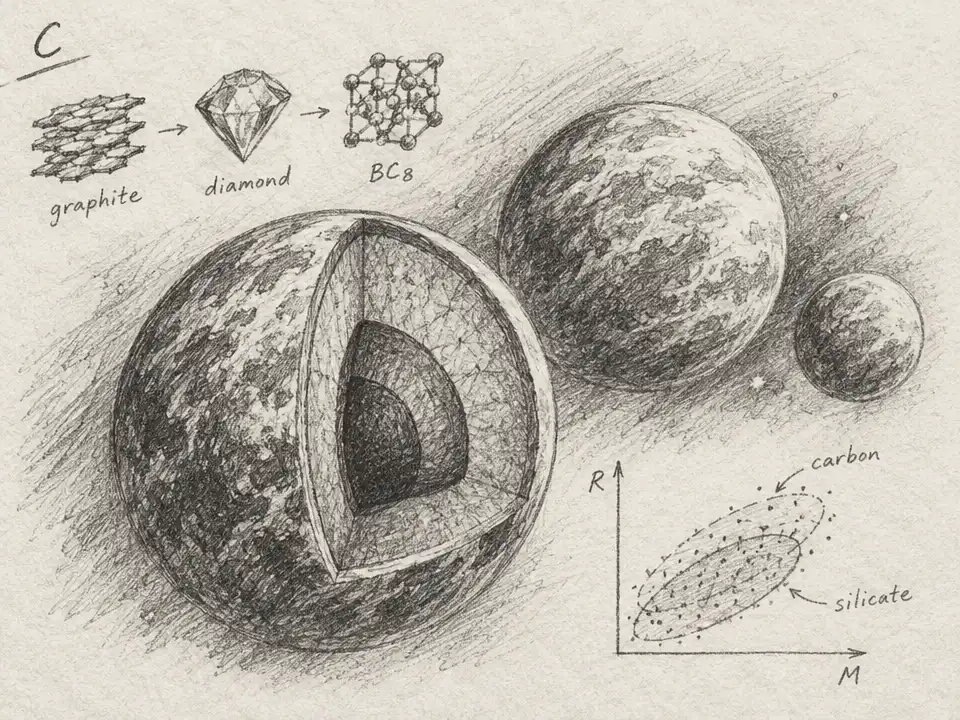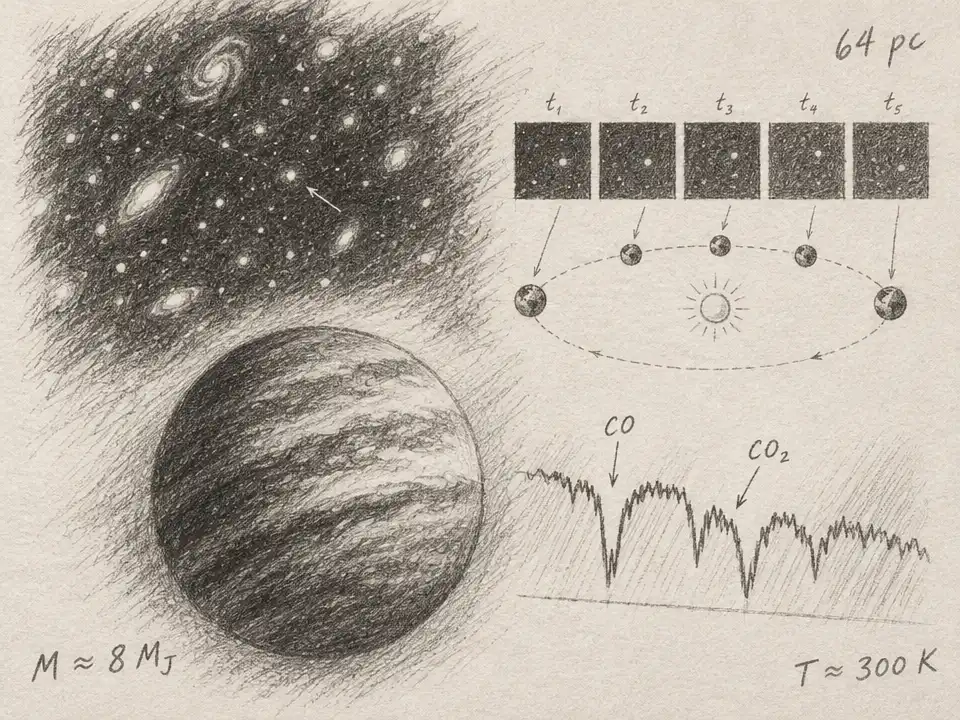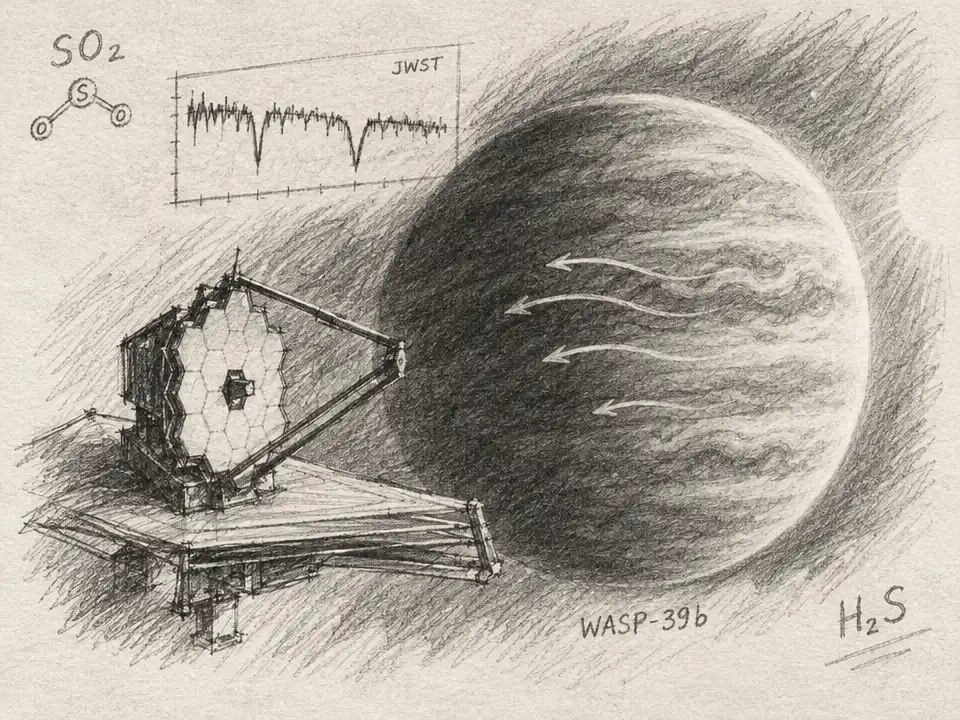
A planet’s atmosphere is a clue to its past—but not a straightforward one. When starlight filters through a planet’s air, molecules leave fingerprints in the spectrum. Methane, water vapor, and carbon dioxide can hint at what the planet is made of and where it formed. Yet a world can hide its ingredients: the gases we see overhead may not match the materials buried below.
That mismatch sets up a puzzle for sub-Neptunes, planets larger than Earth but smaller than Neptune. Their measured masses and sizes can fit several recipes: rocky material, water, gas, or carbon-rich organic material often called soot. In a new modeling study, Caroline Dorn, Aaron Werlen, and Sean Jordan ask whether atmospheric chemistry can help distinguish those recipes—and whether planets already observed by the James Webb Space Telescope need soot-rich interiors to explain their spectra.
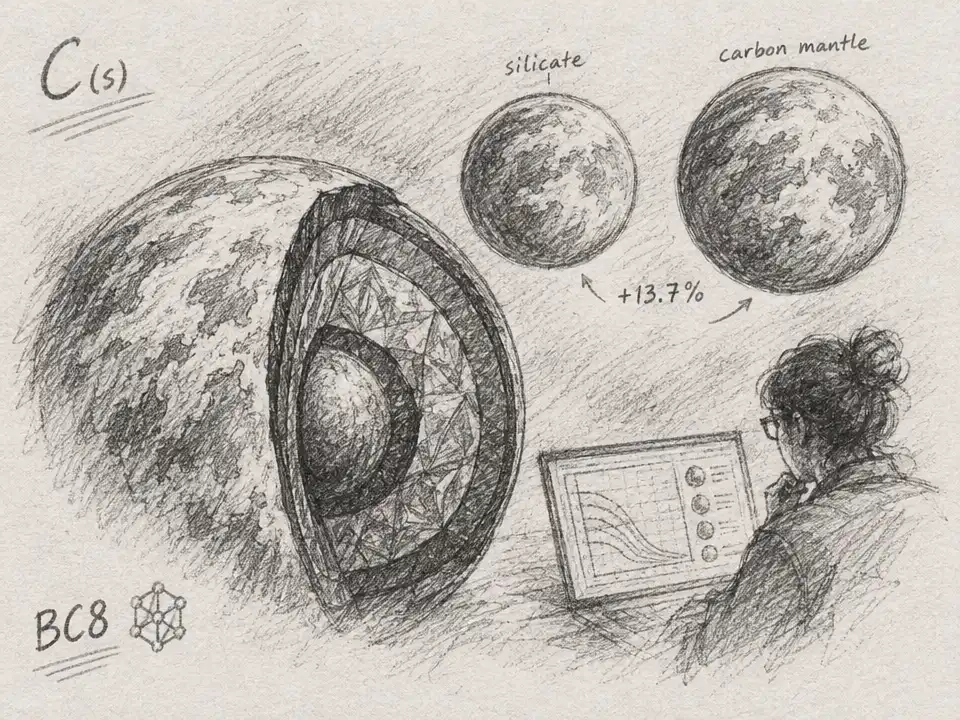
The team compared four modeled starting mixtures: rock alone; rock mixed with soot; rock, water, and soot; and rock with water but no soot. They followed how each mixture could exchange chemicals with a planet’s atmosphere above a deep, molten layer. Their calculations covered planets of 6 and 10 Earth masses, with different amounts of captured gas and two assumed temperatures at the boundary between atmosphere and magma ocean: 2000 K and 3000 K.
These are models, not measurements of the planets’ interiors. One crucial choice is that the calculations allow the atmosphere and interior to reach complete chemical equilibrium. The authors treat this as an informative extreme: in real planets, layers that resist mixing might keep some deep materials from communicating with the observable atmosphere. The model therefore offers a way to test what atmospheric clues could mean, not a direct reading of a planet’s core.
First clue: missing methane does not mean missing carbon. In the modeled rock-rich and soot–rock planets, carbon tends to remain deep inside, including in the metallic part of the interior. The atmosphere above can consequently be poor in carbon-bearing gases even when the planet’s building blocks contain carbon. A quiet methane signal, by itself, cannot settle the case.
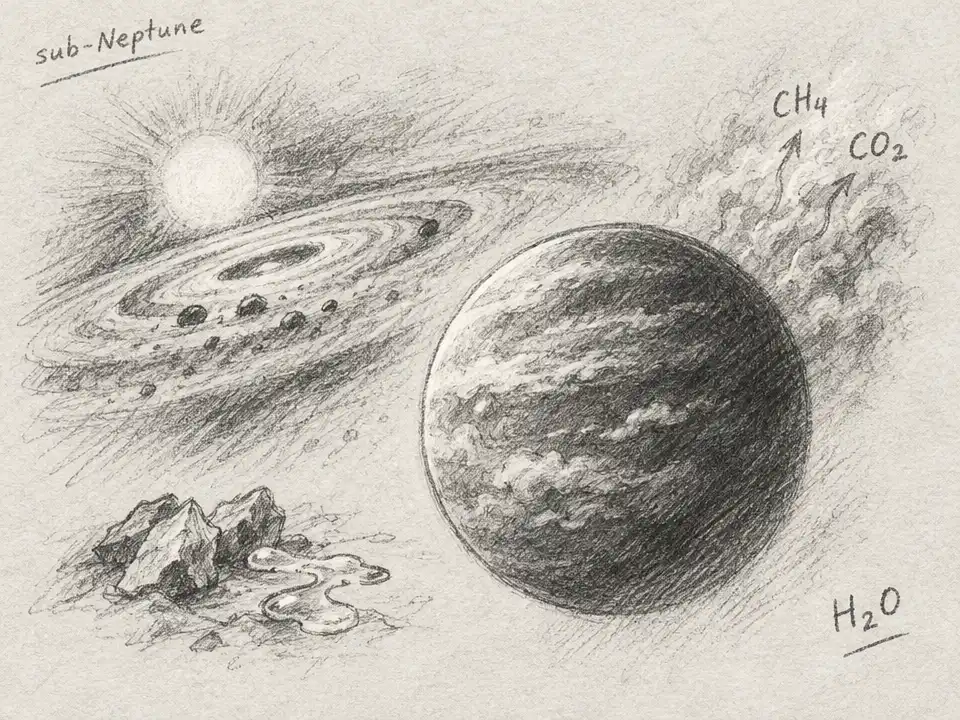
The water-rich models produce a more surprising clue. Adding water also adds hydrogen, and under the modeled conditions that hydrogen helps make methane. Oxygen, meanwhile, can be locked away in the deep interior. So a planet that began with more water can end up with an atmosphere rich in methane and carbon dioxide—even though water brought extra oxygen into the recipe. The atmosphere’s carbon-to-oxygen balance can therefore move in a direction that seems counterintuitive if we consider only the ingredients added at the start.
The soot-and-water mixture makes a distinct prediction: methane can dominate near the deep atmosphere, and the resulting air can have a high mean molecular weight. The water-and-rock mixture, without soot, can also make methane and carbon dioxide. That overlap creates the central detective problem. Methane is a useful clue to a planet’s history, but it is not a unique fingerprint of soot.
To organize the clues, the researchers propose considering the amount of water relative to methane alongside the atmosphere’s mean molecular weight—the average mass of its molecules. In their models, soot-bearing, water-rich planets tend toward a mean molecular weight above 17, while the corresponding soot-free, water-rich case stays below 7.5. In principle, the weight of the atmosphere can help distinguish two interiors that both produce methane. It is a joint test, not a verdict from a single gas.
Some observed planets seem to fit the broader pattern. TOI-270 d has methane and carbon dioxide detections that the study finds more consistent with water-rich formation than with water-poor starting material. Its measured properties appear explainable without requiring soot in the interior. For K2-18 b, the evidence is less decisive. Methane has been reported while water has not been detected in the observable atmosphere, but the model offers a possible explanation: water may condense out of the upper atmosphere, leaving the deeper presence of water hidden from the spectrum. A non-detection aloft does not prove the planet formed without water.
That explanation is a clue, not a confirmation. The authors describe the no-soot interpretation for K2-18 b as tentative, because current atmospheric retrievals and assumptions about the deep temperature leave room for different answers. Carbon dioxide may help distinguish soot-bearing from soot-free possibilities, but estimates for K2-18 b vary across analyses. More precise measurements of carbon dioxide and the carbon-to-oxygen ratio could sharpen the comparison.
Other processes can scramble the evidence, too. Vertical mixing changes which gases reach the observable atmosphere, and the strength of that mixing is not well constrained. Atmospheric escape can preferentially remove lighter hydrogen, shifting the remaining atmosphere’s mean molecular weight. Water condensation can lower the amount of water seen overhead. Each process can move a planet’s atmospheric clues away from the pattern predicted by its original building blocks.
The model’s biggest uncertainty is the assumed exchange between a planet’s interior and atmosphere. If deep layers stay separated, the observable gases may preserve only part of the planet’s chemical history. The researchers also test different magma-ocean temperatures; changing the assumed temperature can broaden the predicted range for some atmospheric clues. These limits matter because the method depends on connecting the air we observe to materials that may have been transformed or trapped far below it.
The puzzle is therefore not simply whether a planet contains soot. It is whether several atmospheric clues, interpreted together, can reconstruct where its ingredients came from—and which changes happened after assembly. The new calculations suggest that some methane-rich worlds may have a less exotic explanation than their spectra first imply: water-rich building blocks could do the job without soot. Future observations can test that possibility by measuring atmospheric composition and molecular weight more precisely. For now, the atmosphere offers a map of planetary origins, but some of its landmarks are still obscured.