For years, Boyajian’s star has seemed to play by its own rules. Its light sometimes plunges in deep, irregular dips, then returns without settling into a reliable pattern. Now one brief, orderly dip has added a new puzzle: a possible giant planet crossing the star appears too large for a cool world of its estimated mass. Could the planet be ordinary after all—and something around it be doing the extra blocking?
The orderly clue came from TESS, which recorded a single transit lasting about 21 hours in September 2019. The star dimmed by roughly 1.1 percent, with a smooth, symmetric profile—the kind of shape expected when a rounded object passes in front of a star. In a separate study, researchers combined that event with measurements of the star’s motion and argued that a companion may be orbiting it. The evidence is tentative, but the proposed object is striking: about 9.4 times Jupiter’s mass and 1.7 times Jupiter’s radius.
That radius is the snag. Cool giant planets don’t usually swell in proportion to their mass. Models and measurements suggest that worlds weighing roughly two to twelve Jupiters should have radii around 1.0 to 1.1 times Jupiter’s. The proposed companion is estimated to be about 270 kelvins, far from the intense heating that can puff up close-orbiting “hot Jupiters.” And at an age of roughly 1.2 billion years, it is not a newborn still radiating the heat of formation. The transit seems to show a planet with too much apparent girth.
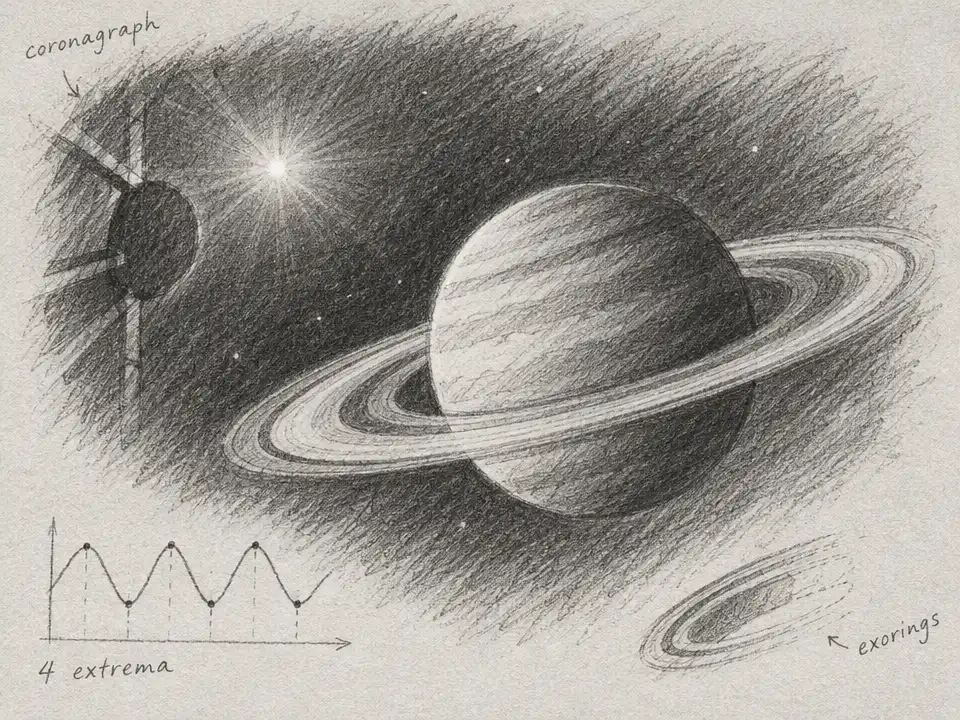
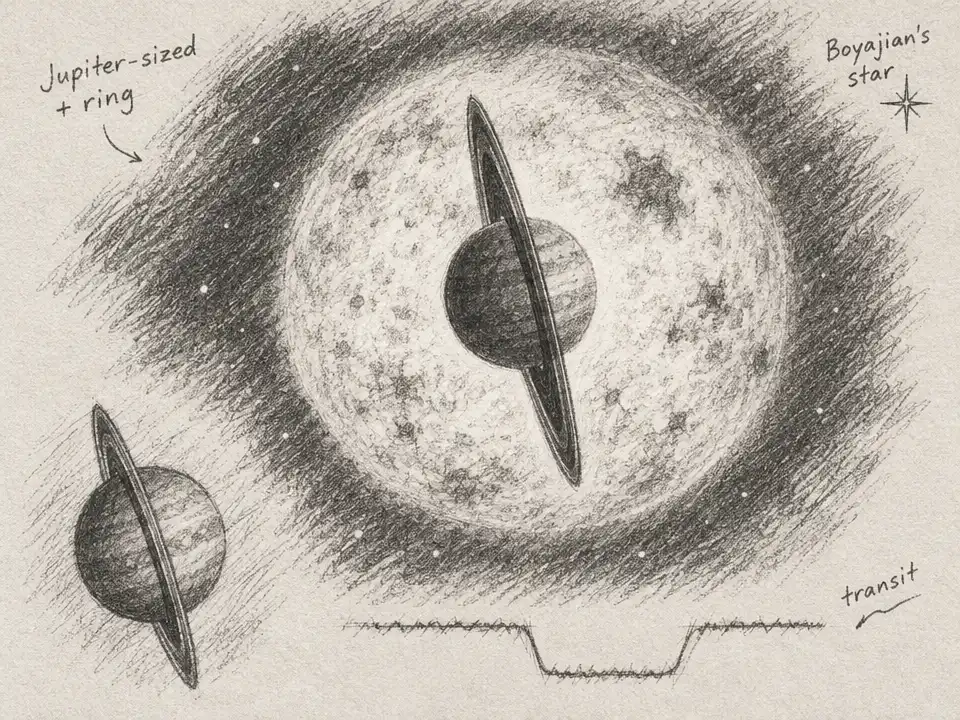
Wei Zhu and Quanyi Liu asked whether the extra size might be an illusion created by a ring. A ring crossing the star blocks additional light, making a smaller planet cast a larger transit shadow. It is a simple idea, but the shape of a transit contains clues: a ring can change how the system enters and leaves the star’s disk, and can leave subtle structure in the dip rather than the clean outline of a bare sphere.
The researchers tested both possibilities against the TESS measurements. First came the simplest sketch: a spherical companion. It fits the overall dip, but leaves structured mismatches near the bottom of the light curve. Then they tried a Jupiter-sized planet surrounded by an opaque, flattened ring. In that model, most of the light-blocking area belongs not to the planet but to the ring. The preferred ring stretches to between 3.1 and 4.4 times the planet’s radius and is tilted to a nearly polar orientation.
That geometry has a visual consequence. Imagine looking down on a tilted hoop as it crosses a star: from our viewpoint, the ring appears flattened into a narrow ellipse. Its angle changes the timing and shape of the transit’s ingress and egress—the moments when the object first moves onto the star and finally leaves it. In the fit, the ring helps explain a small rebrightening-like feature about a quarter of a day after the transit’s midpoint. The proposed ring plane is tilted roughly 80 or 100 degrees relative to the companion’s orbit, an arrangement reminiscent of Uranus’s sideways tilt.
But a good-looking solution is not the same as a detection. Adding a ring improves the fit by about 14 in chi-squared, but the ring model also has two more adjustable parameters. Once that extra flexibility is taken into account, the models are statistically almost tied: the difference in Bayesian information criterion is only about 0.4 to 1.3 in favor of the ring. The authors describe the evidence as marginal. One transit, with noisy data, cannot pin down the ring’s dimensions and orientation securely; even a starspot crossing could contribute to the feature the ring model explains.
There is also a physical constraint. The companion’s estimated distance from the star is about 2.2 astronomical units, inside the system’s water-ice line. If a ring exists there, its particles would likely be rocky rather than icy. The ring would also reach close to the distance where the planet’s tides can prevent nearby debris from gathering into a moon—the Roche limit. The authors suggest a debris ring maintained by collisions or disrupted small bodies, while noting that the details depend on properties that are not yet known.
That debris possibility brushes against the star’s older mystery, but it does not solve it. Boyajian’s star’s historic dips are irregular and, at different wavelengths, consistent with dust. The proposed companion might help steer small bodies onto paths near the star; if ringed, it could also carry debris of its own. That makes an intriguing connection between a planet-scale transit and a dusty environment. It remains a possibility, not evidence that the ring causes the historic dimming.
The next clue must come from watching the companion again. A repeat transit could reveal the ring model’s predicted distortions at ingress and egress, which differ from a bare planet at a level of a few times 10−4. Precise time-series photometry may be able to see that difference, and observations in multiple colors could help test whether the occulting material behaves like dust. Gaia astrometry may help refine the companion’s orbit and mass, though it would not by itself show a ring.
For now, the puzzle has not resolved into a planet or a ring. Instead, one faint dip has opened a contest between two shapes: a remarkably oversized world, or a more familiar giant wearing a broad, tilted veil. The ring is a plausible way to make the numbers fit, and the fit offers specific predictions. But the decisive evidence has yet to arrive. The next transit must tell us whether the strange silhouette belongs to the planet—or to the space around it.