Imagine that astronomers measure a distant planet’s mass and radius with impressive precision. Those two numbers seem like a solid fingerprint: dense worlds should be made of different stuff than puffier ones. But a planet is not a laboratory sample. Several very different interiors can leave nearly the same fingerprint. Could a world built with carbon instead of familiar rocky minerals slip past us as an ordinary planet?
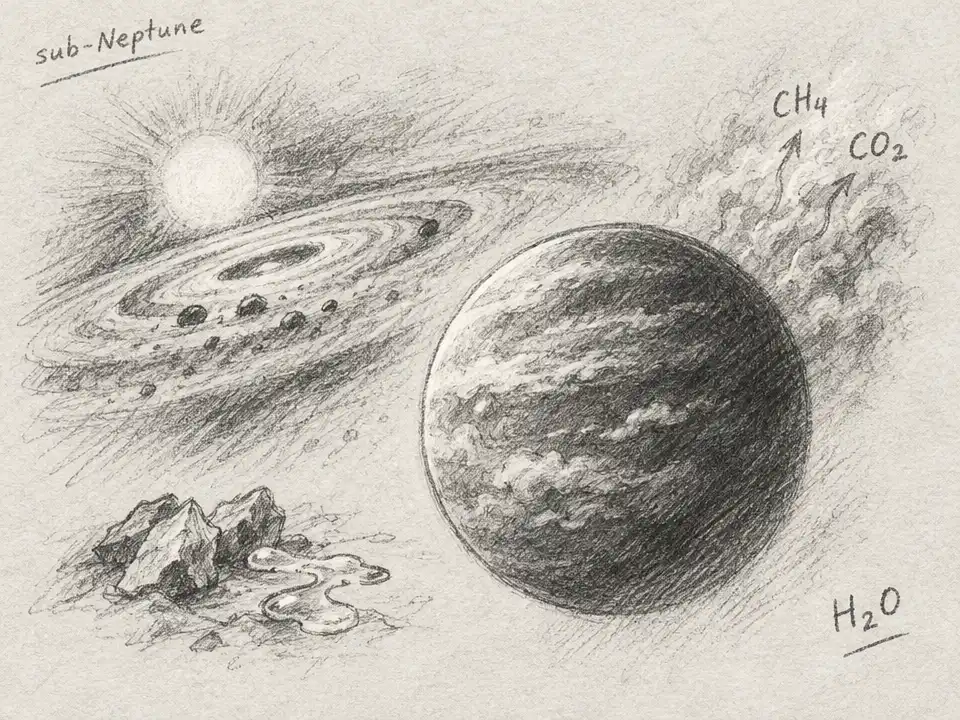
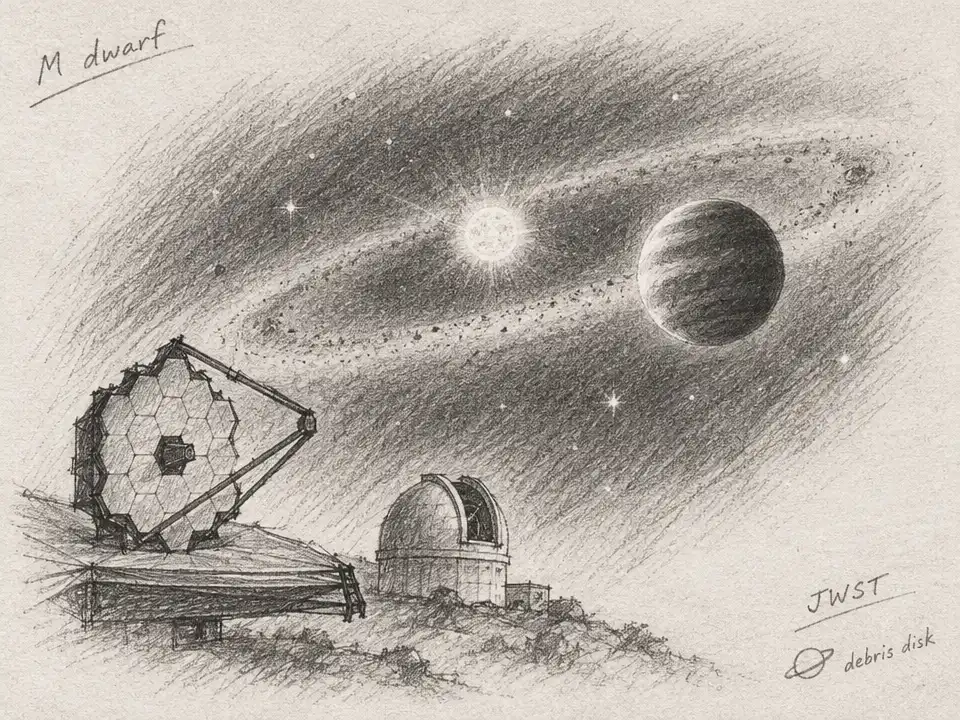
Most models start with a blueprint drawn from our own neighborhood: an iron core surrounded by a mantle of silicate rock. Yet the ingredients available to build a planet depend on the chemistry of its birthplace. In some planetary systems, the ratio of carbon to oxygen in the star and its disk may be high enough to change what solid materials form. At ratios approaching or exceeding 0.9, previous work cited by the researchers suggests, carbon can dominate the disk’s condensed material, making up as much as 80% of it.
That does not mean astronomers have found a planet made mostly of carbon. The new study is a modeling effort: Robert Royer III, David R. Rice and Jason H. Steffen added carbon-rich mantles to a planetary-interior program called MAGRATHEA. Their goal was to give researchers a way to ask what such planets might look like from the outside—and whether that appearance would set them apart from silicate worlds.
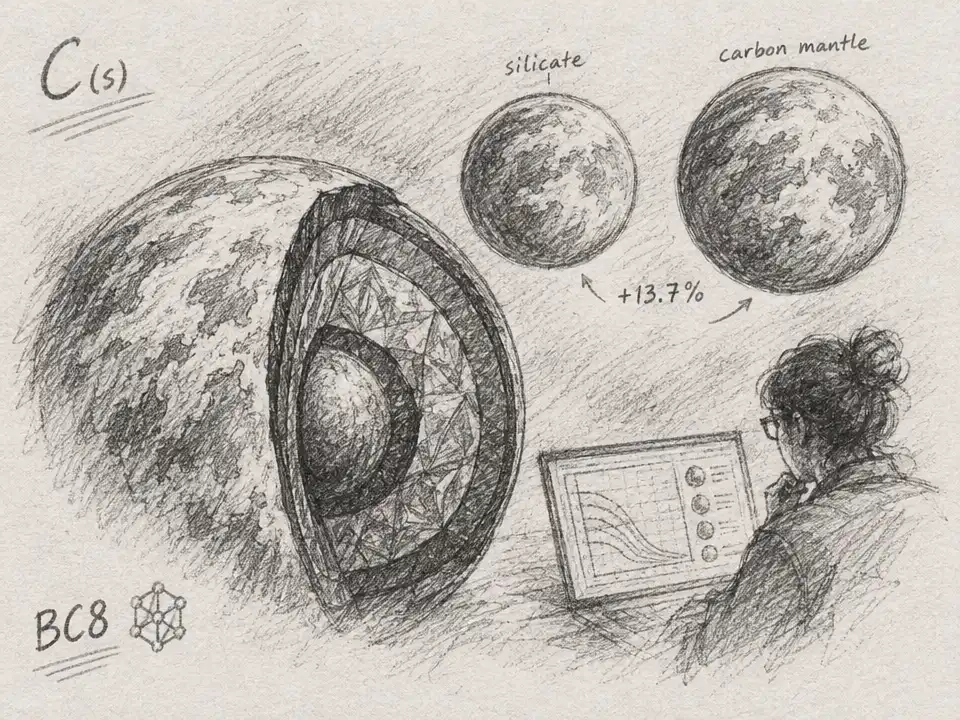
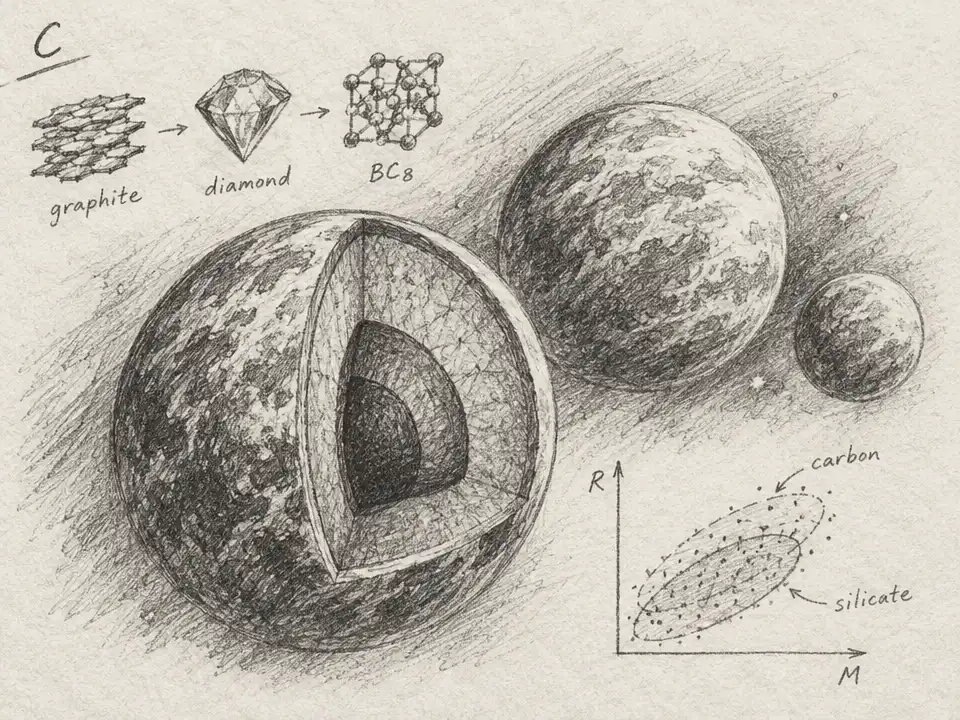
The interior they modeled is not a simple ball of diamonds. Pressure and temperature change with depth, so carbon can take different forms in different layers. In the simulations, graphite occupies the upper part of the mantle, with denser diamond below. In the most massive models, pressure becomes high enough for another predicted form of carbon, called BC8, to appear. The model finds that this phase does not form in a one-Earth-mass planet; it appears only above 10 Earth masses.
Then comes the first clue—and the first complication. For an Earth-mass planet with an Earth-like proportion of core and mantle, the modeled carbon worlds have radii between 1.047 and 1.058 Earth radii across four different temperature profiles. That is roughly 5% larger than Earth, and the carbon planets are larger than modeled silicate planets of the same mass. In principle, a planet’s size could hint that its interior is unusual.
But “larger” is not the same as “recognizably carbon.” Change the planet’s temperature assumptions and its core size, or allow for water or a substantial atmosphere, and different interior recipes can produce overlapping mass-and-radius measurements. The study itself warns that carbon planets are not distinguishable from silicate planets in most cases using size alone. The clue is there, but it is not a label.
The contrast grows in some of the more massive models. Across planets from 0.1 to 20.1 Earth masses, the modeled carbon planets range from 0.535 to 2.41 Earth radii. Their silicate counterparts range from 0.511 to 2.12 Earth radii. At the upper end, the carbon model is as much as 13.7% larger. The researchers attribute the difference to carbon being stiffer than silicates under the conditions they modeled. That makes the most massive examples the clearest potential cases—but not proof that an observed planet has a carbon mantle.
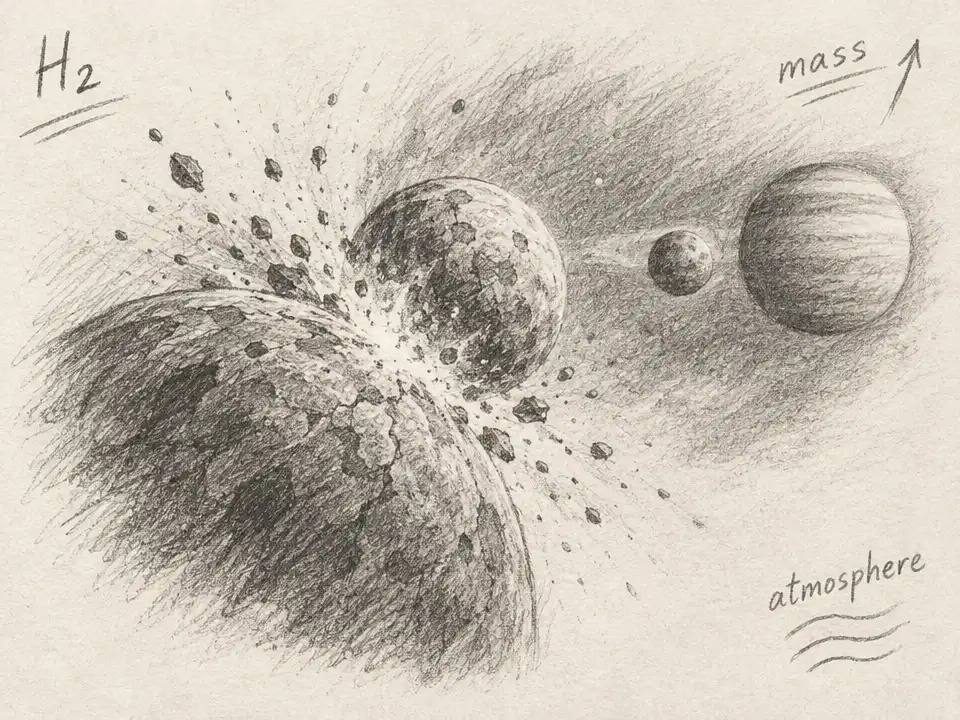
There are other ways to make a planet look bigger or smaller without changing its main rock. A thick atmosphere or a layer of water can complicate the reading of its measured size and mass. The broader puzzle is one of inference: astronomers observe a planet’s exterior, then try to work backward to its interior. More than one combination of ingredients can fit the same data, and a familiar-looking radius does not guarantee familiar geology.
The new calculations also have boundaries. MAGRATHEA treats a planet as a set of spherical layers and uses equations describing how each material behaves under pressure and heat. The authors implemented phases of carbon including graphite, diamond and BC8, but note that their simplified treatment of the complicated thermal behavior of diamond and BC8 uses an intermediate set of values. They also identify mixing carbon with silicon carbide as a capability for future versions of the program. So these results map out a useful possibility, not a final atlas of every carbon-rich planet.
How, then, might the mystery be narrowed? A more precise mass and radius could help, especially for a large planet where the models predict a bigger difference. Measurements of the host star’s chemistry could also provide context about the ingredients available in the planet-forming disk. Neither clue alone would settle the case: a star’s composition does not directly reveal the planet’s finished interior, and an unusually large radius has rival explanations. The puzzle asks researchers to combine clues rather than treat one measurement as a verdict.
For now, the most telling result is not that carbon planets must be easy to spot. It is that a world with graphite near its surface and diamond deep below may still impersonate a more familiar rocky planet. The new model gives astronomers a better map of what to look for, while showing why the answer may remain hidden in the very measurements used to search for it.