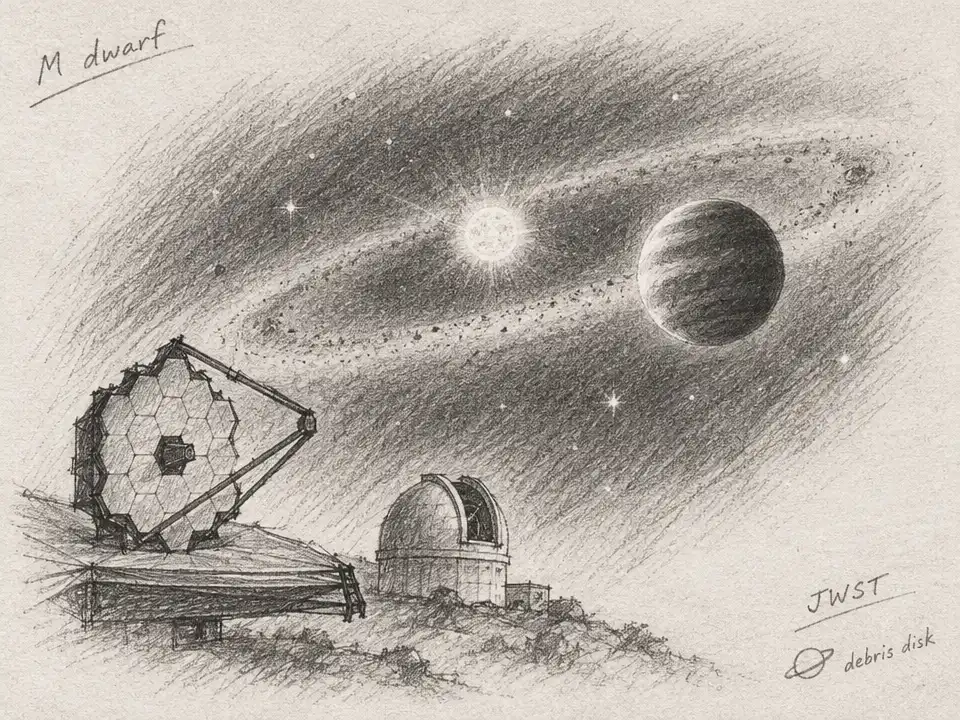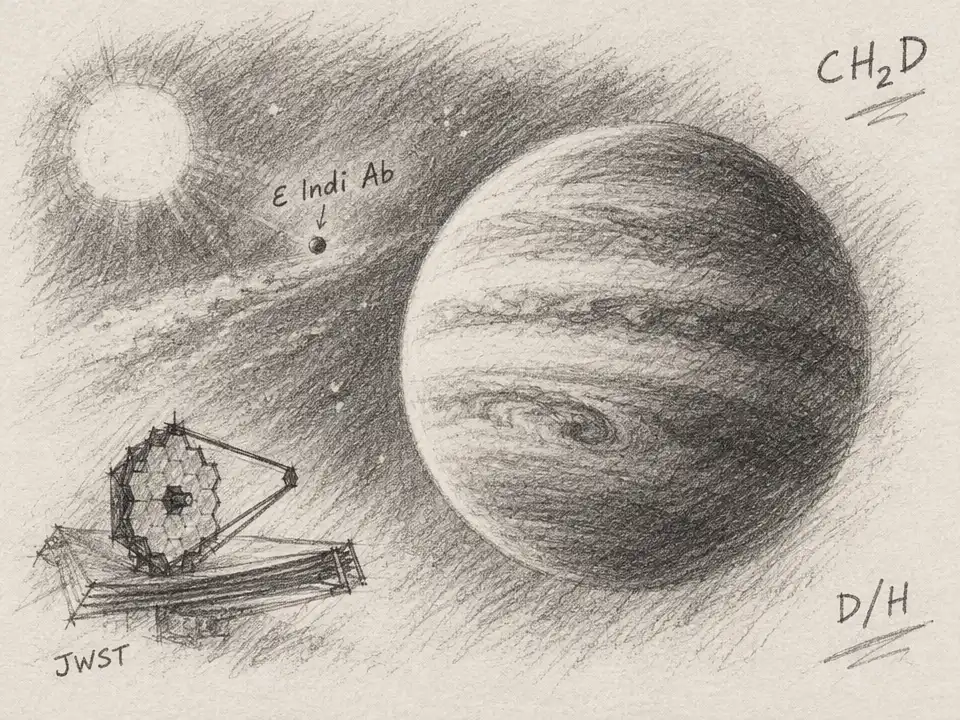
In the raw view from the James Webb Space Telescope, the planet is nearly lost in the glare. Its star is almost 1 million times brighter at one observed wavelength, and the star’s diffraction pattern spills across the detector. Yet hidden in the planet’s faint infrared light is an isotope that may have traveled with its ingredients from a frigid cloud of gas and dust into a world now billions of years old.
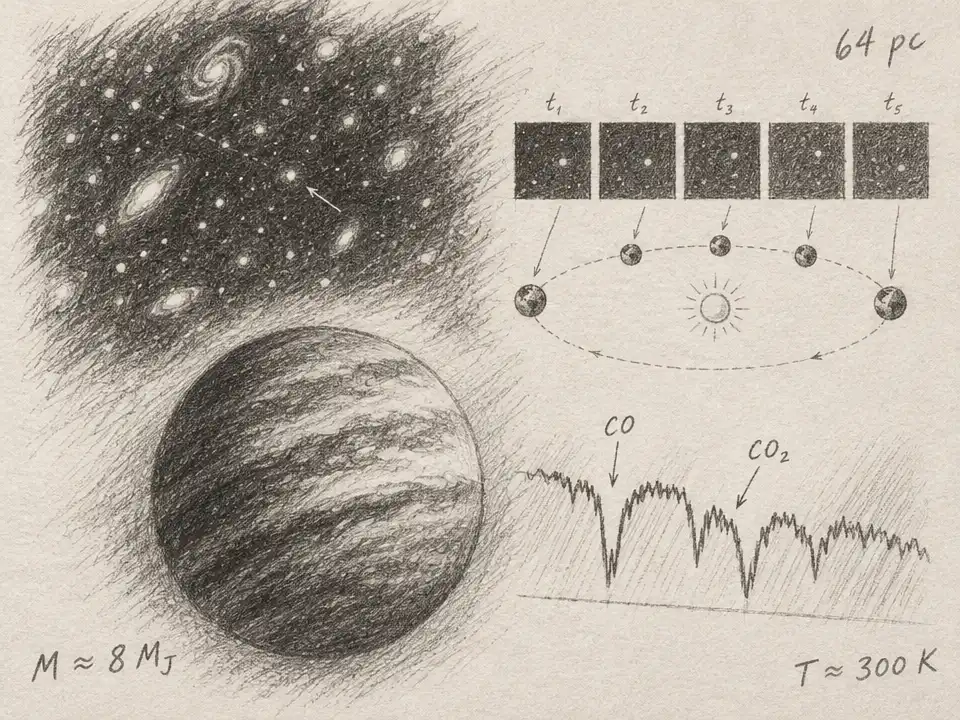
The planet, ε Indi Ab, is a cold super-Jupiter about 3.6 parsecs from Earth. It has 6–8 times Jupiter’s mass, circles its star at 16 ± 2 astronomical units, and is about 4 billion years old. Its estimated temperature is approximately 275 K. These qualities make it a rare chance to study a mature, cool giant planet directly—not just infer its presence from the star it tugs or dims.
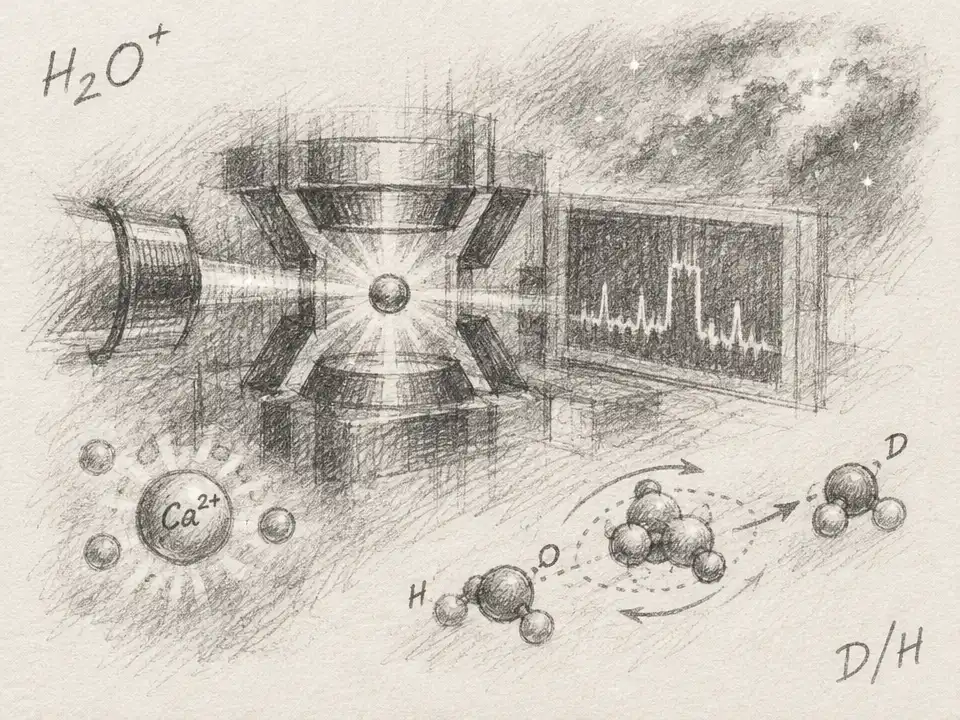
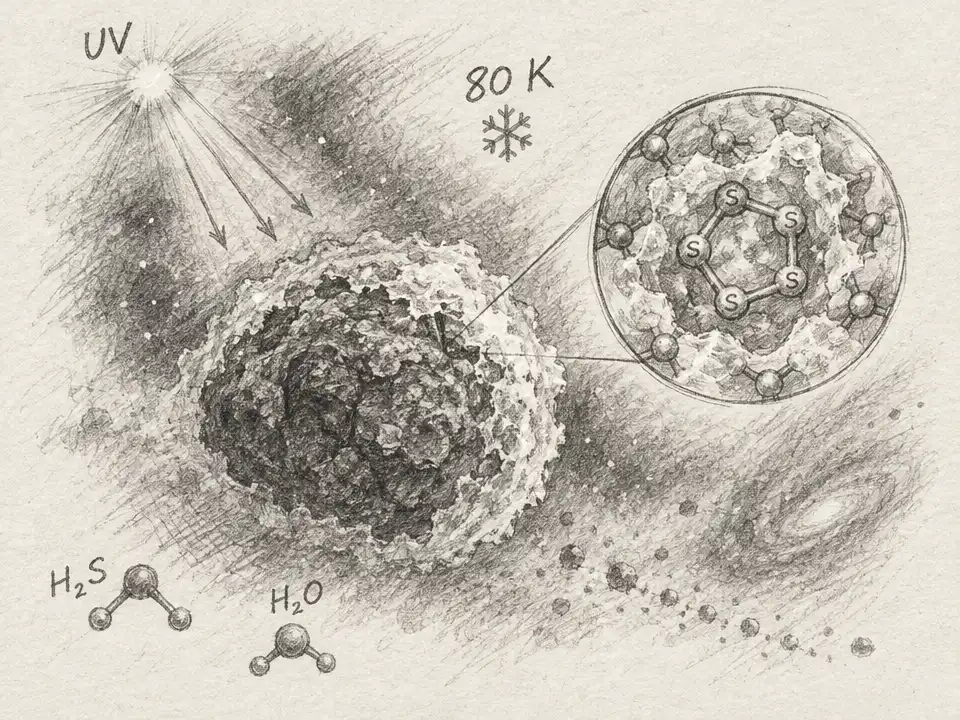
The clue is deuterium, a heavier form of hydrogen. Ordinary hydrogen has one proton in its nucleus; deuterium has a proton and a neutron. The two are chemically similar, but their proportions can preserve information about where material formed. In especially cold star-forming environments, chemical reactions can concentrate deuterium in certain ice molecules and organic compounds. If those materials become part of a planet, their unusual isotope balance may survive as a record of the planet’s raw ingredients.
To look for that record, the team observed ε Indi Ab with JWST’s near-infrared spectrograph for 4.4 hours. They collected light from 2.85–5.30 micrometers, taking observations at two different telescope roll angles. The planet sat well away from its star in the instrument’s field, but the stellar glare still dominated the raw images. By modeling and subtracting that starlight, the researchers could isolate the planet’s spectrum: a pattern of wavelengths shaped by molecules in its atmosphere.
One molecular fingerprint stood out. The team detected deuterated methane—methane with a deuterium atom in place of one ordinary hydrogen—with a significance of 48 sigma. They also identified other molecules in the atmosphere, helping them interpret the methane signal in the broader chemical picture. The central measurement is an estimate: hydrogen and its molecular partner were not directly detected in this spectrum, so the researchers used the deuterated and ordinary methane abundances, along with a calculated correction, to infer the planet’s overall deuterium-to-hydrogen ratio.
That inferred ratio is 4.4 ± 0.7 × 10⁻⁵. It is roughly twice the value measured for the material from which the Sun and planets formed, and it resembles the ratios of Uranus and Neptune more than those of Jupiter and Saturn. This is an unexpected combination. In its enrichment of heavier elements—including carbon, oxygen, nitrogen, and sulfur—ε Indi Ab looks more like Jupiter, with abundances roughly five times those of its star. Its deuterium, however, carries a different kind of fingerprint.
The contrast helps narrow the story. A natal cloud’s overall deuterium abundance cannot simply be high enough to explain the planet’s measurement: deuterium has been destroyed, not created, inside stars since the Big Bang. The researchers instead consider solids whose particular molecules became unusually rich in deuterium through cold chemistry. Such ices and organics could retain a chemical imprint of the planet-forming cloud even after they were incorporated into a giant planet.
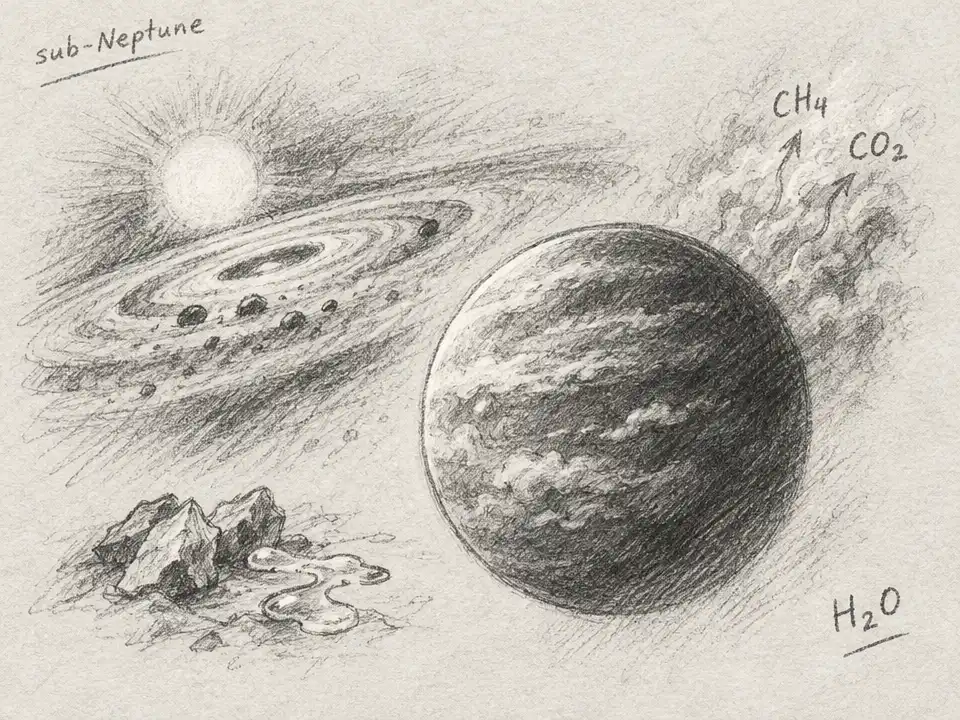
The planet’s other elements matter here, too. If ordinary, Solar System-like comets supplied enough material to explain the deuterium, the model would also predict far greater carbon and oxygen enrichment—about 200 times the star’s values—than the roughly fivefold enrichment observed. So the result is not simply a case of adding familiar comet ice to a giant planet. The solids would need to be unusually rich in deuterium while still fitting the planet’s wider chemical pattern.
One possible route begins far out in the planet’s original disk, beyond the regions where nitrogen and carbon monoxide freeze into ice. Those snowlines lie around 56 and 36 astronomical units, respectively—farther out than ε Indi Ab’s current orbit. The planet may have formed in that colder territory and later moved inward, or icy pebbles from the outer disk may have drifted inward and delivered their preserved materials. In one model scenario, matching both the heavy-element enrichment and the isotope measurement requires water ice with a deuterium-to-hydrogen ratio of about 1.5 × 10⁻², or refractory organics at about 5 × 10⁻². These are model-dependent estimates, not direct measurements of the planet’s vanished building blocks.
There is another uncertainty: the measured atmosphere may not perfectly represent the planet’s full interior. The interpretation could change if the atmosphere is not well mixed, or if later impacts left a chemical signature in its upper layers. But the analysis still points to an important constraint: whichever route delivered the material, it had to be strongly enriched in deuterium. The isotope is not a photograph of the planet’s birthplace; it is a clue that has survived the journey.
That clue shifts the scale of the investigation. A spectrum collected from a faint atmosphere near a nearby star reaches back toward chemistry in a much colder, earlier environment—the cloud from which a planetary system took shape. Measuring deuterium in more cool giant planets could reveal whether ε Indi Ab is unusual, or whether other worlds also carry traces of the ancient ice and organic material from which they grew.