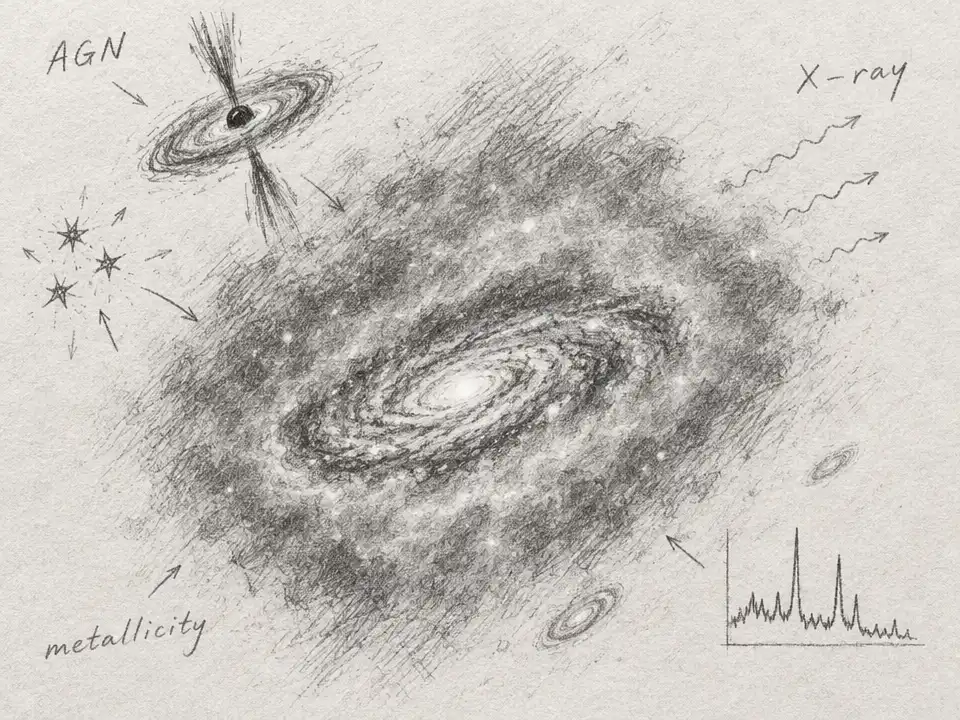
At cosmic dawn, galaxies seem to have been growing too quickly. The James Webb Space Telescope has found galaxies in the early universe that are brighter than many pre-JWST models anticipated, raising a pointed question: what physics lets young galaxies assemble stars so rapidly? One tempting answer is to turn up the energy from supernovae. Exploding stars can push gas around and slow star formation. But in a new set of simulations, that stronger push produced a surprise: galaxies that were too large and diffuse.
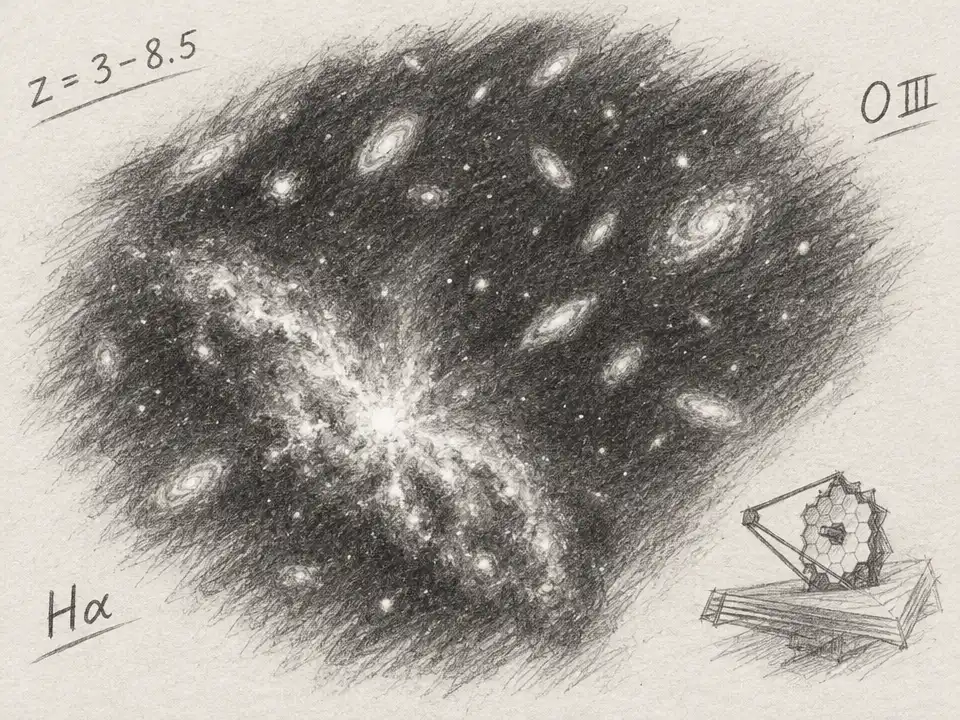
The result comes from a comparison of simulated universes, not a new telescope observation. Researchers followed galaxies from redshift 12 to redshift 3 using the high-resolution Azahar cosmological simulations. The simulations model a region about 8 comoving megaparsecs across inside a larger, 25-comoving-megaparsec box, with a target spatial resolution of 23.8 parsecs. Then the team made synthetic images in three JWST filters, accounting for starlight and dust and blurring the images to mimic the telescope’s resolving power.
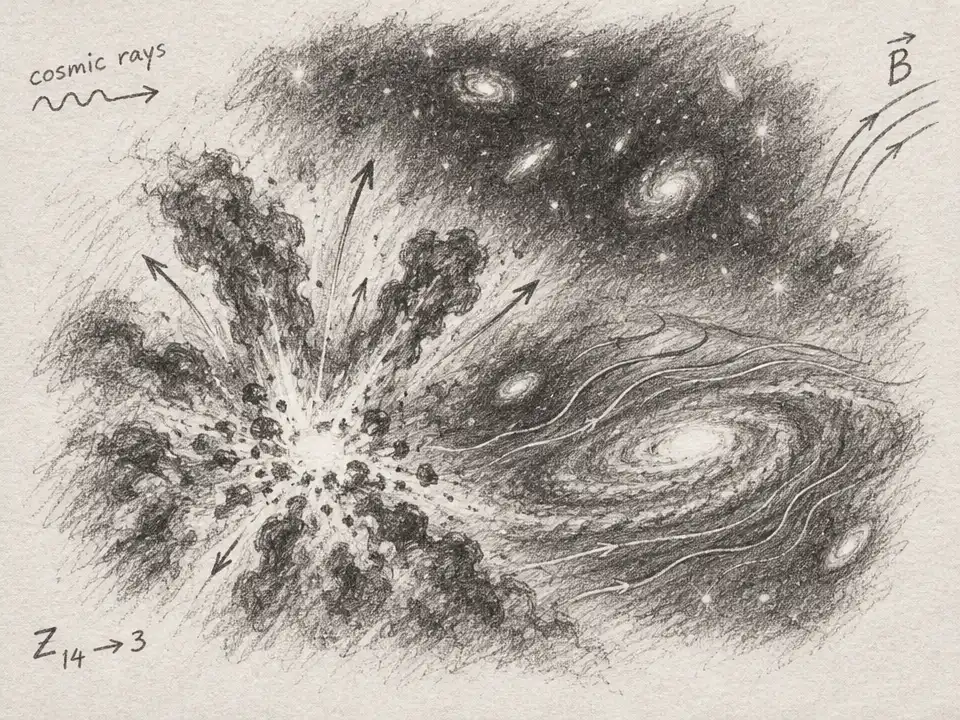
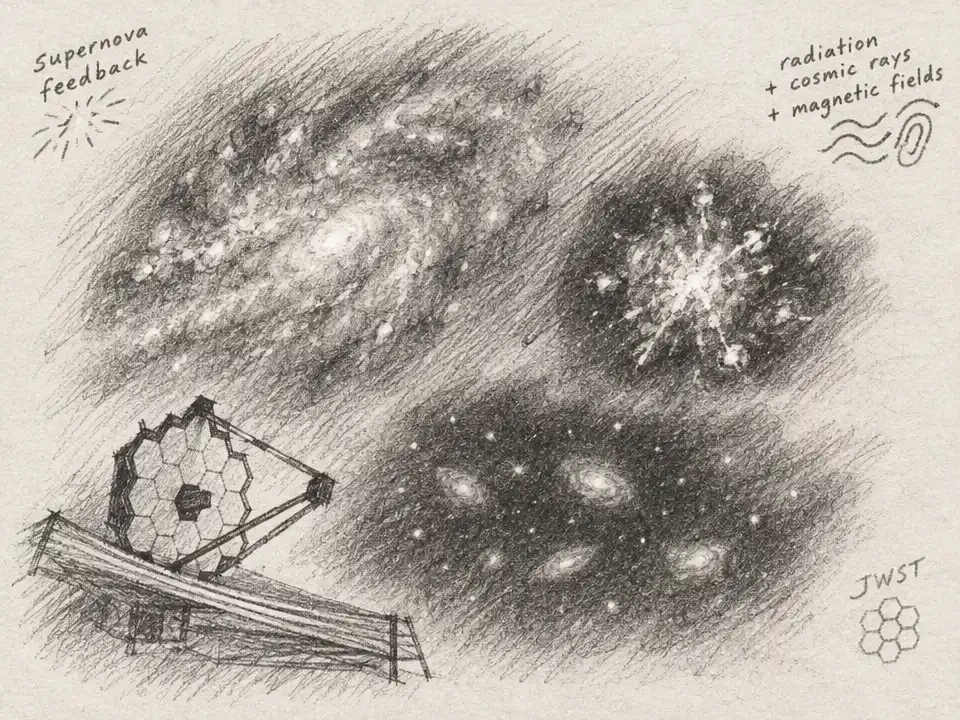
They compared three versions of the same broad experiment. One used standard hydrodynamics and ordinary mechanical supernova feedback. A second increased the energy injected by each supernova by a factor of four; that adjustment was calibrated to reproduce the observed galaxy stellar-mass distribution at redshift 3. The third added more of the physics that can shape gas before and after stars form: radiation transport, cosmic rays, and magnetic fields. The researchers could then ask not only how much stars formed, but what the resulting galaxies would look like to JWST.
The stronger-supernova model did suppress galaxy growth. Yet its galaxies did not simply become smaller. At a given stellar mass, they tended to be more extended and diffuse than the observed galaxies, with sizes nearly twice as large as the measured values. Their structures could look fragmented, lacking the clearer disks and central forms seen in the other simulations. A more forceful feedback setting, chosen to improve one important galaxy statistic, therefore missed the mark on galaxy size and shape.
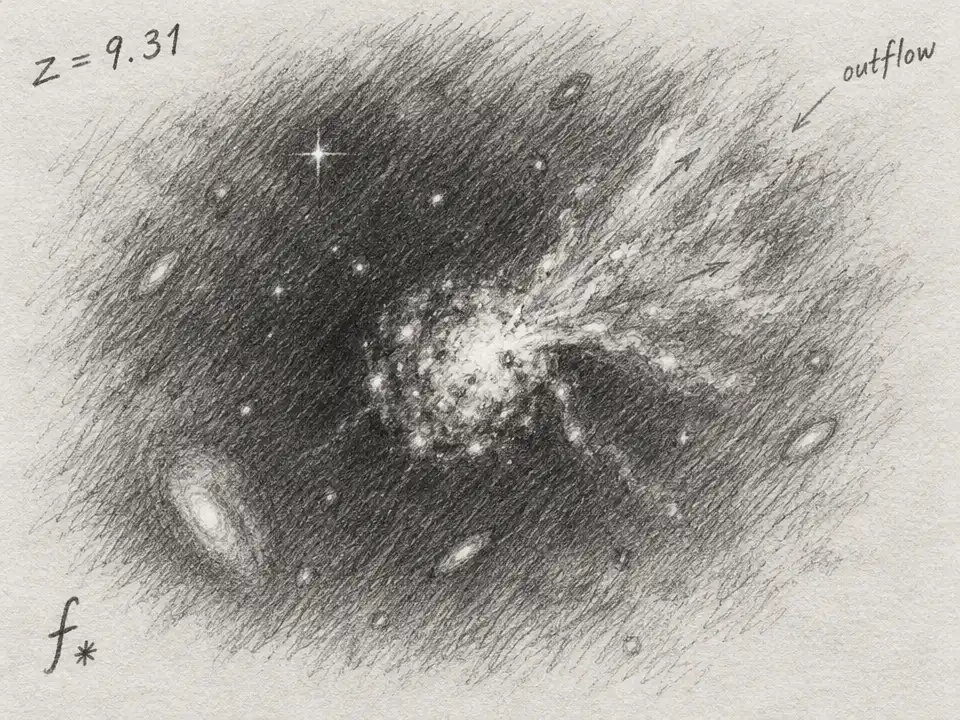
That is the expectation-reversing part: feedback is not a simple cosmic brake. Its effects depend on how energy moves through gas and how the ingredients interact over time. A burst of star formation can create supernovae; their energy can drive gas outward, changing where later stars form and how a galaxy is structured. Simply increasing the supernova energy did not reproduce the compact, bright early galaxies that JWST sees. Matching one outcome at a later epoch did not guarantee the right morphology across cosmic time.
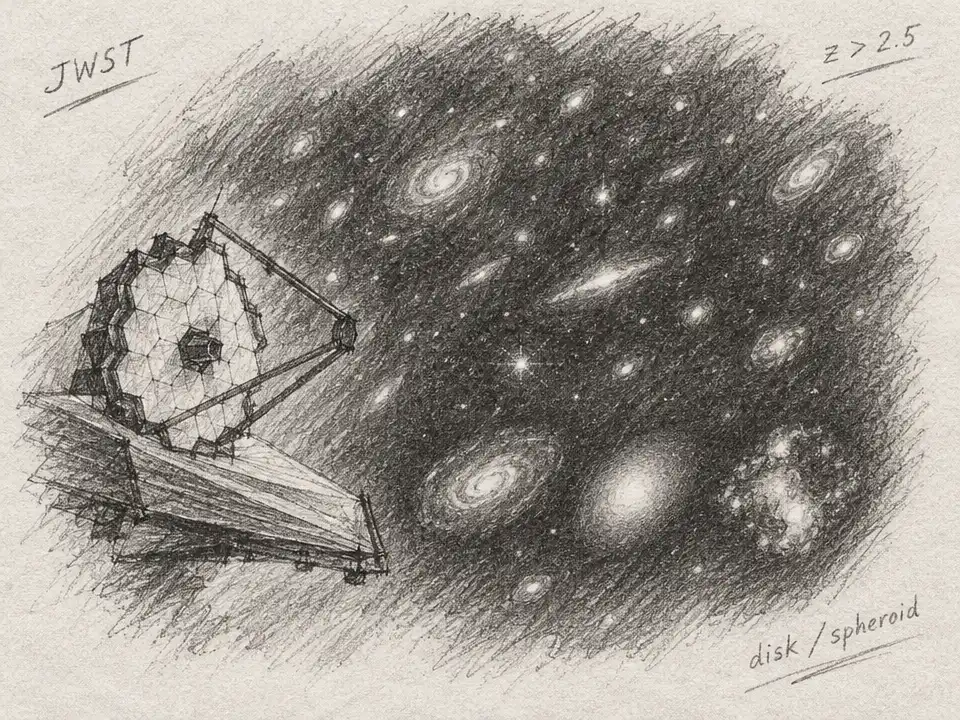
The full-physics model offered a different result. It did not just crank up the supernova setting. It included radiation from stars, cosmic rays generated by supernova remnants, and magnetic fields, alongside the shared mechanical supernova feedback. In this version, galaxies developed more regulated sizes: larger than the most centrally concentrated standard-hydrodynamics galaxies, but not as oversized as the boosted-supernova systems. At later times in the simulation, one representative galaxy formed a disk with spiral arms and dust lanes.
The ingredients also influence the gas in different ways. Radiation can suppress the formation of dense star-forming clumps, while cosmic rays can help drive smoother pressure-supported outflows. Magnetic fields affect how gas cools, fragments, and mixes. The paper tests these ingredients together, so it does not identify one as the decisive fix. Its larger point is that galactic structure can emerge from the interplay among several kinds of feedback—not from treating supernova energy as a single dial.
That fuller picture also changed which simulated galaxies would be easiest to spot. The full-physics galaxies spanned a broader range of surface brightness, including a bright tail of compact, actively star-forming systems. At redshift 12, the brightest reached about 26.5 magnitudes per square arcsecond in the simulated JWST filter. For comparison, the paper estimates a surface-brightness detection limit of about 27 magnitudes per square arcsecond for the JADES Deep observations it references. The boosted-supernova model’s typical systems at that epoch were much dimmer, around 33 to 35 magnitudes per square arcsecond.
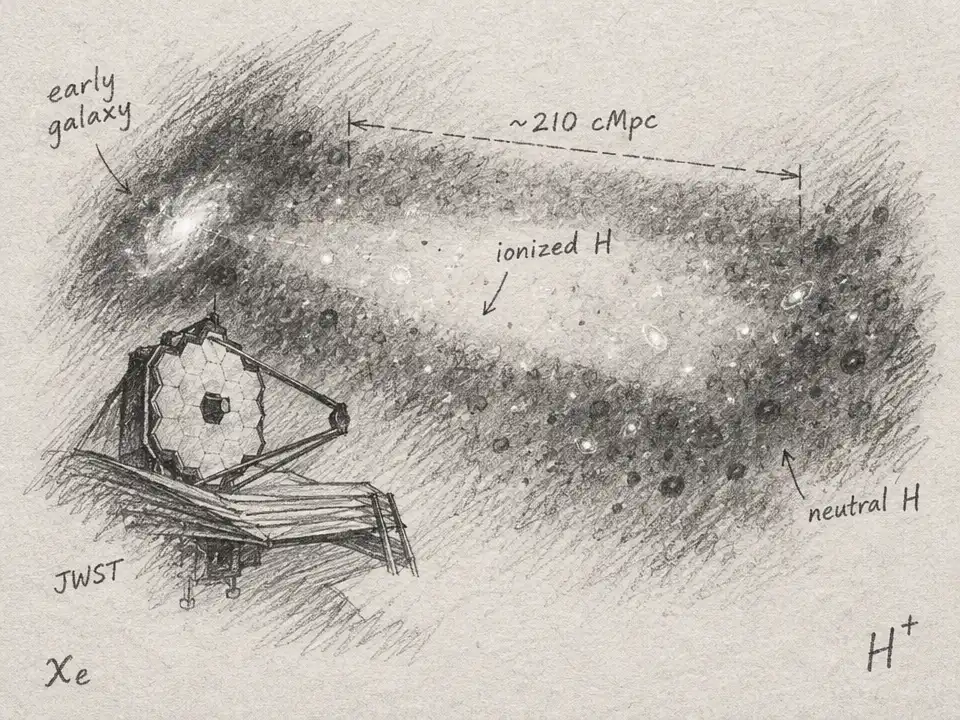
That comparison suggests a possible selection effect: the galaxies JWST detects most readily may be the small, bright, starbursting tip of a much wider population. In the simulations, faint, diffuse galaxies can fall below current detection thresholds even if they are numerous. A telescope survey does not provide a neutral census of every galaxy; compact sources concentrate their light and are easier to notice than equally real galaxies spread thinly across the sky.
But the simulated brightnesses are predictions, not a direct count of hidden galaxies. The mock observations include the telescope’s point-spread function, but the study does not include every observational complication, such as detector and background noise or the full source-detection process. Size measurements are especially uncertain for low-mass galaxies: at redshifts above 10, the models predict sizes of 200 to 500 parsecs for galaxies with stellar masses between 107 and 108 solar masses, often smaller than JWST can resolve reliably. A model may look like a good match partly because the instrument blurs away the differences.
So the finding is not that JWST’s bright galaxies have now been fully explained. It is that a familiar fix—stronger supernova feedback—can make some predictions worse, while a package of interacting physical processes produces a closer match to observed sizes and a plausible bright population. Better measurements of compact galaxies, especially with future telescopes able to resolve smaller structures, can test whether the simulated story holds. For now, cosmic dawn looks less like a contest to find the strongest feedback and more like an investigation into how several kinds of feedback work together.