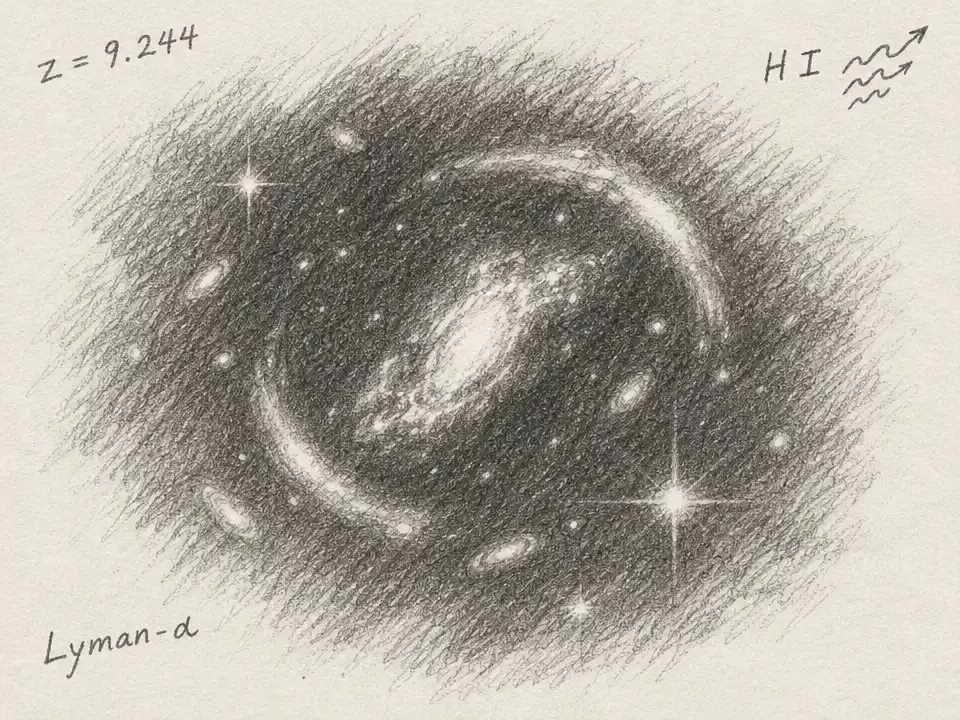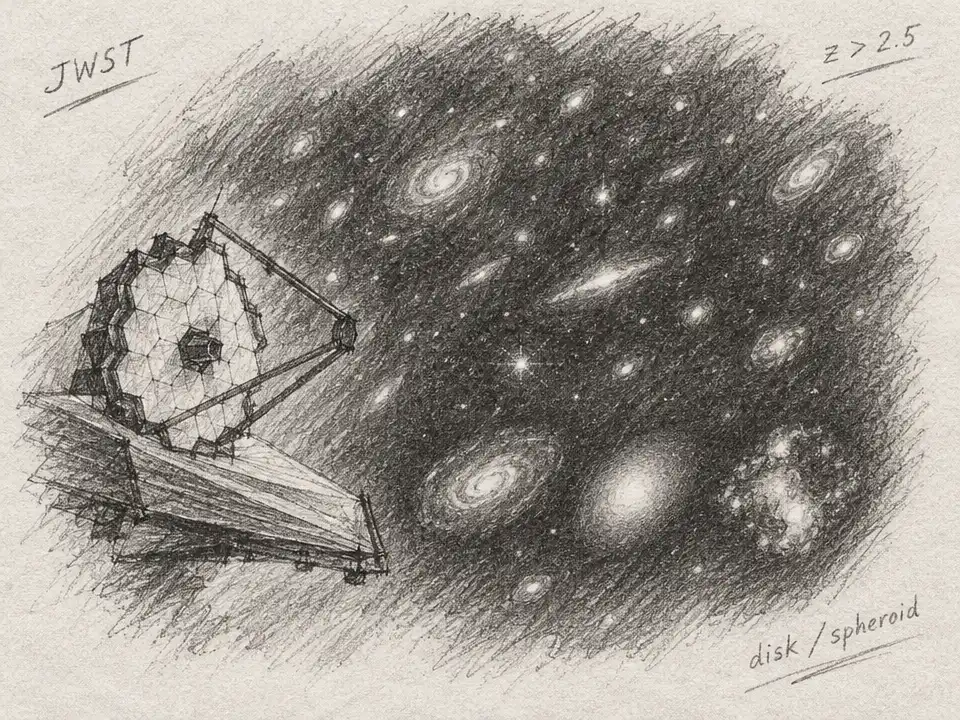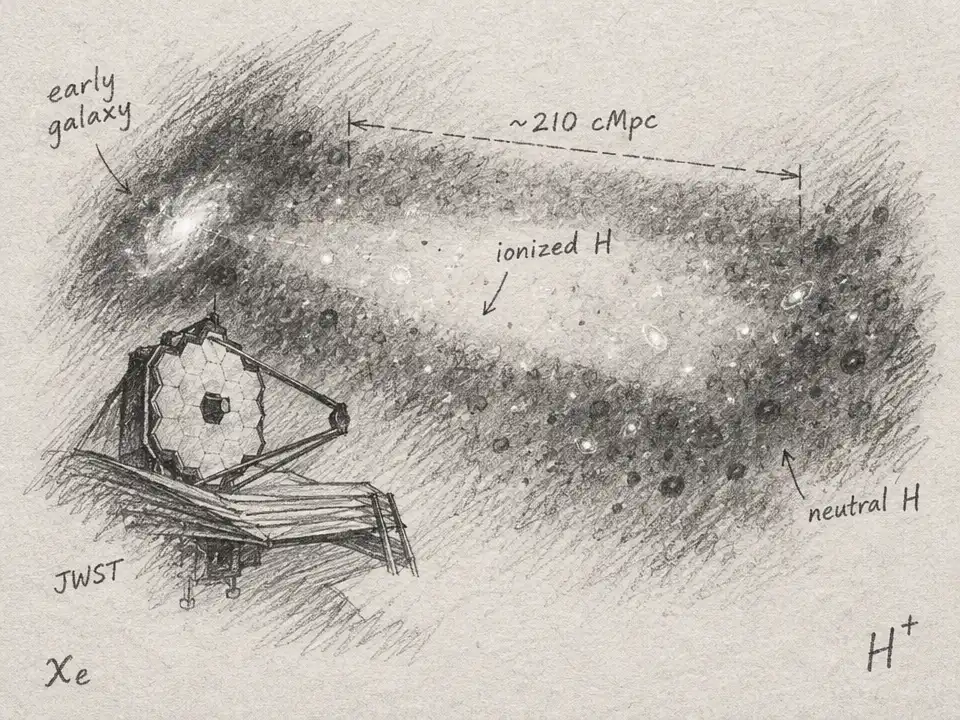
In the JWST images, UNCOVER 3686 begins as a faint patch in a field around the galaxy cluster Abell 2744. Its light has crossed an immense stretch of space, carrying a view of the galaxy from when the universe was young. But the image alone cannot tell us how unusual this distant object may be. The clue comes from its spectrum—and from a question that reaches inside the galaxy: how much of its cosmic allotment of ordinary matter did it turn into stars?
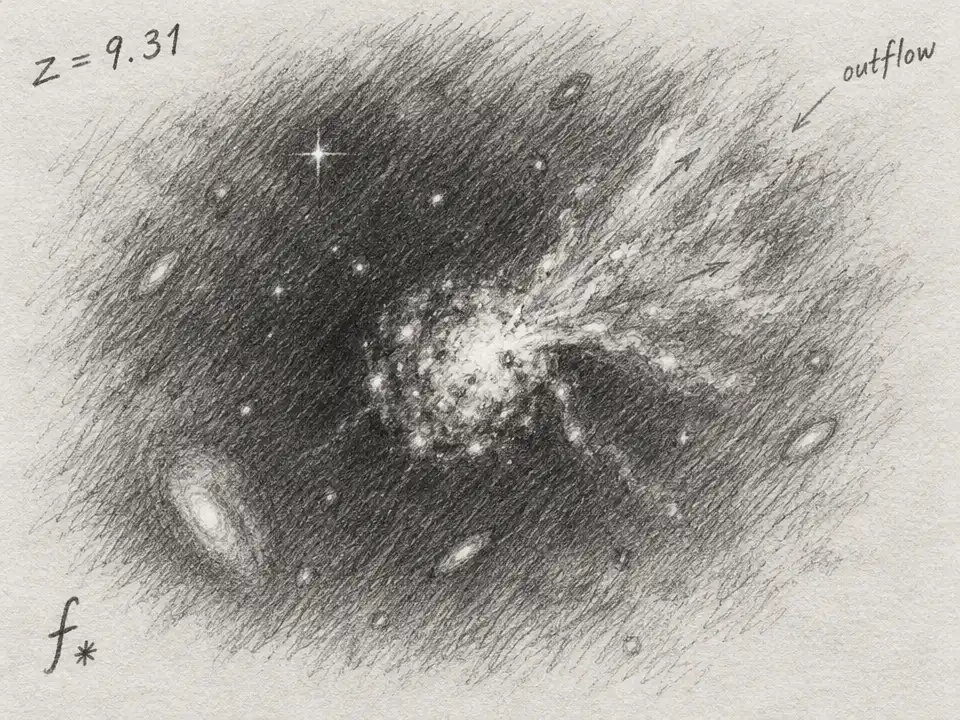
The spectrum shows a sharp Lyman break, a signature that helps establish the galaxy’s distance, along with bright oxygen emission lines. The measured spectroscopic redshift is 9.31, with a reported uncertainty of ±0.01. At that distance, astronomers are not seeing the galaxy as it is today. They are examining an early chapter of its life, when the forces that regulate star formation may have been operating differently.
UNCOVER 3686 is compact: its measured effective radius is 0.45 kpc. The study estimates its stellar mass at a base-ten logarithm of 9.55 in solar-mass units. Its stars have a mass-weighted age of 160 Myr, with an uncertainty of +40 and −30 Myr, and the galaxy is forming stars at an average rate of 29.8 solar masses per year, with an uncertainty of +4.7 and −3.6. The estimated stellar metallicity is 0.20 times the solar value. Taken together, these properties describe a young, vigorously star-forming system that has already assembled a substantial population of stars.
That assembly raises a puzzle. Stars do not form in isolation: they emerge from gas clouds, and young stars can push back on the material around them. Their radiation and winds stir and heat the gas; later, supernova explosions add another shove. This feedback can slow star formation by dispersing the clouds that feed it. Yet some models predict a temporary window in the early universe when gas clouds were so dense that stellar feedback struggled to interrupt the rush. In a feedback-free starburst, stars could form rapidly before their own influence cleared the way.
“Feedback-free” does not mean that stars never affect their surroundings, or that the galaxy escapes the laws of physics. It describes a proposed condition in which feedback is less effective inside extremely dense clouds. The theory predicts that galaxies above a threshold halo mass, and with the right gas density and metallicity, can convert an unusually large share of their available baryons into stars. Baryons are the ordinary matter that can become stars, gas, and dust; most of a galaxy’s total mass is thought to reside in its dark matter halo.
Testing that idea means estimating a quantity that cannot be read straight off the image: the fraction of a halo’s expected baryons already locked into stars. The researchers built a reference sample of 142 galaxies estimated to lie between redshifts 9 and 10, including 31 with spectroscopic confirmations, across about 0.2 square degrees of JWST survey area. They then used abundance matching. In simple terms, this method compares how common galaxies of different masses are with how common dark matter halos of different masses are. That statistical match gives an estimate of the halo that could host UNCOVER 3686—and, from there, its star-formation efficiency.
With their stricter, more reliable sample, the authors infer a halo mass whose base-ten logarithm in solar-mass units is 11. The resulting estimate is about 20% for the fraction of available baryons converted into stars, with reported uncertainty of +0.05 and −0.06. A separate estimate based on the galaxy’s status as the most massive spectroscopically confirmed object in the UNCOVER field gives 0.22, with uncertainty of ±0.06. These estimates are three to four times higher than the comparison empirical model predicts. They also place the galaxy above the halo-mass threshold that the feedback-free starburst model predicts for this epoch.
There is a more provocative number, but it comes with a warning label. When the researchers relaxed one of their photometric redshift requirements, their larger sample contained 721 galaxies and may have included impostors. Using that sample, their method gives an efficiency of about 62% for UNCOVER 3686. The authors treat the difference between roughly 20% and roughly 60% as a real uncertainty to investigate, not as proof that the galaxy reached the more extreme value. Some objects in the relaxed sample may not belong at these distances; if so, their presence could distort the inferred abundance of massive galaxies and the halo-mass estimate.
Even the sturdier estimate does not mean the galaxy turned all its gas into stars in one uninterrupted burst. The theory’s near-maximum efficiencies apply to short-lived, intense episodes in dense clouds. Averaged across a galaxy’s full history, the efficiency can be lower because those episodes occupy only part of the timeline. UNCOVER 3686’s estimated age is also longer than the model’s typical 80–100 Myr feedback-free phase. The observation, then, is not a frozen frame of a single cloud’s brief life; it is a galaxy-wide accounting that may preserve the imprint of several episodes.
And the “feedback-free” window may already be closing. The paper notes that deeper spectroscopic observations from another program detected interstellar outflows at a velocity of about −161 km s−1. That finding comes from the follow-up study, not from the authors’ own analysis of the spectrum used here. Still, it points to material moving out of the galaxy and suggests that stellar feedback may be beginning to take hold. The team describes UNCOVER 3686 as a candidate caught near the edge of unusually efficient star formation—not as a settled example of feedback being absent.
That edge is where the hidden-world story becomes most interesting. From far away, a compact smudge appears to be a simple object; close attention to its spectrum and its place among other galaxies turns it into a test of how star formation gets regulated. If the high efficiency holds up, some early galaxies may have built stars faster than familiar models predict, at least for a while. If the higher estimate disappears as more candidates are confirmed, the result will still show how much the answer depends on identifying the true inhabitants of the young universe. The next shift in perspective is sharper spectra: a way to tell whether this galaxy really raced ahead, and when its own stars began to slow it down.