To understand how the first galaxies grew, researchers have to build a universe they can rewind. In a computer, gas gathers along cosmic filaments, stars ignite, and supernovae blast material outward. The challenge is making that universe behave plausibly not just at one moment, but across billions of years. A model that matches galaxies in the early universe can still go badly wrong when the universe gets older.
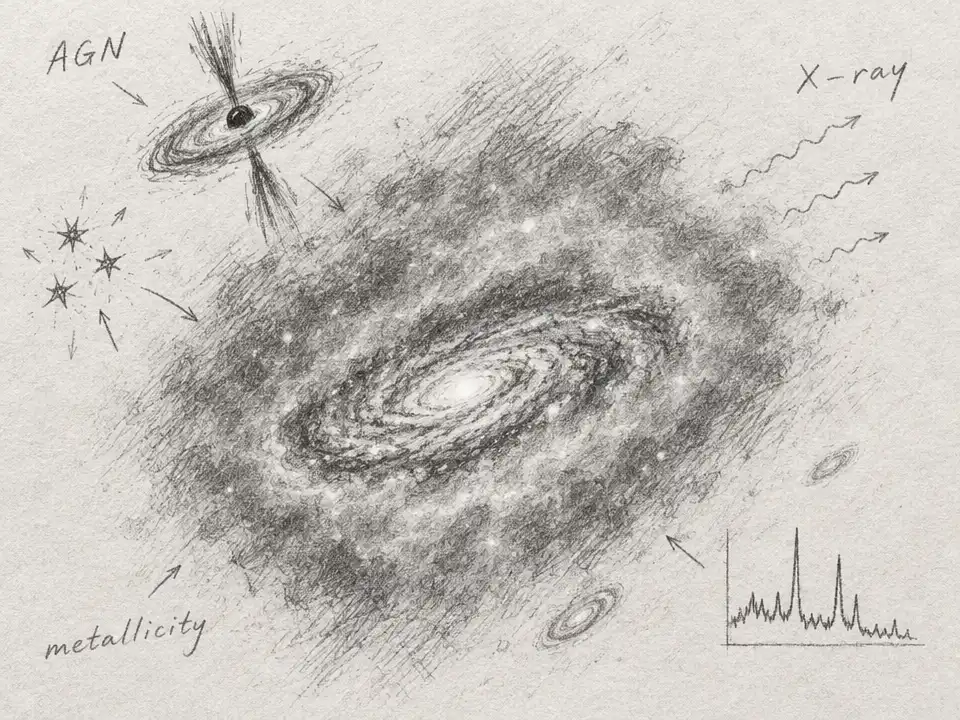
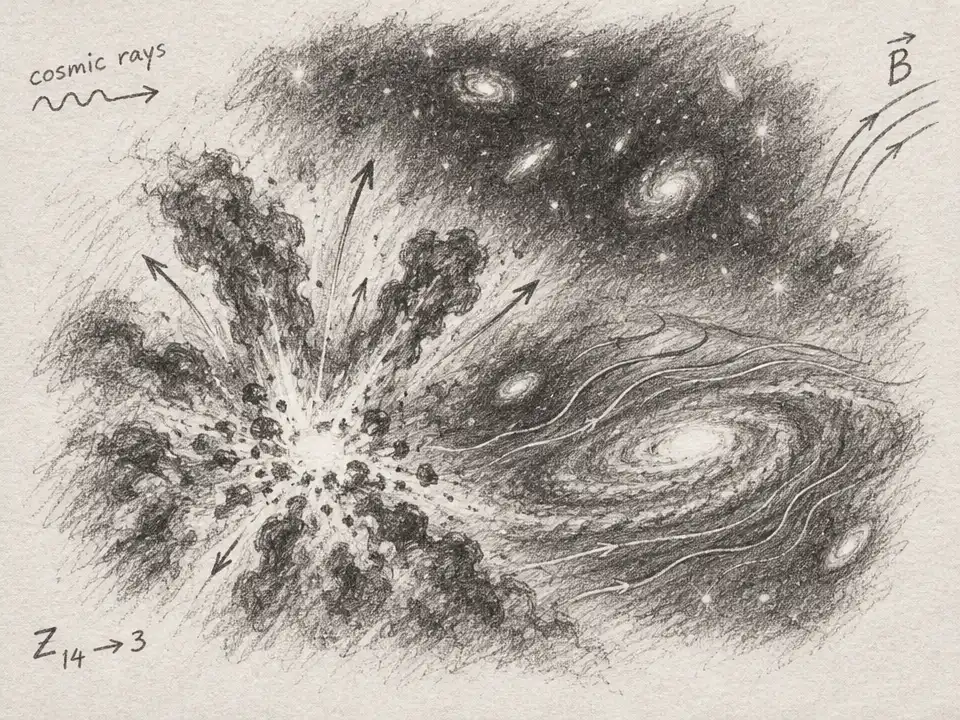
The Azahar Project takes on that problem with a new generation of cosmological simulations. Its researchers compare models that treat feedback—the ways stars and supernovae affect their surroundings—in sharply different ways. The most complete model adds several ingredients often simplified or left out: radiation from young stars, magnetic fields, and cosmic rays, energetic particles injected by supernovae. Together, those ingredients offer a more detailed way to track how galaxies regulate their own growth.
The simulations follow a high-resolution region of the universe from redshift 127 down to redshift 3, spanning the formation of thousands of galaxies. Their maximum spatial resolution is 23.8 parsecs, small enough to represent aspects of a galaxy’s internal gas structure. Rather than trying to simulate the entire universe at that detail, the team zooms in on a selected region within a larger cosmic volume.
They compare three versions of galaxy formation. One uses standard hydrodynamics with ordinary supernova feedback. Another boosts the supernova feedback strength by a factor of four—a calibrated adjustment intended to reproduce galaxy properties at later times. The third, called the Non-Thermal model, includes radiation transfer, magnetic fields, and cosmic rays as the simulation runs. It is not simply a stronger version of the first model. It lets different kinds of energy affect gas in different ways and on different timescales.
That distinction matters because the simpler models struggle to tell a consistent story across cosmic time. The standard model makes too many stars at later stages. The boosted-feedback model can curb that growth, but its forceful supernova feedback suppresses star formation too strongly at some epochs. Each can fit parts of the picture; neither reproduces the observed evolution as well across the full interval.
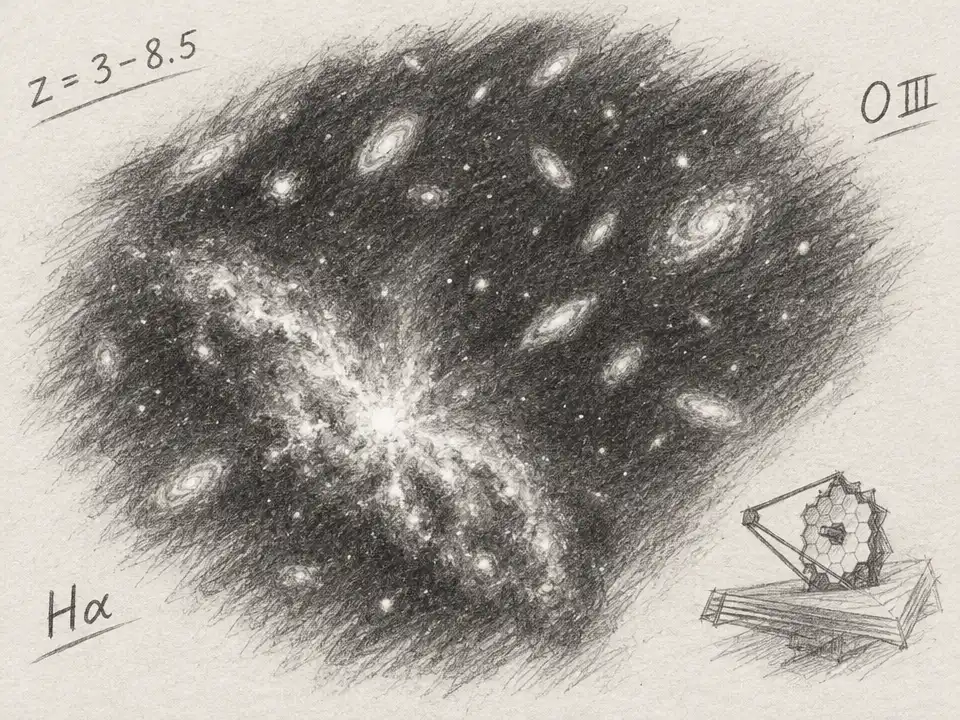
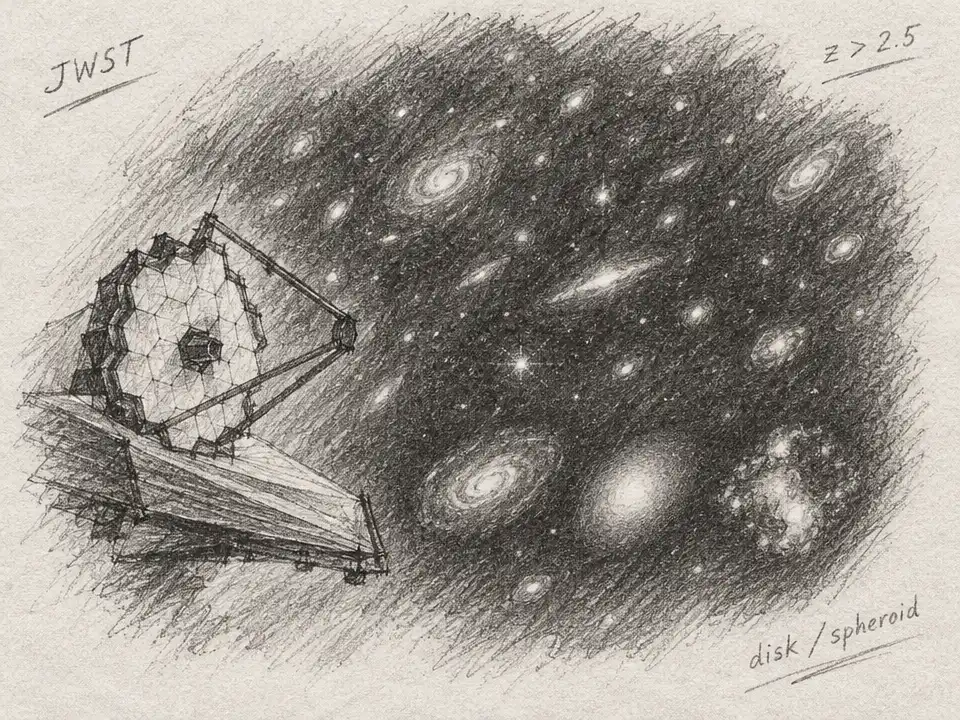
The Non-Thermal model does better on several measures, including the abundance of galaxies at different ultraviolet brightnesses, the growth of stellar mass, and gas metallicities. It reasonably matches the observed ultraviolet luminosity function from redshift 14 to redshift 3. That is notable because the same framework spans the earliest simulated galaxies and the later era often called cosmic noon, rather than being tuned to only one cosmic chapter.
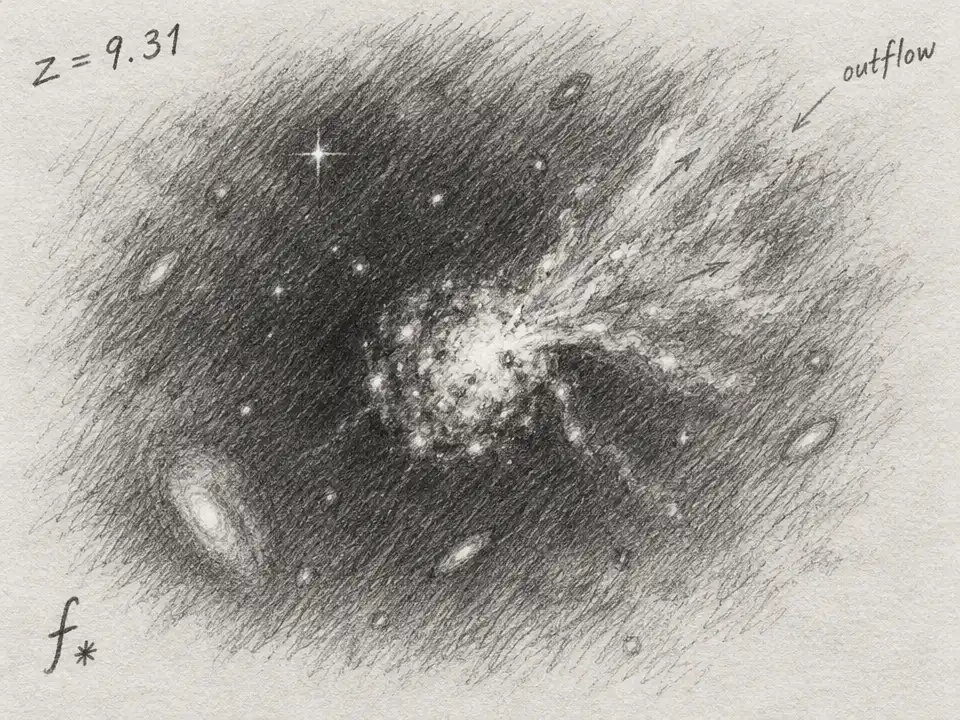
The simulation also suggests a changing feedback rhythm. Early on, radiation from massive young stars and bursts of supernova activity help make star formation more uneven. Galaxies can build up gas, form stars rapidly, and then drive some of that gas outward. The model produces greater variability on both short timescales of less than 10 Myr and longer timescales of more than 50 Myr. These simulated changes can be compared with observations that use different signals to trace star formation over different periods.
As galaxies evolve, cosmic rays from successive supernovae accumulate in the interstellar gas. In the model, their pressure becomes more important over time, especially after redshift 7. Instead of only helping to eject gas, this sustained pressure can also make it harder for gas to collapse into new stars. The researchers describe a shift: early feedback is more ejective, pushing gas out; later, it becomes more preventive, regulating star formation by supporting gas and limiting its collapse. The simulated winds also change, becoming more sustained and less forceful than the early outflows.
This offers a possible explanation for why galaxies might grow in bursts at early times but settle into a different pattern later. It also connects several clues—galaxy brightness, star-formation variability, outflows, and the amount of metals in gas—within one physical model. In this account, cosmic rays do not act alone: the result comes from their interplay with radiation, magnetic fields, and supernova feedback.
That last point is important. This paper compares three representative models from a planned suite of ten, but it does not isolate every ingredient to determine exactly how much each one contributes. The version studied also leaves out cosmic-ray streaming, a process the researchers say they will address in future work. And the zoomed simulation volume is limited: it cannot fully sample rare, exceptionally bright galaxies, and some of its population estimates carry substantial uncertainty. A successful match to observations is evidence that the approach is promising, not proof that this is the only route to the observed galaxies.
The model points toward ways to test its story. Astronomers can compare how quickly stars appear when measured with signals sensitive to different timescales, examine outflows and their metal content, and check whether those patterns change with cosmic epoch. If the predictions hold up, cosmic rays may be part of the missing link between the hectic first bursts of star formation and the more regulated galaxies that followed. The new approach is to let several kinds of stellar feedback work together—and then see whether one evolving cosmic history fits the evidence.