For most of its journey across the universe, light from a distant galaxy had no reason to stand out. Then it reached a stretch of space that, by the usual expectations, should have swallowed it. Instead, some of the light got through.
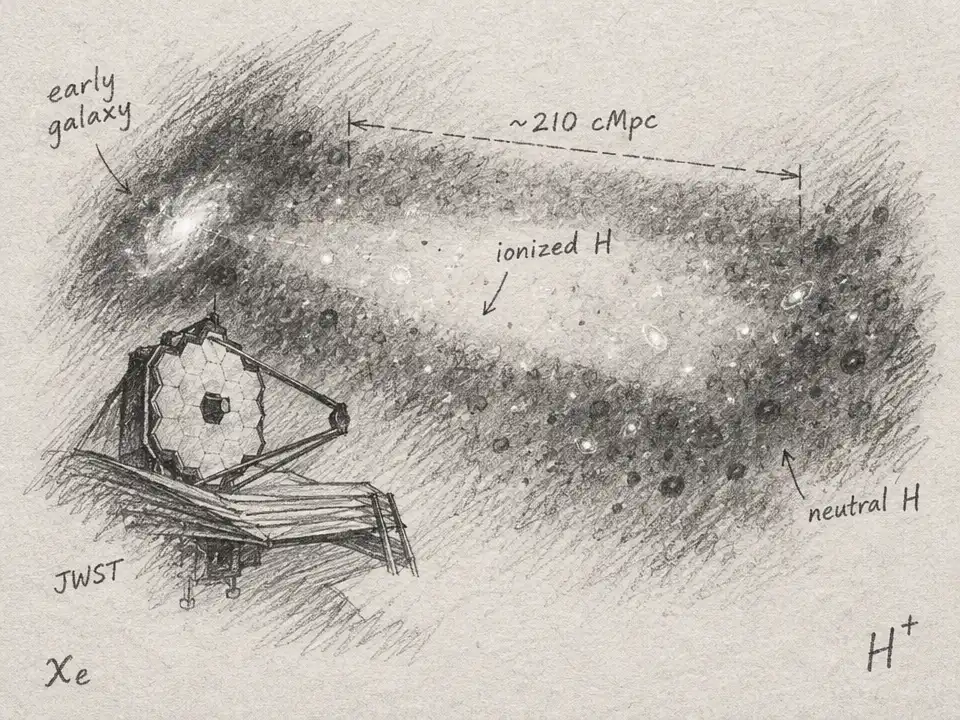
That narrow opening in the cosmic dark points to something startling: a huge region where hydrogen was almost entirely ionized, at a time when the wider universe was still substantially neutral. The evidence comes from one distant galaxy and one line of sight. But along that sightline, the inferred structure stretches more than 200 comoving megaparsecs—a scale that makes familiar bubbles around individual galaxies look small.
The clue surfaced in James Webb Space Telescope observations of a galaxy called JADES-GS-217704. Its light has traveled from a time when the universe was much younger. The galaxy’s redshift, measured from its hydrogen and oxygen emission lines, is 7.567. Astronomers were not looking at it because they already suspected a vast ionized region. A machine-learning model had flagged the galaxy as unusual among a set of known early-universe galaxies, and researchers followed up on what made it stand out.
The model, FM-JADES-v1, had learned patterns in images and catalogs from the JWST Advanced Deep Extragalactic Survey. It was not trained specifically to find clues about the early universe’s hydrogen. Researchers used it to compare 100 spectroscopically confirmed galaxies at redshifts above 7 and rank those that looked different from the group. JADES-GS-217704 landed among the top five outliers. The model did not identify the physics; it helped point human investigators toward a place to look.
What they found was a little light where the expected signal was nearly none. As the universe expanded, the galaxy’s ultraviolet light was stretched to longer wavelengths. A key wavelength called Lyman-alpha, emitted at 121.6 nanometers, arrives from this galaxy at about 1.042 micrometers. But JWST’s measurements also picked up light at shorter wavelengths, including a feature around 0.95 micrometers. The feature appeared in both the telescope’s imaging and its spectrum; in the spectrum, the detection between 0.9 and 1.0 micrometers had a reported significance of 5.66 sigma.
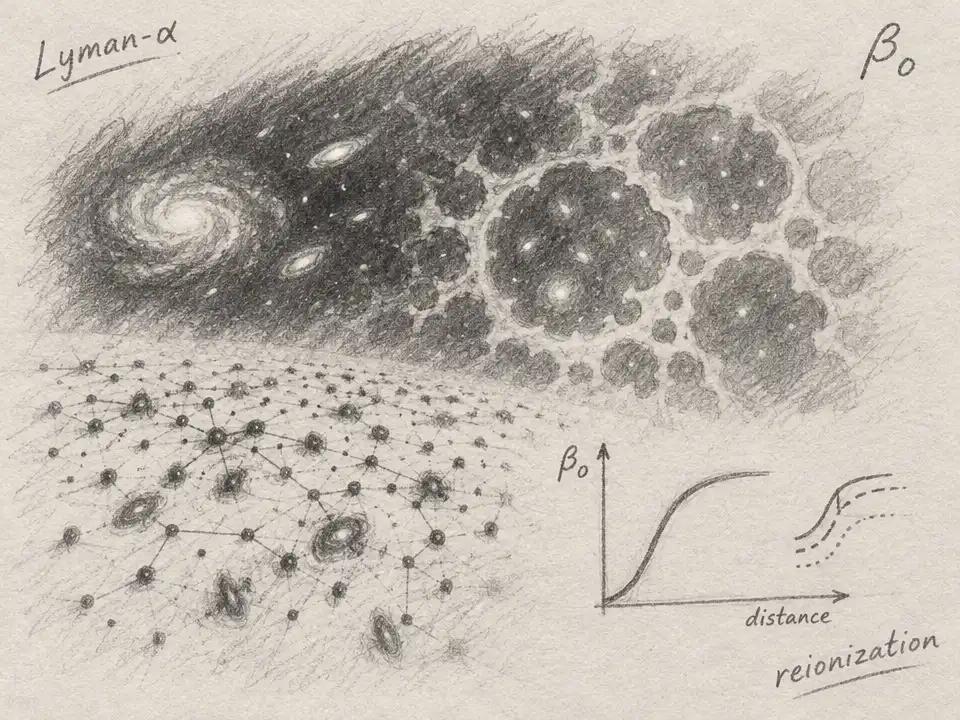
Why is that a surprise? Between the galaxy and Earth lies intergalactic hydrogen. Neutral hydrogen absorbs ultraviolet light at wavelengths shorter than Lyman-alpha, so astronomers expect little or no such light to make it through. The fact that some does arrive suggests the intervening gas is unusually transparent. The team estimates that the hydrogen’s neutral fraction in the transmitting region is about 2.07 millionths. For comparison, the paper uses an estimate of about 0.4 for the cosmic average around that time.
The signal is not a glowing object photographed across its full width. It is a spectral clue: the wavelength range over which the light gets through lets researchers estimate how much cosmic distance the transparent stretch covers along this particular line of sight. Their best fit places it at redshift 6.80, roughly 800 million years after the Big Bang, and gives it a line-of-sight extent of 210.5 comoving megaparsecs, with substantial uncertainty. “Comoving” distances account for the universe’s expansion, making it easier to compare structures across cosmic history.
That scale is the puzzle. Ionized regions were already known in the early universe, but the paper contrasts this feature with bubbles generally associated with galaxies or quasars, which can be less than about 10 comoving megaparsecs across. The newly inferred structure is far larger. Nor did the researchers find a clear concentration of bright galaxies near the sightline that could straightforwardly explain it.
That absence does not prove there are no sources. The team’s search relies partly on photometric estimates of galaxy distances, and the available observations cannot rule out an overdensity of faint galaxies. The transparent region could also reflect several overlapping ionized regions, rather than one enormous bubble with a single source. The origin remains open.
Existing simulations sharpen the mystery, but do not settle it. The researchers compared the observation with three models of reionization, the long transition in which hydrogen across the universe changed from mostly neutral to ionized. None of the 20,000 simulated sightlines in each model produced a comparably transparent stretch without accounting for measurement noise. After including that noise, the estimated chance of a random sightline reaching the observed signal ranged from about 9.14 millionths to 50 millionths. But the team searched a sample of 100 high-redshift galaxies, so the chance of finding such an unusual sightline somewhere in that sample rose to about 0.5 percent. The authors describe the result as a marginal tension with the models, not a decisive refutation.
One possible implication is that reionization was more uneven than the models capture: some enormous regions may have cleared their hydrogen much earlier than others. The authors suggest that variations in ionizing radiation or gas temperature over very large distances could matter. Those are possibilities to test, not an explanation already established by this observation.
For now, the view remains a narrow one: a spectrum from a single galaxy, with an unexpectedly transparent section between us and the source. It cannot map the region in three dimensions or show what powered its ionization. Yet it turns a faint interval in one beam of light into evidence that the early universe may have contained structures both larger and stranger than expected. A model trained to recognize patterns in galaxies helped researchers notice the clue; the physics came from tracing what the light had crossed.