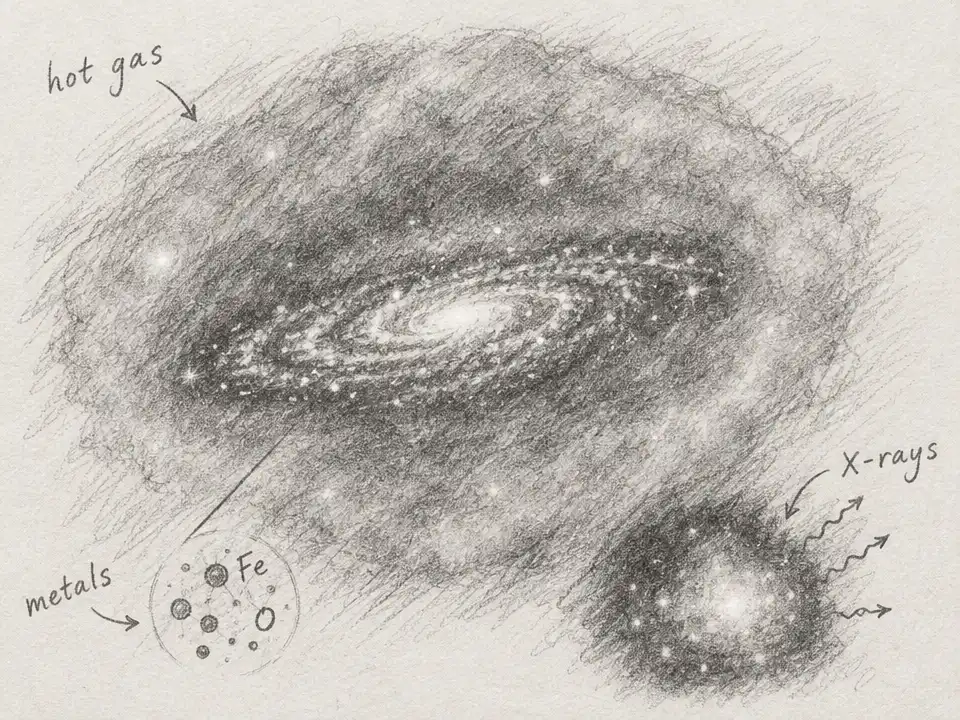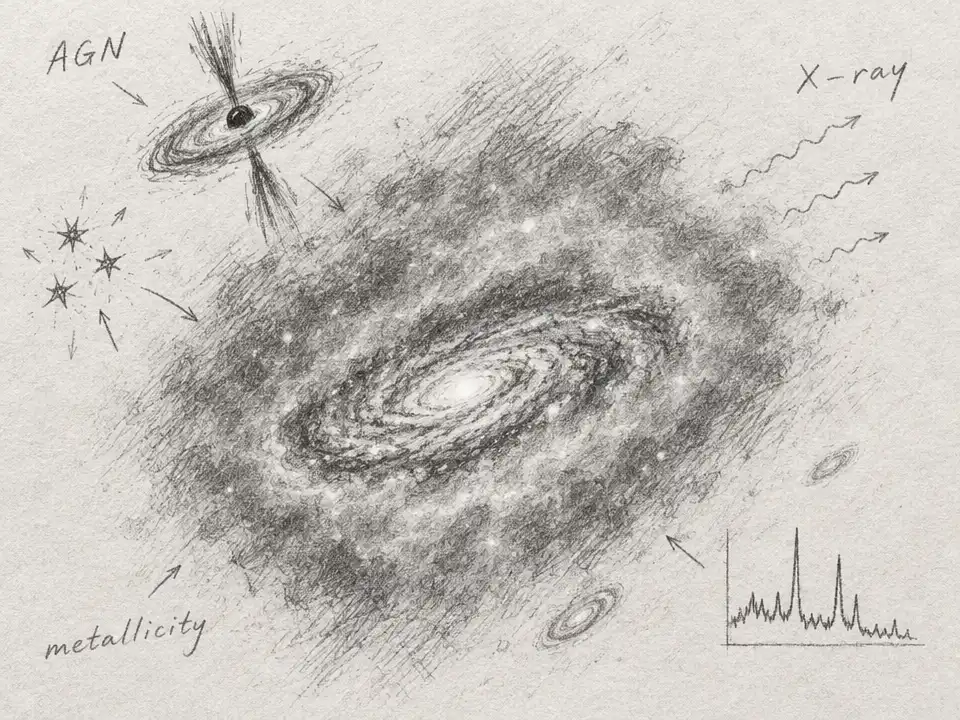
A galaxy like the Milky Way is wrapped in a vast, thin atmosphere: gas spread far beyond the bright disk of stars. Much of it is scorching—around a million degrees—and glows in X-rays. That halo may hold clues to a galaxy’s past. But its glow comes with a catch: a bright halo does not necessarily contain more gas than a dim one.
A new study explores how to read that light. The researchers used computer simulations, not new telescope observations, to investigate hot gas around Milky Way–mass galaxies. Their central question is a promising one for astronomy: could a halo’s X-rays reveal how a galaxy’s stars and central black hole have shaped it over time? The answer is yes—but the signal is more complicated than a simple brightness meter.
The team examined galaxies in Romulus25, a cosmological simulation that follows about 1,000 galaxies in a virtual region 25 megaparsecs across. To probe cause and effect, they also studied a set of four Milky Way–mass galaxies in the PIONEER simulations, each run both with and without black-hole physics. These controlled comparisons let the researchers ask what changes when the ingredients of a galaxy’s history change.
The first clue is the amount of hot gas. In the simulated galaxies, halos with more accumulated energy from both star formation and black-hole activity tended to contain more hot gas—and to shine more brightly in soft X-rays. Neither stars nor the central black hole emerged as the single, universal controller. Instead, the combined energy injected over a galaxy’s history mattered. In the simulations, galaxies whose star formation and black-hole activity had faded earlier held less hot gas and were dimmer.
Then came the twist: gas composition matters too. Astronomers call elements heavier than hydrogen and helium “metals.” Stars forge these elements, and stellar winds and black-hole-driven outflows can carry them from a galaxy’s disk into its halo. In the simulations, halos with hotter, more metal-rich gas could shine more strongly in soft X-rays than halos with comparable amounts of hot gas. The elements change how the gas emits radiation, so the telescope sees not just a reservoir of matter but also a record of what has been mixed into it.
That creates a cosmic guessing game. The researchers found simulated examples in which a halo with up to two orders of magnitude less hot gas could produce roughly the same soft X-ray brightness as a more gas-rich halo. In other comparisons, galaxies with similar hot-gas masses had notably different X-ray emission. A bright halo might mean there is lots of gas—or that the gas is hotter and more enriched. A dim one might be relatively gas-poor, or simply less efficient at producing the X-rays being measured.
The way out may be to treat the halo’s spectrum as more than a single brightness number. Temperature and metallicity can alter the shape of the X-ray signal as well as its intensity. The team’s analysis points to a broader observing strategy: pair soft X-ray measurements with ultraviolet observations of gas absorbing starlight. In particular, ultraviolet measurements of highly ionized oxygen can help trace metal enrichment. Together, the two views could help distinguish the imprint of black-hole activity from the combined effects of stars and other feedback—at least for galaxies in the mass range the study examined.
This could open a new way to reconstruct galactic history. The circumgalactic medium—the gas between a galaxy’s disk and the larger cosmic environment—is not merely leftover scenery. It is a meeting ground where material blown out of the disk can remain hot, cool, mix with metals, or eventually return. X-rays may let astronomers probe that history, while ultraviolet absorption offers a complementary clue about the material carried outward.
But the price of that opportunity is careful interpretation. The paper’s results come from simulations, and the researchers note that their models do not include a full treatment of metal-line cooling. Their analysis also does not establish that each observed galaxy’s halo can already be measured in this way: current X-ray missions cannot yet resolve the emission from individual nearby galaxy halos, according to the study. Future instruments with more detailed X-ray spectroscopy may help, but the proposed combination of observations remains a goal, not a demonstrated survey result.
For now, the lesson is less that X-rays give a direct portrait of a galaxy’s past than that they may offer one piece of a larger forensic picture. A halo’s glow carries information about how much hot gas is present, how hot it is, and how richly it has been seeded with elements from stars and black-hole activity. Untangling those signals could turn a faint envelope around a galaxy into a record of its long history. The frontier is not simply detecting the glow; it is learning what, exactly, made it shine.