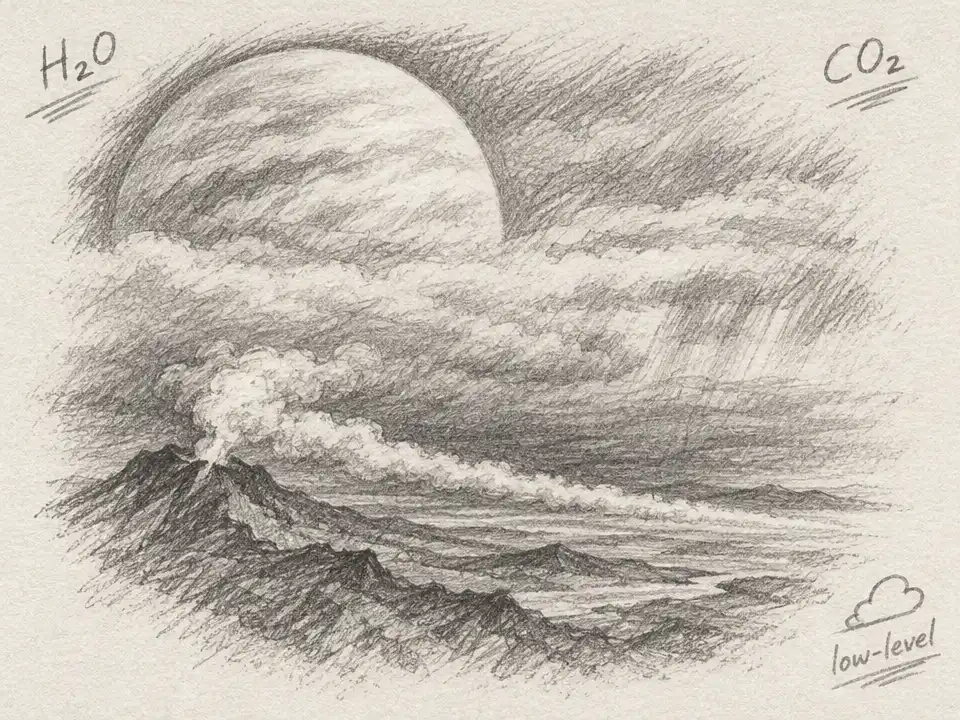
A volcanic eruption on Venus might announce itself not with a mountain of fresh lava, but with a faint streak of gas drifting through the planet’s lower atmosphere. The catch: that streak could be easiest to recognize in a layer where seeing it is especially difficult. A new three-dimensional climate-model study maps where such volcanic clues might linger—and where Venus’s own restless atmosphere could hide them.
The question matters because Venus still holds a geological mystery. Radar images reveal vast volcanic plains and volcanoes, and earlier observations have suggested possible recent changes at the surface. But scientists have not established how often Venus erupts today. Future missions, including EnVision and VERITAS, are intended to investigate active surface and atmospheric processes. To help shape that search, Maureen Cohen and colleagues simulated what happens after volcanic gases enter different layers of Venus’s atmosphere.
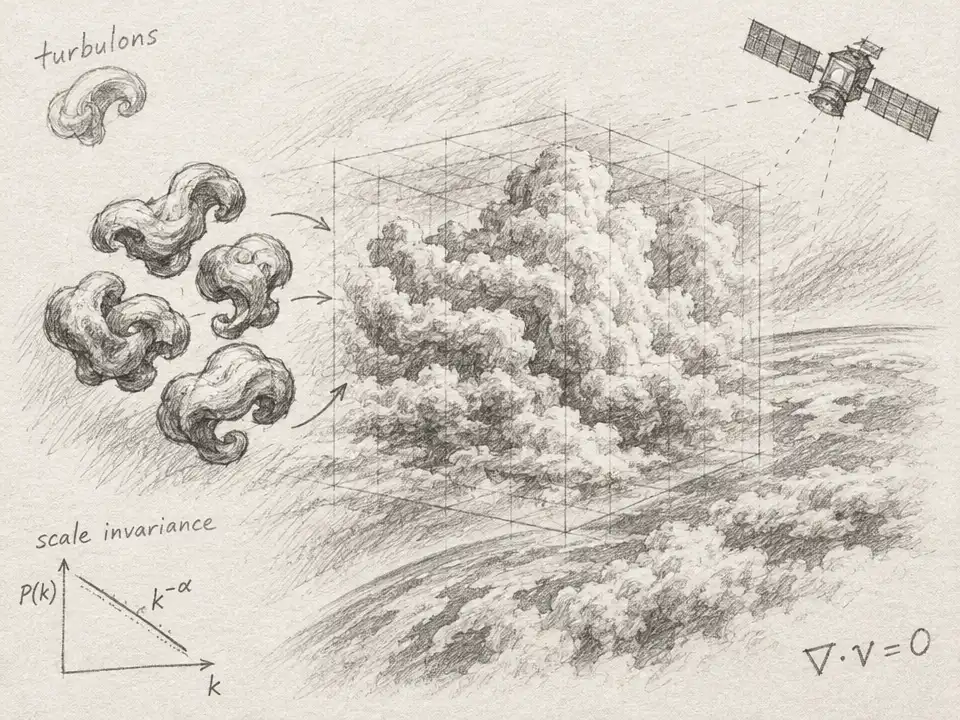
The team used the Venus Planetary Climate Model, which represents atmospheric winds, chemistry and circulation in three dimensions. They introduced localized increases in gases that could be associated with volcanism, including water vapor, hydrogen chloride, carbon monoxide and carbonyl sulfide. Then they tracked how those gases spread and whether their changing concentrations would stand out against the atmosphere’s ordinary fluctuations.
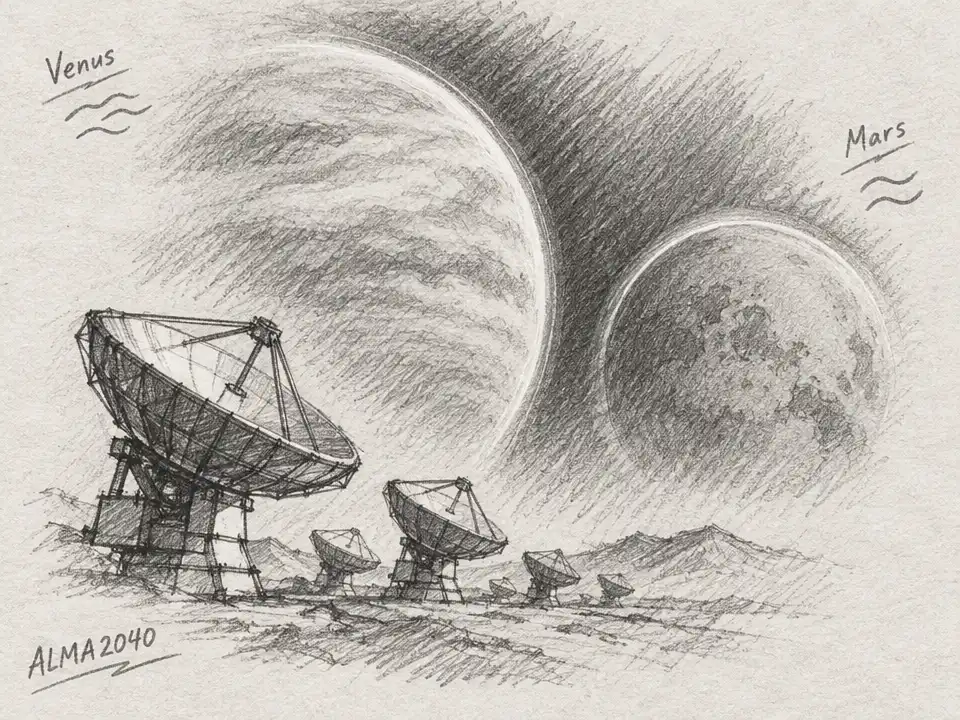
The researchers tested three heights: 8.62, 20.91 and 35.45 kilometers above the surface. These levels correspond to infrared “windows” through which instruments can observe the planet’s nightside beneath its clouds. The simulations show why a volcanic search cannot simply aim higher for a clearer view. Venus’s atmosphere has distinct layers, each with different winds, chemistry and background noise.
Near the surface, below about 10 kilometers, circulation tends to move gases sideways and toward the poles rather than carry them upward. The model suggests it would take roughly 30 to 35 years for air to rise from 10 kilometers to 45 kilometers. That slow vertical journey has an important consequence: a gas plume detected higher up is unlikely to have simply drifted there from a low-altitude eruption. It would more likely have been deposited at that height—or have another explanation entirely.
At 8.62 kilometers, a simulated equatorial increase in water vapor remained above its starting concentration for about 60 hours at the eruption site after the modeled injection stopped. But the signal did not vanish with the source. Winds carried the gas westward into a coherent streak, with parts of that downstream trail remaining elevated for 75 to 100 hours. The background variation in water vapor at this altitude was less than 0.2 percent in the model, making a temporary streak potentially distinguishable from the usual atmospheric pattern.
That is the study’s striking twist: the best volcanic clue may be a low, broadening trail rather than a dramatic cloud rising toward the sky. A nearby observing level, 20.91 kilometers up, offered another possibility. There, water vapor and hydrogen chloride behaved similarly and had very low background variability. Their simulated concentrations spread from the source within about half a day to a day, depending on latitude, while the downstream streak could remain enhanced for as long as 2.5 days. Detecting both gases in a matching pattern could strengthen the case for a volcanic source.
Move higher, however, and the search gets trickier. At 35.45 kilometers, stronger winds carried water vapor and hydrogen chloride out of the source region quickly: about 12 hours for an equatorial plume and 5 to 6 hours for one at high latitude. Carbon monoxide and carbonyl sulfide created a different problem. Their natural variability was large—reaching 22.5 percent for carbon monoxide and 15 percent for carbonyl sulfide at high latitudes. Atmospheric waves and chemical reactions could produce changes resembling a plume, masking even a simulated gas increase of 50 percent.
So the higher layer may offer gases that affect infrared observations, yet those same gases can be poor volcanic fingerprints because the background already shifts so much. Lower down, the signals are more stable and last longer, but the paper notes that changes in radiance are smaller and may demand higher signal-to-noise observations. This is the price of the promising search strategy: missions may need to prioritize carefully, revisit a region promptly and distinguish a modest, low-altitude signal from measurement limits and natural weather.
Timing is not hopeless. The paper notes that EnVision and VERITAS are expected to use orbits of about 1.5 hours, allowing repeated opportunities to observe a target region. But a long-lived modeled plume is not automatically an easy detection. The team measured how long gases remain above a chosen baseline; actual observability also depends on instrument sensitivity, viewing conditions and how much the plume changes the observed light.
There is another crucial limit: these were simulations of gas enhancements, not simulations proving that real eruptions can loft material to each tested height. The study represents a plume as a gas increase in a model grid cell roughly 400 by 200 kilometers across, holds the nominal injection for 28 hours, then lets winds disperse it. The authors explicitly leave open whether an eruption could produce such a plume at a given altitude. Their results answer a narrower question: if volcanic gases are there, how might Venus’s atmosphere spread or disguise them?
That distinction turns the paper into a practical guide for the next stage of exploration, not a claim that an eruption has been found. A westward water-vapor streak near known volcanic terrain, especially at low latitude, could become a persuasive lead. Catching it may require looking where the atmosphere is least flashy, and returning before the signal fades. Venus’s clouds still conceal the ground—but the gases moving beneath them may offer a brief, carefully timed route to discovering whether the planet remains volcanically alive.