A cloud looks like a thing with edges: a bright tower rising over the horizon, a gray blanket sliding across the sky. But to a weather model, it is also the outcome of countless motions interacting across an immense range of sizes. To calculate those motions, conventional models repeatedly advance the atmosphere through time. Thomas DeWitt’s new approach asks a different question: could a model assemble the cloud patterns we care about without tracing the wind’s every turn?
The surprising inspiration comes from a familiar scientific sleight of hand. A fluid can be described by following its molecules, but that would be a wildly inefficient way to predict pressure or flow. Fluid mechanics offers a simpler, emergent description: it sets aside most molecular detail while preserving the bulk behavior that matters. DeWitt brings that logic to the atmosphere. Perhaps, he argues, researchers can skip some of the labor of simulating atmospheric motion and work directly with the large-scale patterns produced by it.
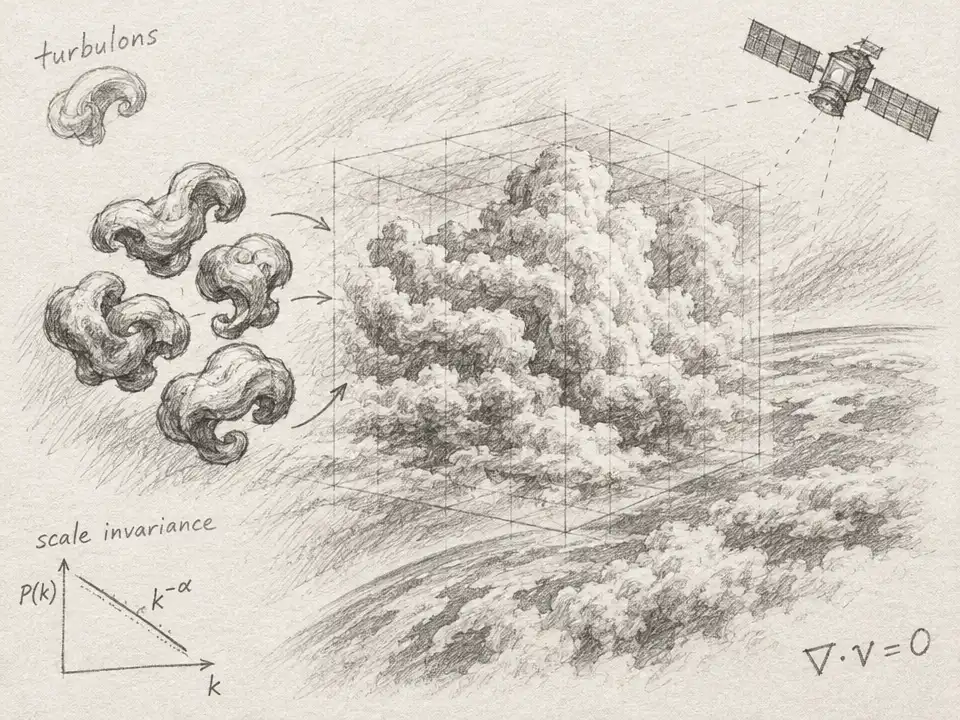
There is already a mathematical clue. Atmospheric fields often show scale invariance: patterns at one size resemble stretched or compressed versions of patterns at another. Turbulence theory describes how fluctuations pass from large scales to small ones in cascades. But the atmosphere is not a tidy cascade of identical, round swirls. Buoyancy and gravity make its motions direction-dependent, while the strongest fluctuations tend to cluster rather than spread evenly. The result is a sky with delicate wisps, broad layers, and sudden pockets of intense activity.
Some existing theories capture these statistical patterns well, yet their mathematical machinery can be hard to picture. In a multiplicative cascade, for instance, a region is repeatedly divided and its values multiplied by random factors. This can produce realistic, uneven fields, but the operations do not offer an intuitive physical building block for the atmosphere. DeWitt’s proposal is to give those patterns a more tangible mathematical vocabulary: turbulons.
A turbulon is not a newly discovered atmospheric particle, nor a tiny puff that instruments have spotted drifting through a cloud. It is a modeled piece of a field: a localized fluctuation with a particular size, shape, and strength. Think of a cloud field as a mosaic assembled from overlapping marks, some broad and shallow, others small and compact. Add the marks at different scales, and their superposition creates a three-dimensional pattern. The name turns an abstract wavelet-like component into something the model can build with.
The shape of each piece matters. Large atmospheric motions tend to stretch horizontally, while small ones can be closer to round. DeWitt’s framework uses turbulence theory to set how turbulon sizes and amplitudes change with scale, and how their vertical thickness relates to their horizontal width. One scale, called the spheroscale, marks where the modeled pieces shift from roughly round to increasingly flattened. This direction-sensitive rule is the bridge from turbulence theory to a practical way of generating atmospheric structure.
The resulting model is called STEAM, short for Superposition of Turbulons and Eddies Atmospheric Model. It starts with supplied average profiles of atmospheric moisture and moist static energy, a measure that combines heat and the energy associated with water vapor. Then it adds fluctuations from the largest modeled scales down to the smallest. A saturation adjustment step estimates where cloud water and ice form, allowing the model to produce three-dimensional fields of cloud condensate and other atmospheric quantities.
DeWitt compares STEAM’s output with both detailed hydrodynamic simulations and satellite observations. The comparisons do not show that one model wins at everything. But for selected measures of cloud geometry, a STEAM setting came as close to, or closer to, MODIS satellite observations than the hydrodynamic simulations did. That is intriguing because it hints that a model can depart from another simulation and still resemble the real sky more closely on a particular measure. The cloud renderings are also visually convincing in some cases, though appearance alone cannot establish that a model captures the atmosphere’s physics.
There is a striking computational payoff, too. The author estimates that STEAM can generate an independent snapshot between 105 and 106 times faster than the comparison hydrodynamic model on the same hardware. The key is that STEAM does not step through all the intermediate moments needed to evolve a storm. It produces a field directly. That makes the speed comparison meaningful for generating independent samples, but not equivalent to forecasting where a storm will move next.
That distinction is crucial. STEAM does not yet predict its own average atmospheric state; it needs those moisture and energy profiles supplied as inputs, which in the comparisons came from a hydrodynamic simulation. It also lacks precipitation, and its current treatment of temperature inversions can produce unrealistic variability near the tropopause. The model’s cloud shapes are constrained by a setting that is held constant across a simulated region, even though real clouds of the same width can have very different heights. These are not small footnotes: they define what the model can and cannot claim.
So this is not a new way to forecast tomorrow’s rain without physics. It is a test of whether atmospheric science can borrow the deeper trick of statistical physics: replace an overwhelming description with a leaner one that keeps the features relevant to a question. STEAM suggests that cloud fields might be built from scale-spanning pieces rather than reconstructed only by marching fluid equations forward in time. The turbulons are mathematical ingredients, not literal particles. Yet imagining the sky as a superposition of them may help researchers see what its familiar categories—cloud, storm, layer—leave out, and what a more useful atmospheric theory might contain.