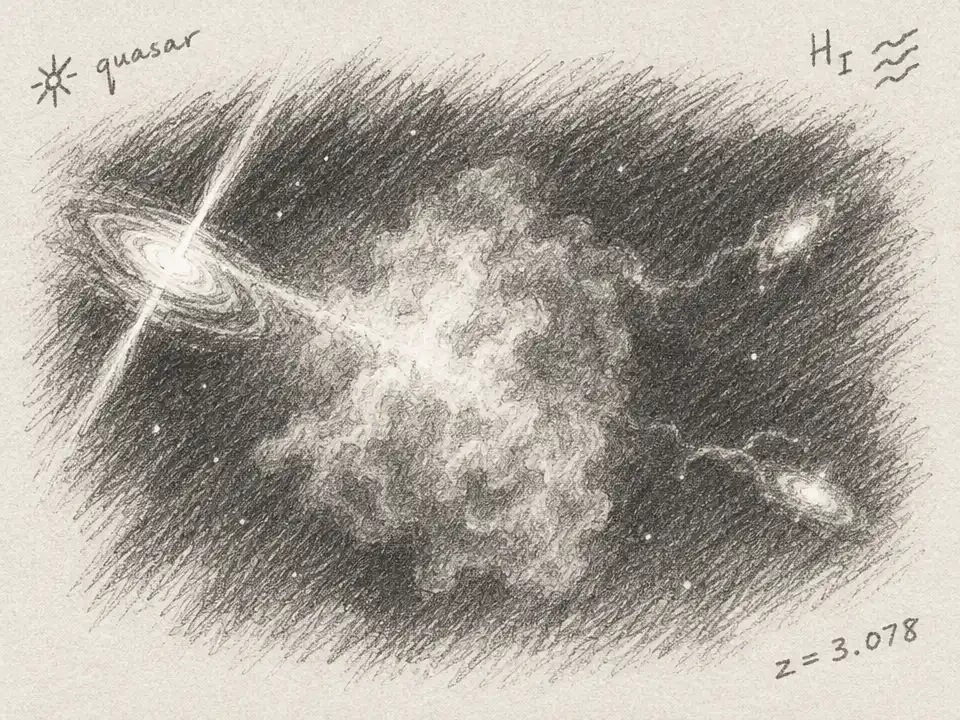
The clue was not a galaxy in a photograph. It was a bite taken out of a quasar’s light: a pattern of dark lines where gas between us and the distant beacon had absorbed particular wavelengths. In that shadow, astronomers found a hydrogen cloud with extraordinarily little iron. Then they turned their attention to the space around it—and caught two faint galaxies glowing in the dark.
The cloud sits at redshift 3.078, when the universe was about 2 billion years old. It belongs to a class called damped Lyman-alpha absorbers: dense clouds of neutral hydrogen that reveal themselves when they cross a quasar’s sightline. This one is chemically near-pristine. Its iron abundance is below [Fe/H] = -3.66 at 2σ, and its oxygen abundance is [O/H] = -3.08 ± 0.05. The cloud holds less than one-thousandth of the Sun’s abundance of these elements.
That scarcity matters because elements heavier than hydrogen and helium are made inside stars and scattered into space when stars die. A gas cloud with so few metals may preserve a record of very early chemical history. It could even have been enriched by some of the universe’s first stars. But the cloud is not itself a visible galaxy, and a quasar’s absorption lines cannot show what is happening across the surrounding landscape. To look for that, Louise Welsh and colleagues used the Keck II telescope in Hawaii.
In March 2025, the team used two instruments, the Keck Cosmic Web Imager and the Keck Cosmic Reionization Mapper, to collect spectra across a wide patch of sky. Rather than taking one spectrum from one point, these integral-field instruments record light across many neighboring positions. The result is a data cube: a map of the field in which every pixel carries information about its spectrum. The observations covered a region extending as far as 230 physical kiloparsecs from the quasar’s sightline.
The search focused on Lyman-alpha, a characteristic ultraviolet glow from hydrogen. In an actively star-forming galaxy, young stars energize surrounding hydrogen, which can then emit this light. Because the universe’s expansion stretches the light on its long journey to Earth, the signal arrived in the visible range, where Keck could detect it. The researchers examined spectra across a broad range of possible velocities, checking that each candidate appeared in more than one exposure or pixel and ruling out a possible look-alike signal from a different kind of emitter.
Two sources passed those checks. The first, called LAE1, lies at a projected distance of 66 physical kiloparsecs from the quasar’s sightline; the second, LAE2, lies at 137 kiloparsecs. Their Lyman-alpha luminosities are (3.8 ± 0.6) × 1041 erg s-1 and (3.2 ± 0.8) × 1041 erg s-1, respectively. The signals are faint: their detection significance is 6 and 5 per spatial pixel. The projected distances are not necessarily their true three-dimensional distances from the cloud.
The line profiles add another clue. LAE2’s Lyman-alpha line is especially narrow, with a measured width of 51 ± 39 km s-1; LAE1’s is 243 ± 136 km s-1. Both are unresolved at the observations’ spatial resolution, which corresponds to about 12.5 physical kiloparsecs. Their faintness, compact appearance and narrow lines are consistent with metal-poor galaxies—but they do not prove it.
The team also searched for a helium emission line that can help distinguish between different kinds of star-forming populations. They did not detect it. Instead, they set limits on the Lyman-alpha-to-helium line ratios: greater than 11 for LAE1 and greater than 10 for LAE2. Those limits are compatible with several models, including metal-poor and potentially primordial star formation. They are not strong enough to identify the galaxies’ stars as Population III—the hypothetical first generation—or to rule out other explanations.
That distinction is crucial. The galaxies’ own metal content has not been directly measured. An estimate based on their Lyman-alpha brightness suggests each has a stellar mass around 107.5 solar masses. Extrapolating a relation between galaxy mass and chemical abundance points toward low oxygen content, but the paper stresses that more observations are needed. Dust and the way Lyman-alpha light scatters through gas also complicate estimates of how quickly the galaxies are forming stars. For now, the authors report lower limits of more than 0.34 and 0.29 solar masses per year.
Nor is it certain that these galaxies belong to the same structure as the almost metal-free cloud. LAE1’s emission is offset by -1200 km s-1 from the cloud’s redshift; LAE2’s is offset by -200 km s-1. Lyman-alpha can shift relative to a galaxy’s true motion, so LAE2 could be closer in velocity to the cloud’s host than its measured line suggests. The observations also found no significant excess of galaxies around the cloud compared with a similar region without a strong absorber. The galaxies could trace a larger structure, sit in a broader halo, or be separate systems along the same general direction.
That uncertainty is part of the discovery’s promise. The result is not a portrait of the first galaxies, but evidence that a rare, chemically primitive gas cloud can serve as a signpost for finding faint star formation nearby. Follow-up observations of hydrogen and metal lines could establish the galaxies’ chemistry, dust and true star-formation rates. If this search works in other fields, astronomers may be able to use quasar shadows to locate small pockets of the universe that have remained astonishingly little changed—then study them while their light is still within reach.