A deep image of the universe is supposed to make distant things visible: galaxies whose light has crossed space for billions of years. But one faint red speck in the JWST JADES survey posed a more basic question. Was it truly far away, or was something much closer masquerading as a remote galaxy?
The distinction matters. A cold brown dwarf can look red in infrared light, much like a distant galaxy or a dust-shrouded black hole. In a single image, color alone may not settle the case. JADES-GS-BD-5 had already been identified as a very cold brown-dwarf candidate, but its distance—and therefore its true brightness and physical scale—remained uncertain. The clue was not just what the object looked like. It was how it moved.
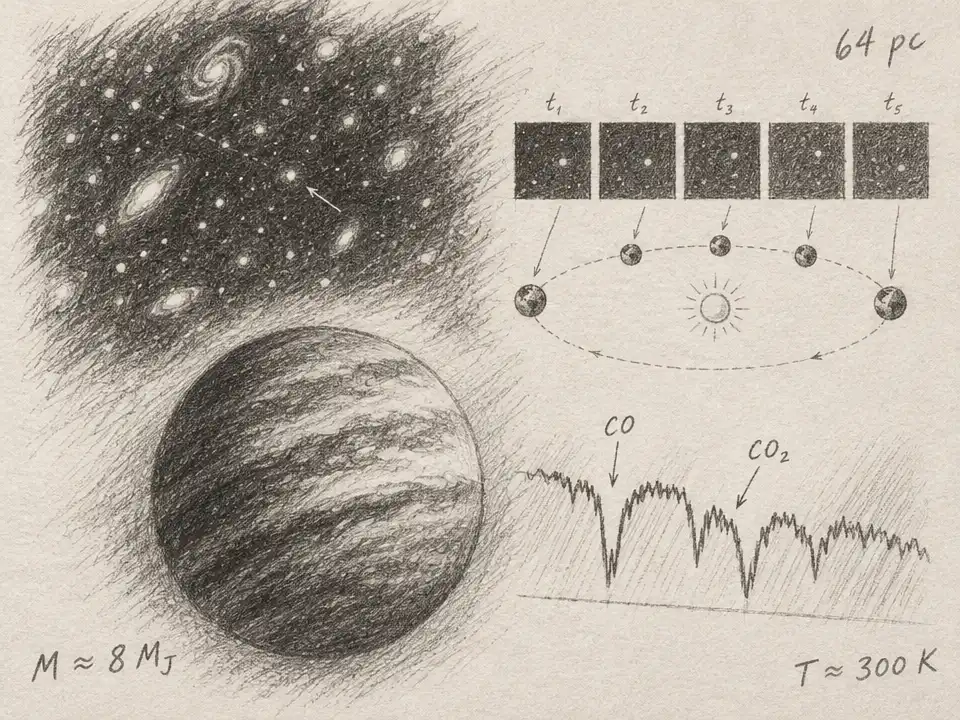
The research team assembled JWST images taken across five observing epochs over about two years. The observations were not designed as a dedicated parallax campaign; they came from different programs with different image footprints. That made the astrometry a careful reconstruction problem. The team aligned the images, built a consistent reference frame from other sources in the field, and tied that frame to the International Celestial Reference System using Gaia-calibrated galaxies.
Two kinds of apparent motion had to be separated. The dwarf’s own motion carries it steadily across the sky. Parallax adds a smaller, repeating wobble: as the telescope changes position during its orbit around the Sun, a nearby object appears to shift against much more distant background galaxies. The wobble is a distance clue, but it is tiny. A poorly calibrated image or a shifting reference frame could imitate it.
So the team looked for the signal in multiple ways. They measured the target in 50 images through JWST’s F444W filter, then checked whether other filters showed consistent motion. They also tested whether a simpler, straight-line track could explain the positions. It could not: the fit was substantially worse without the parallax term. Finally, they injected artificial sources into the images and reran the analysis. Those tests supported a real parallax rather than a convenient curve fitted to noisy data.
The result was a parallax of 15.7 milliarcseconds, detected at 11.5-sigma significance. That corresponds to a distance of about 64 parsecs, roughly three times farther than the most distant Y dwarfs with previously measured parallaxes. Its motion across the sky is also clear: about 49.8 milliarcseconds per year. In other words, the object that appeared amid a field of faraway galaxies is a neighbor by cosmic standards.
That distance changes the next part of the puzzle. Once astronomers know how far away an object is, they can turn its received light into an estimate of its actual energy output. The team combined the JWST spectrum with mid-infrared measurements to estimate its total luminosity. The result places JADES-GS-BD-5 among the coldest and faintest known Y dwarfs, with an estimated temperature near 300 kelvin—roughly room temperature, though the object is not a rocky planet with a surface.
Its estimated mass is about eight times Jupiter’s. That number comes from comparing the measured luminosity with models of how substellar objects cool over time, so it depends on evolutionary modeling rather than a direct weighing. Still, the researchers found that more than 90 percent of the modeled mass estimates fall below 13 Jupiter masses, a commonly used boundary for the planetary-mass regime. They found no convincing stellar or substellar host, making it an unusually isolated object to study. A very close, faint companion cannot be ruled out, however.
Calling it planet-mass does not reveal how it formed. It may have formed in a way more like a star, or through a planet-like process and later become unbound. The motion measured by JWST suggests it belongs to the Milky Way’s thin disk, with a tangential speed of about 15 kilometers per second. That is consistent with ordinary Galactic disk motion, but does not solve the object’s birth story.
And even after the distance puzzle was solved, the spectrum offered a fresh one. JADES-GS-BD-5 shows strong absorption from carbon monoxide and carbon dioxide, while some methane features appear weaker than expected. In a very cold atmosphere, carbon would generally be expected to favor methane. One way to bring carbon monoxide and carbon dioxide into view is vertical mixing: material from hotter, deeper layers gets carried upward before chemical reactions can settle into the balance expected near the top.
The researchers found that models allowing this kind of disequilibrium chemistry generally fit better. Cloud structure may matter too. But no single available atmospheric model includes all the ingredients needed to explain this object at once, and the evidence that water or water clouds are responsible for some of the unusual features remains uncertain. Some fits can reproduce parts of the spectrum only by pushing parameters to extremes that do not sit comfortably with the independent evidence about the object.
That leaves the speck with two identities: a nearby, isolated, planet-mass Y dwarf whose distance is now pinned down, and an atmospheric benchmark that current models still cannot fully explain. The survey’s deep images did more than look toward the far edge of the universe. Repeated with enough precision, they also traced the minute motion of a cold object in our own Galactic neighborhood. In the end, the decisive clue was not its redness or faintness, but the barely perceptible wobble that told astronomers where it really was.