Imagine taking the universe’s recipe from its first minutes and comparing it with the oldest stars you can find. Most ingredients match. One does not. The stars contain far less lithium than the recipe predicts—and the difference is big enough to make cosmologists wonder whether the trouble lies in the stars, in nuclear physics, or in the recipe itself.
This is the cosmological lithium problem: a small element caught between enormous clocks. To investigate it, researchers have to reconstruct reactions that happened before galaxies existed, then read the faint fingerprints of lithium in stars that formed billions of years ago. Each clue comes with a catch. The stars may have changed what they inherited, and the early-universe calculations depend on reactions that are difficult to measure.
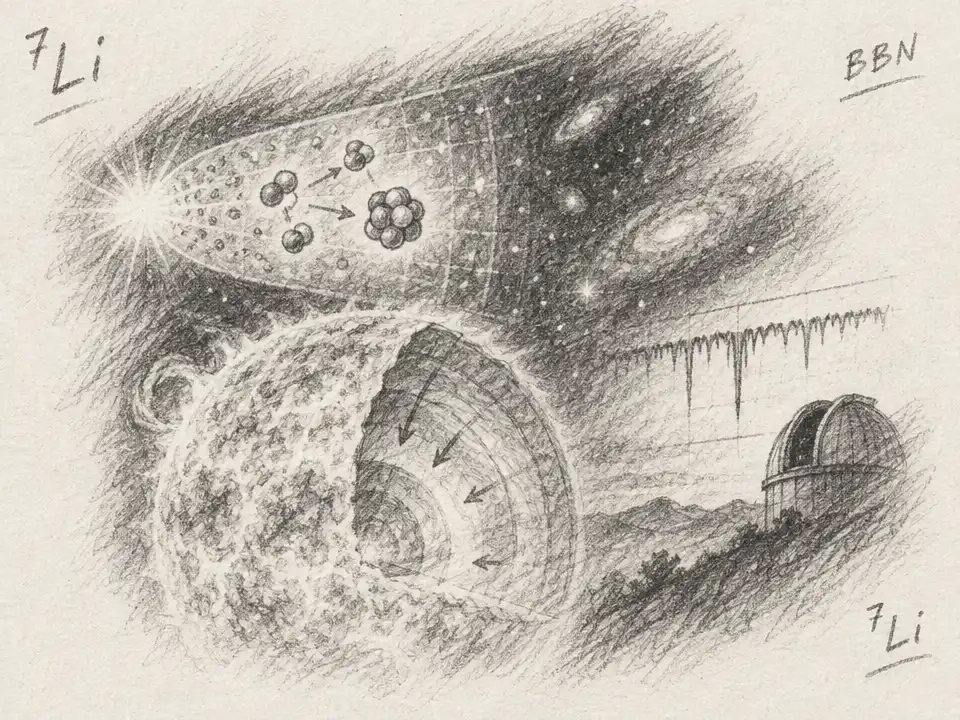
The story begins during Big Bang nucleosynthesis, a brief period in the young universe when it was hot and dense enough to build light elements. The process lasted only minutes. As space expanded and cooled, nuclear reactions made hydrogen, helium, deuterium, and traces of lithium and related nuclei. The universe soon became too cool for those reactions to continue efficiently.
Scientists can calculate the expected abundances using nuclear reaction rates and the density of ordinary matter. That density can be inferred independently from patterns in the cosmic microwave background, the afterglow of the early universe. The setup creates a demanding test: use one measurement of the young cosmos to predict its light-element inventory, then compare that prediction with evidence gathered elsewhere.
For deuterium and helium, the comparison broadly works. Lithium does not. Standard calculations predict roughly two-and-a-half to three times more lithium-7 than astronomers infer from old, metal-poor stars. The exact size of the mismatch depends on the abundance estimates and the calculations used, but it has resisted decades of attempts to make it disappear.
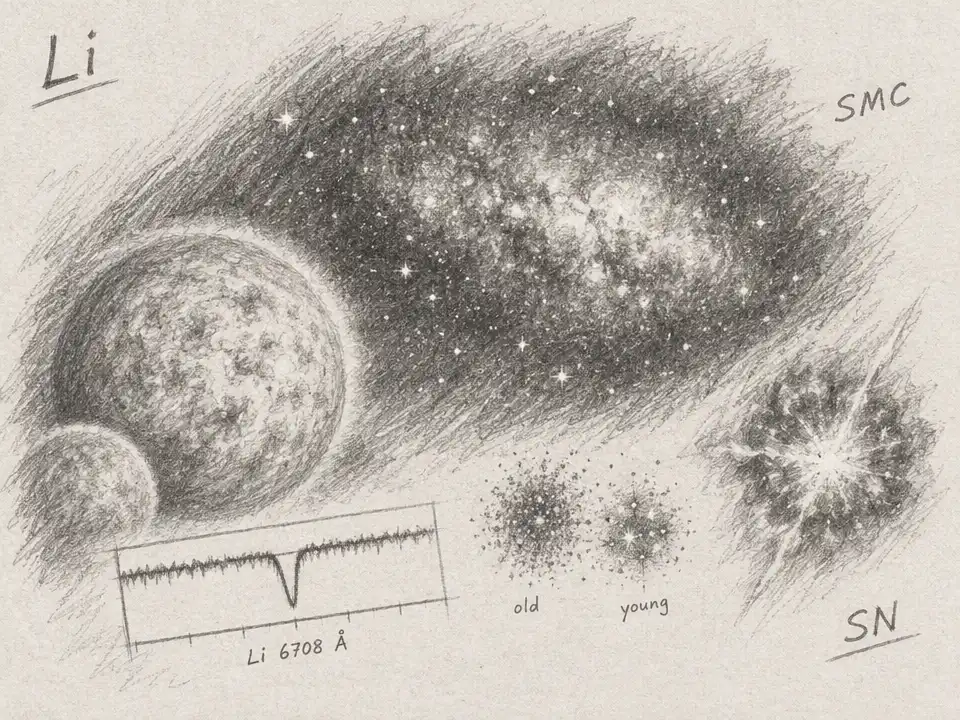
Why use stars as a record of the early universe at all? Astronomers look at old stars with very little iron and other elements that were forged later in stars. These stars formed from relatively primitive material. In many warm, metal-poor stars, the measured lithium abundance changes little from one star to another, even as their iron content varies. That near-flat pattern is known as the Spite plateau. Its apparent consistency once made it seem like a reliable snapshot of primordial lithium.
The snapshot, though, is taken at the surface of a star—not from the cloud of gas that formed it. A star can shuffle its ingredients. Convection can carry surface material down toward hotter layers, where lithium is destroyed. Gravity can also cause elements to settle below the visible surface. A star’s atmosphere may therefore show less lithium than the star began with.
This possibility turns the stars from simple measuring devices into suspects—and potential witnesses. Models that combine atomic diffusion with additional mixing can account for some observed changes in elemental abundances as stars evolve. A 2021 review of globular-cluster observations found that turn-off stars and subgiants often show lower surface abundances of several heavy elements than giants in the same cluster. The review argued that diffusion moderated by extra mixing can explain these trends and implies that some lithium was lost from the visible layers.
In that interpretation, the lithium in a star’s birth cloud may have been higher than the amount now measured at its surface. One analysis estimated that correcting for stellar evolution could raise the inferred lithium by about 0.3 dex—roughly a factor of two—leaving a smaller gap with the standard primordial prediction. But the correction depends on how mixing near the edge of a star’s convective zone is represented in models. Researchers cannot yet calculate that process with enough certainty to declare the stellar explanation complete.
Observations of globular clusters add another twist. These dense, ancient groups let astronomers compare stars that formed in the same broad environment but are now at different stages of evolution. A 2023 study measured lithium in five unevolved turn-off stars in the 13-billion-year-old cluster M5. The stars showed a range of lithium abundances spanning a factor of two, far larger than the stated individual measurement errors. Comparisons with five other clusters found similarly broad ranges.
The highest-lithium stars in those six clusters had similar maximum abundances, and some exceeded the field-star plateau. Yet none reached the standard prediction for primordial lithium. The result does not identify a single cause: stellar evolution can alter surface abundances, and globular clusters may contain multiple generations of stars formed from gas with different chemical histories. Instead, it warns that the lithium value measured in one old star—or even one class of stars—may not straightforwardly equal the amount made in the Big Bang.
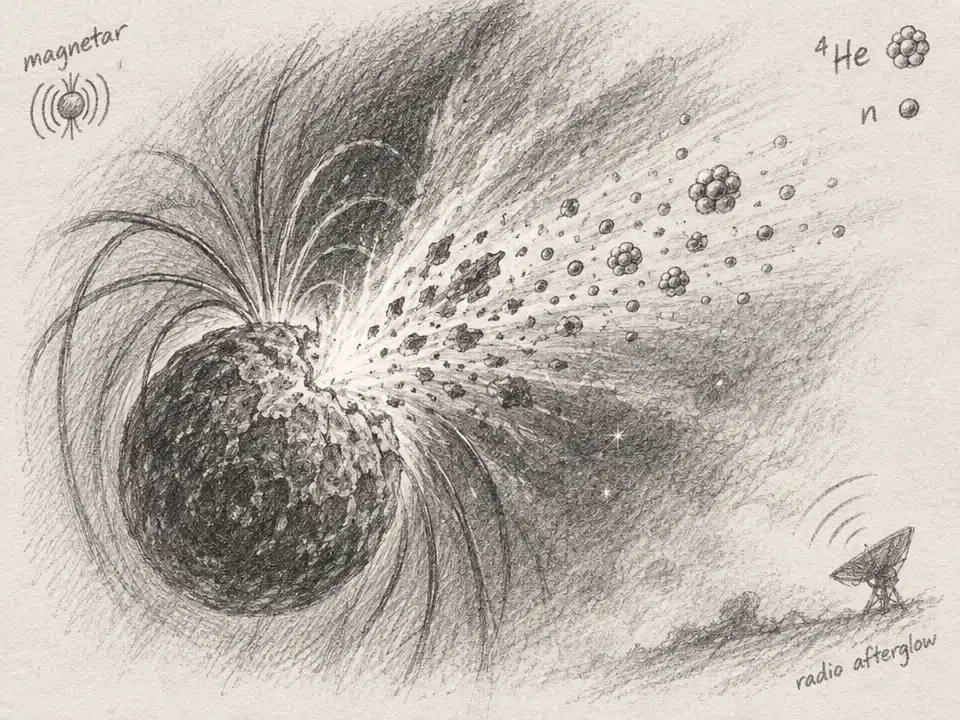
Could the missing lithium have been erased before the stars ever formed? That leads the investigation into nuclear physics. In the early universe, much of the mass-seven material that eventually became lithium-7 first existed as beryllium-7, which later decayed into lithium. Changing the rates of reactions that create or destroy these nuclei can shift the predicted final abundance.
To test one such possibility, researchers at CERN’s n_TOF facility measured how beryllium-7 reacts with neutrons across a wide range of energies. The experiment used a high-purity beryllium-7 sample and measured the reaction that converts it into lithium-7. The updated reaction rate lowered the predicted cosmic lithium abundance by about 10%. That was a real change, but far short of the factor-of-three discrepancy. It made this particular nuclear route a less promising escape hatch; it did not settle every uncertainty in the nuclear network.
Other calculations have tried updated reaction rates and measurements, too. They can shift the predicted abundance, but one 2023 study found only a modest improvement, leaving a substantial disagreement. This is the frustrating scale of the problem: a nuclear rate can be important enough to measure carefully and still not be uncertain enough to explain the whole mismatch.
A more radical option is to change the conditions of the early universe. If its expansion history differed from the standard picture during the brief period when light elements formed, reactions would have had different amounts of time to run. A 2024 paper proposed modifying the relationship between temperature and time in a particular range to reduce lithium without pushing deuterium beyond the values allowed by observations. That is a model proposal, not an established account of what happened. Any such change has to fix lithium while preserving the successful predictions for the other light elements.
A 2025 arXiv study offered a different interpretation, modeling how lithium from the first generations of stars could mix with later material as galaxies assembled. Its model argued that this chemical history could produce the observed plateau without a discrepancy between primordial predictions and the stellar measurements. That proposal, too, is a framework to test—not a verdict. It highlights the central difficulty: astronomers observe lithium after stars and galaxies have already had time to transform and redistribute it.
So the puzzle is no longer just whether the early universe made too much lithium. It is whether the number read from an ancient star is a clean record of the original amount. Stellar mixing has a credible physical pathway and supporting clues, but the corrections remain uncertain. Nuclear experiments have narrowed some routes without closing the gap. New cosmological and chemical-evolution models offer possibilities that must still explain the other evidence.
The next decisive clue may come from connecting these scales more tightly: measuring lithium across stars at different evolutionary stages, improving models of how stellar interiors transport elements, and refining the nuclear reactions that shape the first light nuclei. Each effort asks the same forensic question in a different language: what happened to the lithium between the Big Bang and the moment a telescope caught its light?
That is why this tiny element matters. Deuterium and helium suggest that the universe’s early recipe is remarkably dependable. Lithium challenges scientists to check every step between that recipe and the evidence. The answer may be hidden in a star’s interior—or in a small correction to the cosmos itself. For now, the mismatch remains an unusually precise clue that the universe has not finished giving up its secrets.