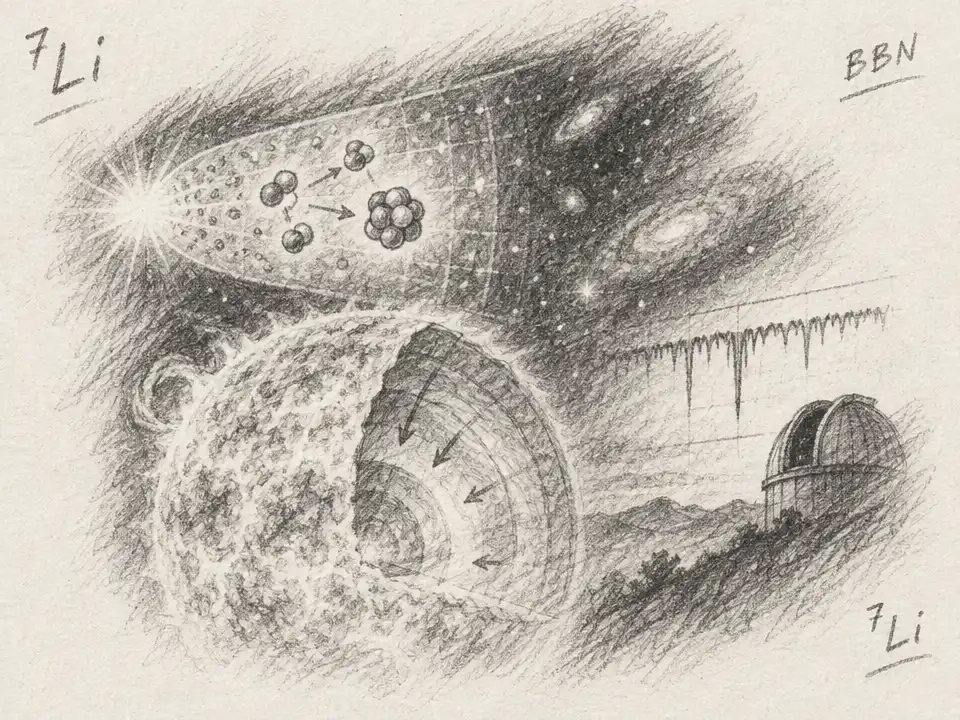
A star can carry a record of its galaxy’s past in an element that barely survives inside it. Lithium is easily destroyed in stellar interiors, yet it can also be made and returned to space by stellar processes. Read its faint signature in a star’s light, and you may glimpse both what happened inside that star and how its galaxy changed over time.
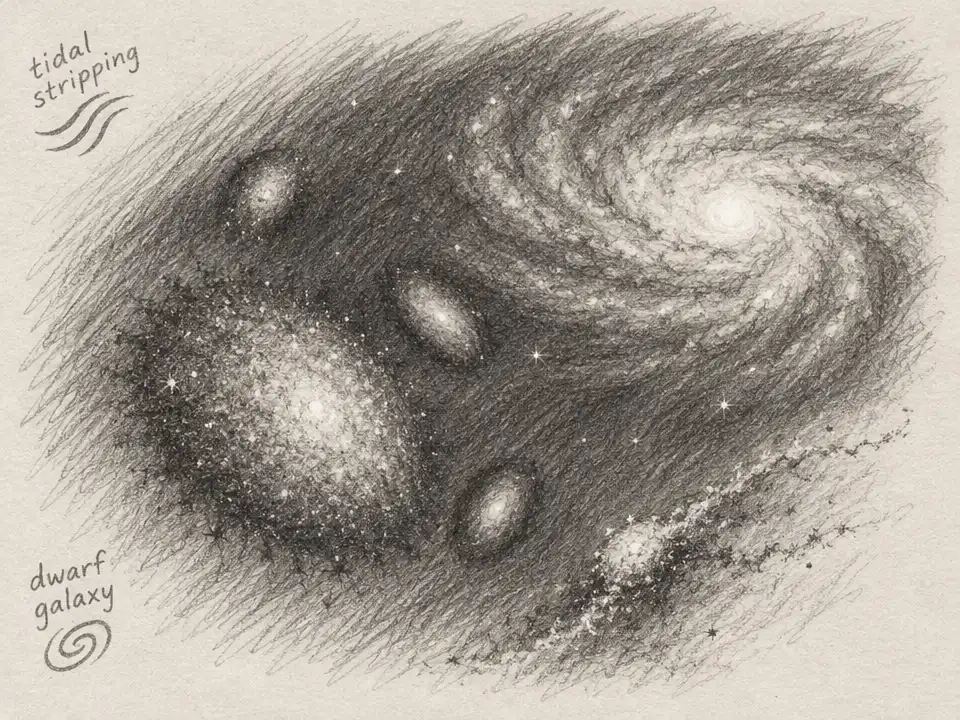
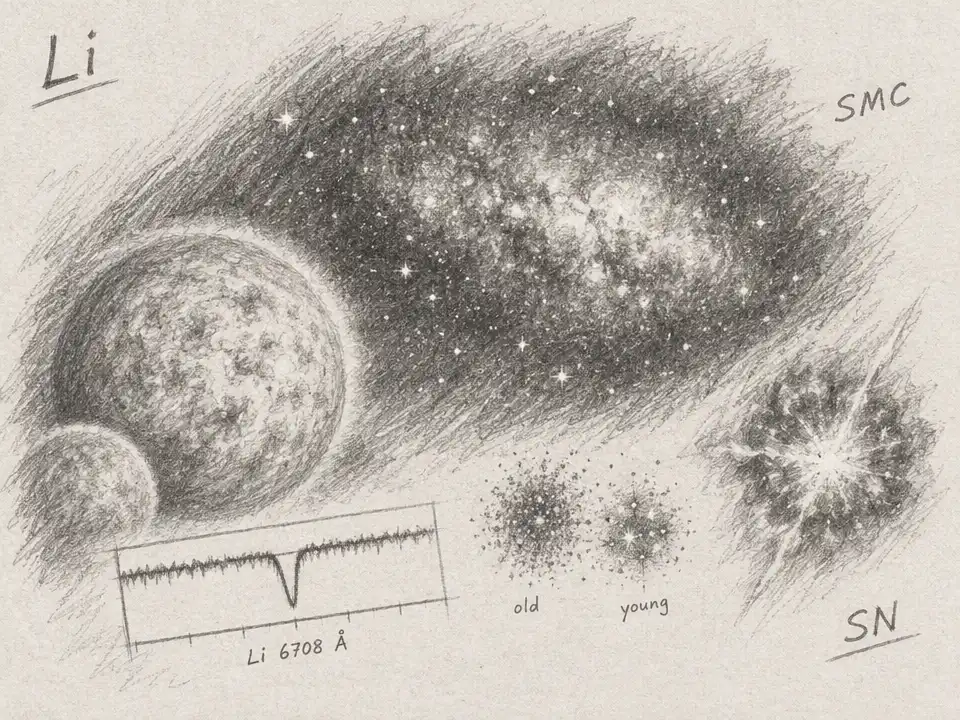
A new study follows that trace in the Small Magellanic Cloud, a neighboring dwarf galaxy. Using the FLAMES instrument on the Very Large Telescope, researchers examined spectra from 209 red giant stars. They were looking for lithium’s telltale absorption line at 6707.8 Å: a narrow dip in starlight that reveals the element in a star’s outer layers.
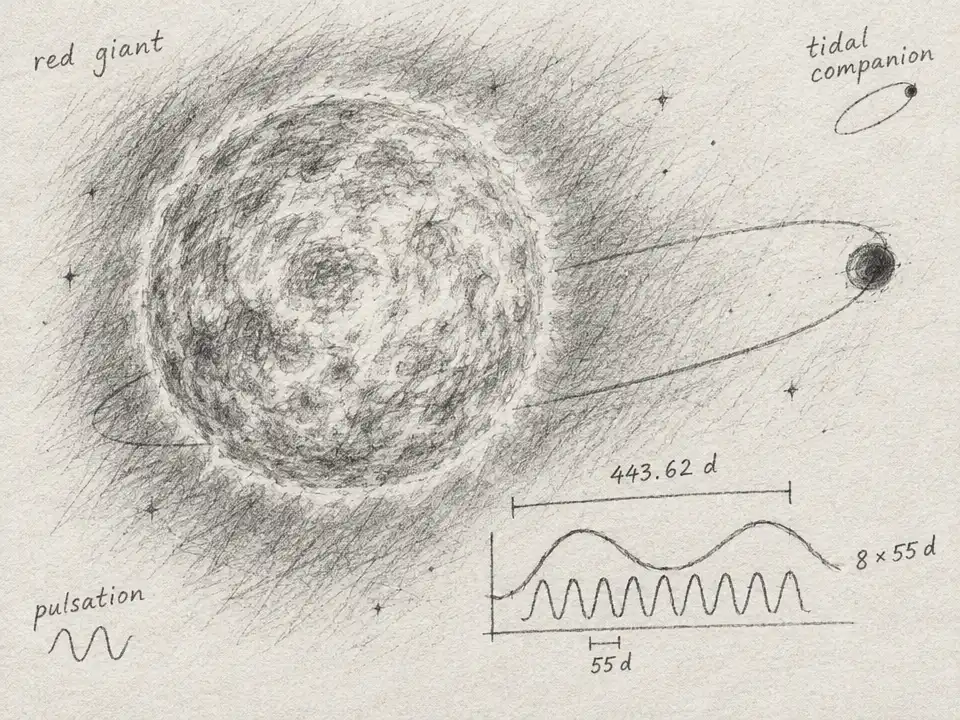
The target stars pose a challenge. They are past a key stage on the red giant branch, when a star’s expanding outer layers can mix material from deeper inside. Lithium is destroyed at about 2.5 × 10⁶ K, so mixing can carry it into hot regions where it disappears. By the time astronomers can observe these distant giants, their surface lithium has already been altered. Their spectra are not a simple inventory of what the stars were born with; they are a record of what happened afterward, too.
The team treated that faint spectral dip cautiously, testing whether a line fit the data better than a smooth continuum. In 67 stars, the lithium line was detected at greater than 5σ significance. Include less-secure detections, and the count rises to 111. For many other stars, the researchers could report only limits: the line was too weak to measure confidently. This distinction matters. A questionable feature can look like a chemical clue, but it can also be noise.
Even with that care, the stars did not settle into one neat pattern. Their measured lithium abundances spread widely, beyond what the estimated measurement uncertainties alone could explain. The researchers suggest that two different clocks contribute to the scatter. One ticks inside individual stars: mixing after the red giant branch bump can deplete lithium by different amounts depending on a star’s mass and metallicity. The other ticks across the galaxy: lithium made by novae can gradually enrich the gas from which later stars form.
The second clock may run differently in the Small Magellanic Cloud than in the Milky Way. A nova is a burst from a closely paired stellar system, and novae are a delayed source of newly made lithium. Because the Small Magellanic Cloud formed stars less efficiently, its supply of iron and other elements built up more slowly. In the researchers’ chemical-evolution models, the lithium rise associated with novae begins around an iron abundance of [Fe/H] ≈ −1.5 dex in the Small Magellanic Cloud, compared with about −0.8 dex in the Milky Way. In other words, a dwarf galaxy’s slower pace can make delayed enrichment show up while the galaxy is still relatively metal-poor.
Three star clusters offer a separate, if still limited, glimpse of the timeline. Their ages are better constrained than those of the field stars. The two older clusters, NGC 121 and NGC 339, are more than 6 billion years old; the lithium measurements in their sampled giants are only upper limits, below −0.3 and −0.5 dex, respectively. In the younger cluster NGC 419, about 1.5 billion years old, the average measured abundance is +0.36 ± 0.04 dex. That contrast is consistent with lithium accumulating over time, perhaps with help from novae. But just three clusters, with only a handful of observed stars in each, cannot establish a smooth history by themselves.
Then there are four stars that break away from the rest. Their lithium abundances range from +1.49 to +3.62 dex, making them lithium-rich by the study’s criteria. Together they account for about 2% of the sample, a share similar to that seen in the Milky Way. They are the first low-mass lithium-rich stars identified in the Small Magellanic Cloud.
How did they get that way? One possibility is that a star produced fresh lithium internally, then moved it quickly to cooler layers before it could be destroyed. Another is that a companion star made the lithium and later transferred material to the giant. The available observations do not distinguish those routes. One star’s Gaia measurements offer a hint of a binary companion, but the researchers found no change in its measured radial velocity between the two available observations. For the other three, the evidence does not decide the question.
That uncertainty is part of the value of the survey. Lithium in these giants cannot simply tell astronomers the original abundance in the gas that formed them: stellar mixing has altered the signal, while galactic enrichment may have changed the starting supply. The study instead shows how to read the layers of that history together. A trace element exposed to a star’s hidden interior can also retain clues about slow, galaxy-wide enrichment. The next measurements—especially more clusters of different ages and richer observations of individual stars—could help separate those stories. For now, a slim line in starlight has turned a nearby dwarf galaxy into a record of processes too faint, too slow, or too deep to see directly.